EP288 - Why Poor Governance is Killing the Value of Your MSP and How to Fix it with Ken Roulston and Ian Luckett
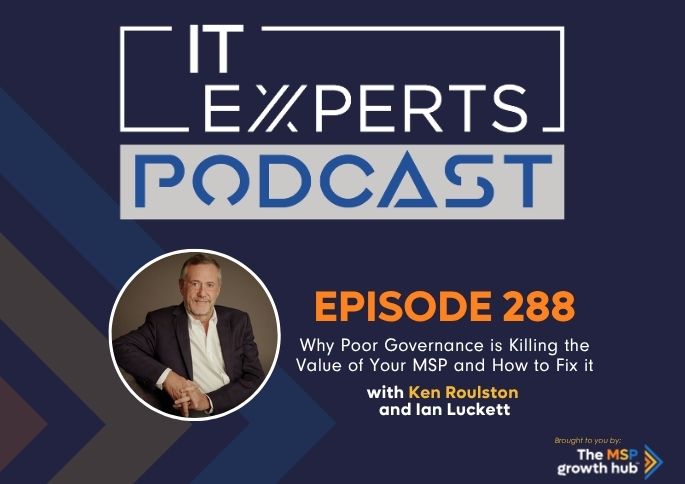
Click below to listen to the episode
In this episode of The IT Experts Podcast, I sit down with Ken Roulston to explore a topic that many MSP owners know they should be paying attention to, yet often leave until much later than they should. Governance.
Now, before you switch off thinking this is a subject reserved for larger businesses, stay with me. This conversation is one of the most important discussions we’ve had around protecting the value of your MSP, reducing unnecessary risk and building a business that is genuinely attractive to a future buyer.
Ken brings a huge amount of experience to this conversation. Having built and successfully exited a £17 million MSP, he has seen first hand what separates valuable businesses from those that struggle to achieve the valuation their owners expect. Through his work with MSPs across the UK and Ireland, Ken regularly helps business owners understand the factors that drive value and the mistakes that can quietly destroy it.
One of the points I often make is that every MSP owner will eventually sell their business. Whether that happens in five years, ten years or twenty years is almost irrelevant. At some stage, ownership changes hands. The question is whether you will be rewarded properly for all the hard work, investment and sacrifice that went into building it.
That is where Governance comes in.
Throughout our conversation, Ken and I unpack why Governance is far more than a compliance exercise. Good Governance creates confidence. It gives buyers reassurance. It reduces risk. It demonstrates professionalism. Most importantly, it helps you build a stronger business today, regardless of whether an exit is anywhere on your immediate horizon.
We begin by looking at financial Governance and why understanding your numbers is only part of the story. Many MSP owners can tell you their monthly revenue and profitability. Far fewer fully understand the financial responsibilities that come with being a company director. Ken explains the importance of financial controls, cashflow management, solvency and proper accounting practices. These are not optional activities. They are part of your legal responsibility as a business owner.
We also discuss how poor financial Governance can raise serious red flags during an acquisition. Buyers want confidence that a business is being managed professionally. Strong reporting, clear approval processes, documented decisions and consistent financial management all contribute to a stronger valuation and a smoother due diligence process.
From there, we move into legal Governance, which is often where hidden problems begin to emerge. Ken shares examples of acquisitions where customer contracts, supplier agreements and employee terms created unexpected complications. In some cases, a single clause buried within a contract was enough to significantly impact the value of a deal.
One example in particular highlights how an overlooked contract clause could force a buyer to seek approval from every customer before completing an acquisition. It is a powerful reminder that Governance is not about having paperwork in place. It is about understanding exactly what those documents mean and how they affect the future of your business.
We also spend time discussing employee Governance. As MSP owners, our people remain our greatest investment and often our largest cost. Strong Governance creates clear expectations, supports accountability and helps protect both employees and the business. Ken explains why current employment contracts, documented processes and professional HR support are essential if you want to build a resilient organisation.
Towards the end of the episode, we broaden the conversation into business risk. This is an area we regularly help MSP Growth Hub members address because many business owners spend their days helping clients manage risk while overlooking risks within their own organisations.
Ken shares practical examples of the risks every MSP should be assessing, including customer concentration, supplier dependency, cashflow exposure and operational vulnerabilities. We discuss why creating a risk register does not need to be complicated and how taking time to identify potential threats can significantly improve decision making and business resilience.
If you want to build a stronger MSP, improve its future value and avoid the costly mistakes that catch many owners out during an exit process, this episode is packed with practical insights. Governance may not be the most glamorous topic in business, although it could be one of the most valuable conversations you will have this year.
As Ken says throughout the discussion, buyers are looking for confidence, credibility and professionalism. Good Governance helps you demonstrate all three.
Connect with Ken Roulston through LinkedIn and his website.
Make sure to check out our Ultimate MSP Growth Guide, a free guide that walks you through a proven process to take your MSP from stuck to scalable, without working even more hours. It’s 44 pages rammed with advice, insights and inspiration to help you decide what support is available to you now if you want to grow and scale your business. Click HERE to get your copy.
Connect on LinkedIn HERE with Ian and also with Stuart by clicking this LINK
And when you’re ready to take the next step in growing your MSP, come and take the Scale with Confidence MSP Mastery Quiz. In just three minutes, you’ll get a 360-degree scan of your MSP and identify the one or two tactics that could help you find more time, engage & align your people and generate more leads.
If you’re serious about growth and want to explore what this could look like for your MSP, you can book a Right Fit Clarity Call with us HERE.
OR
To join our amazing Facebook Group of over 400 MSPs where we are helping you Scale Up with Confidence, then click HERE
Until next time, look after yourself and I’ll catch up with you soon!
Check Out the Full Transcript Below:
IAN: In this episode of The IT Experts Podcast, we answer the question why poor governance is killing the value of your MSP, but more importantly, what do you need to do to fix it?
INTRO: Welcome to The IT Experts Podcast, the only podcast to help MSPs scale to 1 million, and if already there, get to five and go faster. At the end of the day, isn't it all about building a business that works for you rather than you for it? I hope you enjoy the show
IAN: So good morning, good afternoon, good evening. Welcome to The IT Experts Podcast, and welcome back into the podcast lounge, Ken Roulston. Welcome back, Ken. How are you doing today?
KEN: Doing very well, thank you.
IAN: Yeah. Good stuff. Got another great topic for you today. Before you all fall asleep, today we're going to talk about governance. So yes, you can yawn, yes, you can moan, yes, you can say, "Oh, yeah, but it's only for the bigger businesses, isn't it?" But we know that's not the case, and we're going to dive into this subject today with Ken, who's got a massive experience in what good governance, what bad governance looks like, and more importantly, what not doing the right governance and having the right governance in your MSP can affect the ultimate end valuation of your business. So this is really important, and it's time to put your big boy and your big girl pants on and step up as business owners, I think. That's the bit of a punch in the ribs for the beginning of this show. Ken, if people don't know who you are or what you do, please let us all know now. Who are you, what do you do, and who do you help?
KEN: Hello, everyone. Yes, I've been working in the IT services industry all my working life. Initially an as an engineer, then in sales, then the '90s I moved into management. And in 2009 I actually started my own MSP and used a buy and build strategy to grow it from zero, to a point in 2023 when we were 120 staff, 17 million of revenue, 2 million of EBITDA, and we then subsequently sold to BCN up in Manchester. Subsequent to the obligatory three months of handover I've spent the time since traveling the world, primarily initially with Kaseya, talking to MSP owners about the way to best unlock value in their businesses, how to grow their value even if they're not preparing for sale at this stage. But also working with companies that are actively engaged in acquisition.
IAN: Yeah.
KEN: And indeed companies who are on the exit path and are looking advice and guidance of how to maximise their valuation when it comes to that stage. So I'm working with a number of clients, primarily around the UK and Ireland in that regard. And as you say, governance is a slightly boring subject to many people within the scope of an MSP business, but it's absolutely critical to make sure that you tick all the relevant boxes, particularly when it comes to exit.
IAN: Yeah. Absolutely. And Ken's one of the friends of the MSP Growth hub. You've been helping our clients unlock the what we're calling the value multipliers. There's 10 key elements of this. And you know, you and I and many others, you know, here on a weekly basis, Oh, someone's offered me ridiculous amount of money for my MSP and then, just within a very, very short conversation you can say, Well, yeah, there's all these various things that are just not going to add the multipliers and that's what we've been helping our clients with. And this is just one of them really. It's the whole governance piece. And making sure that, you know, we're... as a director and an owner of a business, you know, you're obliged to make a profit, right? So why people think that governance is just for larger MSPs, it's not.
IAN: We're going to touch on financial governance, legal governance and then HR governance today, and why they're important, why people kind of aren't doing it. And then when you start to get the brilliant basics right, what's that going to help you in your MSP? But, first off, Ken, I've repeat this because you said it to me, and every time I say it I get the impact, is one day, whether you like it or not, everybody listening to this podcast is going to sell their MSP. And they want to sell it for a good return and value. And some of the most basic things that we talk about, and we've touched on this on other podcasts, are still not being done. But this governance piece is it more about governance and doing something or is it more about actual business risk and understanding what the risks in your business are?
KEN: It's a very big subject and, if you if you take the terms risk, compliance, governance, you know, they are all interlinked to some ... different degree, or other. But yeah, if you take financial, first of all, which is the, one of the three areas that we're going to cover, it's not just a matter of understanding your numbers, which is absolutely key, to a business owner to be able to ensure that they get the best return when it comes to that exit. But it's also understanding the balance sheet of the business and in particular the business's ability to actually pay its debts to manage its finances.
IAN: Yeah.
KEN: And that's important, not because it's a nice to do, but because it's a legal need to do. Every business owner, and in fact, anybody who carries a title of a director, in a shadow capacity, whether they're a shareholder or not, has this thing called a fiduciary responsibility. They are legally required to understand is the business actually trading in a solvent state-
IAN: Yeah ...
KEN: or is it not? Because if it's not trading in a solvent state, then you are technically breaking the law and you, if you don't do something about that, and I mean doing something about it in a significant way, like reporting it up to external bodies, you could find yourself behind bars. So it's that important. Now, you know, it's, that's at the most serious end of obviously of the risk but, profile when it comes to a business owner and financial governance. But you also have to understand that there's a lot of risk attached to not managing your business in a professional manner, so that the, you know, you're taking the income streams in line with effectively your delivery of the work because this is another big area which is, like I said, deferred and so on. It's whereby some businesses could turn around and take their revenue upfront of delivering the services to inflate their profitability and that, you know, might look okay in some respects on paper.
KEN: But whenever you then look at an exit scenario, it distorts the figures significantly. And when a buyer potentially sees financial manipulation of accounts and things not being done to what's called the GAAP accounting principles. which is the sort of standard, way that you should run your business, that raises a real red flag and in many cases, that will kill the deal. Because, if a buyer sees the financials of the business not being managed professionally and in line with legal requirements, it raises a real question mark over the professionalism of the business in general, and therefore, as I say it just, I've actually seen that killing a deal because the buyer just walked away once they realised, no, you know, what these guys are doing in this business is all wrong. They're mixing in their personal assets, into the business. They're making the accounts look better or worse depending on what they're trying to do with it, whether they're trying to minimise tax or whether they're trying to maximise profit. There's all sorts of things you can do within the term of creative accounting. But you have to be very careful from a governance perspective that you stay within the law and you stay within the accounting principles, because it'll come back and bite you in the bum if you don't.
IAN: So for most MSPs, you know, we bang on all the time about, you know, got to know your numbers, got to know your numbers, and yeah, that's your net profit, your gross profit, your revenue per employee, and all of those kind of other, all those other issues as well. But, you know, does the governance then cover into the financial practices as in the processes and the approval? You know, we hear a lot of the time of, oh, so and so spent this and so spent that, and I'm going, you know, what I would've remembered from the corporate days, FAL, you know, your financial approval level. Well, what FAL are you giving these people? Are you just letting them spend on credit cards and doing this and doing that? And, you know, and if spending's out of control, then you're not in control of the business, are you? So what does the process of good financial governance look like?
KEN: Well, I think it requires you to have, you know, good, experienced, professional people managing your finances.
IAN: Okay.
KEN: I think it's important to have- I say, you know, people who've got the professional skills, on board, first of all. That can be internal, but it can be external. But you need to be using professionals when it comes to your finance. But you need to put in place proper processes around procurement, you know, and what levels of authority various people within the business have. You know, because depending on the size of the business, yes, you could devolve authority down to certain people, which says, you know, you can spend up to £500 or £5,000 at their level in the business. And that's fine if there's proper levels set and you trust in those people. But you also need to be very careful that what they're spending that money on is actually in line with the overall business. So it's not about micromanagement, but it's about ensuring that you are, as a business owner, comfortable that any financial elements of the business are being appropriately controlled by various people within the organisation at whatever level.
IAN: Yeah. It's having, you know, something just popped into my head then when just thinking about that. Now, at what level should an MSP start to have, board meetings, you know, official register... And I know that, you know, under the company's regulations everybody should be having a board meeting. But in terms of, you know, because this is where all of these issues can come to a head, can't they? And you can report on them and the progress and the maturity of them and everything like that, but what's your view on kind of board meetings?
KEN: I've always worked on the basis that any business I've been involved in needs to have board meetings at whatever size they're at. Now, you can say if it's a three or four-person business, you know it's not really maybe a board meeting, but there needs to be documentation of decisions that are being made by the business that are material, minutes and records of that. And this falls, more in the best practice than necessarily legal requirements. But yes, whenever a buyer is looking to acquire, one of the first things that will appear on the list of certainly due diligence is any minutes of any meetings that have taken place within a business that effectively dictates the direction and scope of what that business is doing. Now, I think that what you can have is, you should or should have is a monthly management meeting...
IAN: Yeah.
KEN: Whereby it's not necessarily a board, but it's a management of the company are getting together and they're reviewing the financials of the business from the previous month. They're looking at what issues need to be addressed or otherwise in terms of operational efficiencies and so on, and specific actions need to be recorded from that. There needs to be at least, I think, one board meeting per quarter.
IAN: Yeah.
KEN: Which is a slightly higher level than a management meeting in terms of it's more focused on the strategy rather than operational matters.
IAN: Yeah.
KEN: But minute taking and recording things like business plans and stuff of that nature, doing proper budgets, for a business, I think's good best practice and good governance and will, you know, look very positive to any buyer. A buyer looking at a business, no matter what size it is, and seeing that it's being run in a professional manner just adds to the credibility of things. And that's what a, a lot of this comes down to. There's the risk factor, yes, legally, financially, and all the rest of it, but there's also, it's the credibility issue. Whenever you're looking to sell your business that you want that buyer to feel as comfortable with this business as possible and give them the least amount of scope for tucking, you know, driving the price down or changing the scope of the deal in some shape.
IAN: Okay. That's absolutely brilliant. And thanks for covering that section off.
STUART INTERRUPT: Hold that thought for a moment, Ian. It's Stuart here. I just got a quick pit stop here for everyone that could really move the needle. If growing your MSP is on your radar, but it feels somehow a bit foggy, a bit difficult to get your arms around the concept, then download our Ultimate MSP Growth Guide because it lays out all of the best support options that are out there in the channel, so you can fast-track what really works for you and make a clear decision. Alternatively, you may be the kind of person that likes to see things up real for yourself in action physically. So why not come to one of our events where you can do exactly that? And we'd love to meet you, so there's just a head up for you down in the show notes that you'll find the links to be able to take the next step. But otherwise, let's get back to the good stuff and back to the show.
IAN: Cheers!
IAN: Right. Let's talk about legal governance. Many MSPs are out there, they haven't got any contracts with their clients.
IAN: Some have a three-month contract some have one-year, three-year contracts, all of this kind of great stuff. But, you know, we've got the whole risk element here in are you transferring risk if you're not back-to-back with some of your security vendors, for example, with some of the Ts and Cs. You're just opening yourself up to carry that risk, aren't you? Again, this could be another big pitfall that should you know, the unfortunate happen, it could be game over, couldn't it?
KEN: I've just been asked a question on a separate forum, you know, what is do I believe is the biggest thing that doesn't get properly covered off when it comes to the point in time that a business wants to sell, and it is contracts.
IAN: Right.
KEN: Whether it's customer contracts, employee contracts, or supplier contracts, most businesses, MSPs run up to the point where they're selling the business without having given proper consideration.
IAN: Yeah.
KEN: To the actual contracts that are in place. Are they current? Do they meet the requirements of whatever the engagement is at that point in time? Are they, you know, sufficiently in depth to cover, you know, all the issues that could arise when a buyer is looking at taking them over? But one that, what do you say? There, there's an, there are many, MSPs that don't operate on customer contracts at all. That's very easy. It makes for a very good lifestyle business. It's low administration. But it's an absolute issue when it comes to sale, you know, you, a buyer is effectively buying a sustainable income stream, sustainable cashflow, and it can only judge how long it's got based on what the contracts in place are.
IAN: Yeah, yeah.
KEN: Now, we all know a customer can get out of a contract easy enough if it really comes to it, but it shows, again, credibility. It shows that the business is being managed with a long-term recurring revenue mindset, and that's important for a buyer. But also it, and I've seen this very recently with a company that is, their customer contracts very detailed, very well managed in that respect. But in the contract there is a clause which says, in the event of the business being sold or other mechanisms, then the client effectively has to give approval in writing before their contract can actually be transferred. Right, I know that. It's called an assignability clause. It falls within the scope of what's called novation rights. But the buyer looking at that business, seeing that in the standard contract for the customer, just right away says, "There's no value in this business."
IAN: Right.
KEN: Because if that customer, or that target seller business has, say, 100 customers, you've got to go around all of those 100 customers and get their approval to doing this. And of course, when you do that, You're exposing that fact and that risk to that customer at that point in time.
IAN: Right.
KEN: Which gives them the opportunity to break out of the contract or renegotiate the price or at the very least say what's going on here, so...
IAN: Yeah.
KEN: That's like, I would love to show you the document, the contract document. The, it's pages long, and this little clause is about two lines within that. And that little clause basically scuppers the whole deal pretty much.
IAN: I'm intrigued. Why would you even put that clause in?
KEN: I think that what happens is that some MSPs when they start, they know nothing about contracts. So what they do is they go out and they, they borrow effectively a contract from somebody else or from some other company or otherwise, and they use that. And then somebody else borrows theirs, and then it mutates and it moves around like a virus. And, I think that may well be a clause that works in certain types of industries, but not in our game. So I don't think any MSP would want to put that in there.
IAN: No.
KEN: I suspect.
IAN: No.
KEN: It's been picked up and has been passed over because they didn't read through the detail, because that's the other thing it's the detail level. And that's what I'm saying, it's not just the fact you have a contract, it's exactly what it says within it. And that can apply to customers, but it also can apply to employees, and it also applies to suppliers. You know, all of those get scrutinised in real depth by a buyer when they're going through the due diligence exercise. And there can be all sorts of things. You know I saw an issue that affected me at one stage, which was a dilapidation clause, which, you know, a lot of people, myself included, didn't know what that meant at that time. But it was a clause which if I hadn't got proper legal advice and I'd accepted, would've cost me about a quarter of a million pounds.
IAN: Bloody hell.
KEN: And I was at the start of my journey and would've, it would've killed the business right at the start. So, that's a due diligence exercise issue. But all of these things are painful, they're boring they're not what most MSP owners like to do or otherwise, but if you don't pay attention to them, they will, as I say, bite you in the bum.
IAN: Well, I mean, just thinking about that clause there, that novation clause you mentioned, I can see where that's come from now because, you know, number one, I hear MSPs all the time, "Oh, I've got this Ts and Cs , off this portal or that portal, off this group or that group," and they spread it around. And if you don't read it, then you, as you say, you're spreading a virus. But, also, many MSPs that we speak to, when you hear their story, they started with one big client And you can imagine that clause actually being quite relevant for that big client at that time when they were the only client. But if that's then the same thing as you say you spreading that morris to all 100 clients you're inadvertently causing yourself a real problem. So. action point there is to get somebody, you know, a legal expert to review your client contracts and make sense of it and give you the layman's version of it if you don't understand it yourself.
KEN: Absolutely, and there are people out there who are in our sector specifically doing that. But yeah, you know, that's a very good point. I think that larger clients You know, tend to want to the buyer to use their contract, as you quite rightly say. And of course, that clause is very relevant to them, as a large client of that MSP. So I guess your, what you said is potentially a way that it could spread, but depending on how you approach your contracts with those larger customers, that type of thing needs to be given, you know careful consideration because it will be an issue come the sale. now, if it's one or two customers within, a large basket of clients, it's less of an issue. But if it's every customer on a standard contract then it's a deal breaker.
IAN: It's no surprises, is it? You know, just don't want any surprises. People go, "Oh, the MSP wasn't ... My, my business isn't worth as much. My business is worth more than that." Well, do you know, unfortunately it probably isn't because, you know, the people that in your sphere of influence, Ken, who are looking at acquisitions all the time, and even your own experience, these people know, right? So listen to podcasts, sup, sup it all up. If someone says something this, that isn't right, go and kind of work on it and get it working round. Last bit I just want to touch on, is, you know, people are the biggest cost in an MSP. And we talk an awful lot about leadership and cascading down targets and accountability and teams and all of that kind of great stuff. But what's the, what does HR governance look like? Because you need to have a people process, don't you? There needs to be a way to either bring in or remove people who don't work. Because if, because they're, as, as far as a, an acquisition's concerned or the valuation's concerned, people are an asset just like a server, aren't they? And it's how that kind of works, isn't it?
KEN: This is probably the biggest minefield, when it comes to governance that every MSP owner faces because as you quite rightly say, you know, MSPs are a service industry, which means it relies on people and, you know, if you follow the model of people, service profit, then you know, you've got to, you've got to get the right people on board, and we all know how challenging that can be. You've got to be able to obviously retain them. And that means you've got to you know, recognise them, reward them, give them job satisfaction. But sometimes you also have to let some people go because of poor performance or otherwise. So there has to be an element of a carrot and stick approach to it. And what you need to make sure is from a governance perspective, that your employee contracts, give you the right tools and the right scope as a business owner to make changes to terms and conditions, you know, in terms of where employees work from, you know, what hours they work you know, what they're expected to do what you don't want them to do. And of course, with all the different requirements now environmentally, privacy, technology, you know, there's just so many different elements to this. And if you get some of those wrong, it can really be an issue, you know, and especially when you're trying to discipline people or let people go. Unless you follow the right processes, unless you have the right contracts in place that facilitate those processes, you could end up in a court, in a tribunal paying unlimited amounts of money, especially if you're deemed to have broken some sort of discrimination.
KEN: Because there's no cap in that situation. So employee contracts and the management of staff is critical for any business. And again, from a buyer's perspective, what they want to see, you know, is a happy workforce, that's, not being abused. Has got, you know, fair terms and conditions of employment. Are, you know, doing the job that they are being paid to do, and being provided with, you know, a fair set of terms and conditions. Every employee wants to get paid more and wants more of this and more of that. That's just nature. So when I use the term fair, it's about what's fair to both the business and the employee.
IAN: Yeah.
KEN: Yeah. Because sometimes, you know, one that's maybe not fair if it gets abused. So yeah, we've seen, and there's going to be more changes to employee legislation, coming down the track. So, you know, most MSPs, when they're relatively small, can't justify having an internal HR, function to oversee these things. Certainly we didn't have one un- until we were considerably larger, but what we had from day one was an outsourced provider that we used to pro- to keep us up to date, just like, customer contracts up to date with employee legislation. Because it changes so rapidly, and you need to make sure that whenever it comes to that point in time, particularly when you're going to exit.
IAN: Yeah.
KEN: That those contracts are current and, you know, reflective of current legislation.
IAN: Absolutely. Now, key thing, I mean, it's very similar to the legal governance with your customer contracts and everything like that, but with the employee contracts. Just before we go, let's just talk about what good, better, best would look like in terms of risk registers and risk identification. This is something that, we're we obviously help our clients with, and over the years it's one of the key things. And the best thing about this at the moment is that many of our clients are now opening up conversations with new prospects around what business risks have you got, and then how can IT help you overcome those business risks. MSPs don't sit down and look at risks. They don't do a risk register generally. They don't think it'll ever happen to them. But, you know, you just look at what's going on in the Middle East right now, and you've just mentioned to me that there might be a problem with, you know, airline fuel in the east of the world. Okay, that's a problem. That's an issue. If you can't get, you know, if you can't get supplies, look at the pandemic. What's the best practice and what should, you know, small, medium, and large MSPs do when, if they want to start this, putting their sensible heads on and start looking at their risks properly?
KEN: They need to take a bit of time out of the day-to-day sort of operational aspects of the business and try and I don't know, go left field in terms of thinking what are the things that could really kill our business if we don't do it properly? You know, so, if we don't manage our cashflow, for example. Then many business, profitable businesses go out of business because they haven't managed their cashflow. So what they, one of the first things is have we got the proper processes and focus in place to ensure that we have managed our cashflow properly? So that, that would be maybe one. Depending on the mix of a business' customers, but if you have in particular one or two very large customers. Within your business then one of the risks might be, well, what happens if one or all of those businesses stopped using us for whatever reason? You can't control their business. Maybe they go bust. Maybe they get taken over or otherwise. So looking at, okay, well, what can we do, not to prevent that happening, but what can we do to minimise the risk to the business in the event of that? So perhaps that means saying, "Well, what we need to do is get a longer term contract in place so that if the event comes to that, that we can negotiate with that client and try and get them to pay out the rest of the contract or hold them to that contract term if applicable." So a big client provides a lot of risk to a business particularly a relatively small business. Putting in place good account reviews making sure that your, every member of staff understands that big client needs to get the best quality of service because without that big client, perhaps the whole business is unsustainable.
IAN: Yeah.
KEN: Yeah. So, there's perhaps that, you could look at, a technology provider that you've put a lot of emphasis around and said, "That's a fairly unique, relatively niche product that we're using, but it's become sort of central to, to what our business is." What happens if that, provider of the, of that technology was to go out of business for whatever reason? We have all seen many technology companies come and go. Not, I'm not talking about the likes of Microsoft, but I'm talking about maybe smaller ones. Again, what is the risk associated with us losing that bit of technology? Is there an alternative technology that we could bring into play if needs be?
IAN: Yeah.
KEN: And the one which I think we're going to talk about at a different time is- What happens if my business got hacked, yes. And-
IAN: Yes, we are going to cover that off.
KEN: And, you know, all my customers' data was stolen as a result of that. That is, I would have to say, every MSP owner's worst nightmare, and it's happened to me.
IAN: Yeah.
KEN: Yes. So I will talk about that more in one of the other-
IAN: Definitely. That's a whole another show.
KEN: But it's kind of looking at, and almost and saying, what is it that causes you to lie awake at night and think, God, if this was to happen, what would I do? And try and preempt that by putting in place as many means as possible to minimise the risk of it happening or mitigate the impact of it when it does happen.
IAN: Yeah. Yeah, absolutely. Absolutely. Ken, thank you very much as always for your, insights and wisdom. Very useful show. I think that's covered an awful lot. Quite a dry subject, but one that, as you can imagine as you've gone through it, if you haven't had your interest piqued at least three or four, five, maybe six times during the show, then you need to listen to it again. Ken, tell us too, how do people get in contact with you if they want to continue the conversation about some of the stuff that you're doing right now?
KEN: The best thing probably that people could do is go and have a look at a website that I put together with a guy called Mark Koopman. It's called mspmanda.com, or otherwise known as mspmanda.com. And in there, there's some information, advice and guidance about just the whole subject of M&A from both a buyer and seller's perspective.
IAN: That's great. Thank you very much. And great, and yeah, watch out for the next show, which we'll be recording very soon. We're going to hear all about what happened when Ken's MSP was compromised, was hacked, and, exactly how you got in and got out of that, alive as it would be. So, again, thanks for your time, Ken. It's been a brilliant show. Look forward to catching up with you on the next one.
KEN: Okay. Thank you, Ian. Thank you, everyone.
NEXT WEEK TEASER: And in next week's show, we've got a real treat for all of you out there who hate doing exhibitions, conferences, stands, and speaking slots. We have got Steve Lloyd from Exhibition Mastery, and he's going to help you work out how to set up your stand, how to set prizes at events so that people come towards you, and how to just get your whole team aligned up to help you generate more business from exhibitions, stands, and shows. You're going to love it. See you next week on that one
OUTRO: Just before you go, and if you're curious about how this episode links with the ability to scale your MSP to a million or, or if you're already there, accelerate to five, then we want to invite you to come and take the MSP Mastery Quiz. And in just three minutes, you're going to get a 360 degree scan of your business where you can identify the one or two tactics that can help you find more time, engage and align your people, and help generate more leads in your MSP. It's really simple. Just click on the link in the show notes. And if you have enjoyed this episode, we'd love to get some feedback from you by means of a rating review on Spotify or iTunes or your podcast platform of choice. We really appreciate every single one of them. Now you can go and enjoy the rest of your day and we look forward to catching up and connecting with you soon. All the best now.