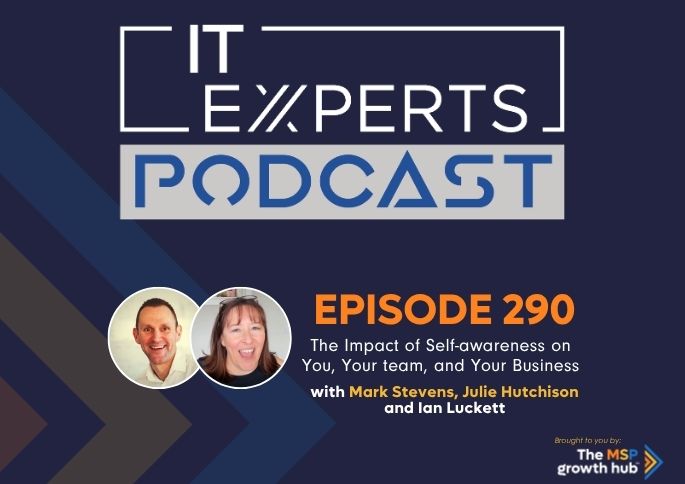
EP290 - The Impact of Self-Awareness on You, Your Team, and Your Business with Mark Stevens, Julie Hutchison, and Ian Luckett
Click below to listen to the episode
In this episode of The IT Experts Podcast, we explore one of the most powerful leadership skills any MSP owner can develop: self-awareness. While many business conversations focus on strategy, sales, systems, and growth, this discussion takes a different path. I am joined by leadership coach Julie Hutchison and Managing Director of Mark1 IT Mark Stevens to unpack how self-awareness impacts you, your team, and ultimately the success of your business.
The conversation begins with Mark sharing his own leadership journey and the challenges he experienced as his business grew. Like many MSP owners, he found himself frustrated when team members did not perform in the way he expected. He wanted people to move at the same speed, think in the same way, and approach challenges with the same intensity. Over time, that created pressure, frustration, and a growing disconnect between what he wanted from his team and what they were able to deliver.
What makes this episode particularly valuable is Mark’s honesty. Rather than focusing on what was wrong with his team, he reflects on what he discovered about himself. Through coaching, reflection, and experience, he began to understand that many of the challenges within the business were connected to the way he was showing up as a leader. This realisation became the starting point for meaningful change.
Julie explains that self awareness is not simply about understanding your personality. It is about recognising the impact your behaviour has on other people. Every leader influences the confidence, motivation, and performance of their team. When leaders become more aware of how they communicate, react under pressure, and set expectations, they create an environment where people can thrive.
A key moment in the discussion centres around behavioural profiling and understanding different communication styles. Mark shares how learning about his DISC profile helped him recognise that not everyone thinks, works, or processes information in the same way. What felt obvious and straightforward to him often felt overwhelming or unclear to others. Developing greater self-awareness allowed him to adapt his communication and lead people more effectively.
The conversation also explores the relationship between self-awareness and emotional intelligence. Mark talks openly about recognising the impact of stress, fatigue, and even lifestyle choices on the way he interacted with his team. Rather than allowing frustration to dictate his behaviour, he learned to pause, reflect, and respond more intentionally. This shift created stronger relationships and helped build trust throughout the business.
One of the most powerful themes throughout the episode is the idea that leadership starts with personal responsibility. It is easy to blame team members when results are not where you want them to be. It takes courage to hold up the mirror and ask what role you might be playing in the situation. Julie introduces the concept of “Can’t, Won’t, Don’t”, a framework that helps leaders understand whether team members lack capability, confidence, motivation, or clarity. Instead of assuming people are underperforming, leaders are encouraged to become curious and seek understanding.
As self-awareness increases, leaders become better equipped to identify the real barriers holding their teams back. They stop reacting emotionally and start creating conditions where people can succeed. This leads to improved communication, stronger accountability, and greater engagement across the organisation.
Mark also shares how greater self-awareness transformed the culture inside Mark1 IT. What was once a source of frustration became a business environment he genuinely enjoys. Team members became more confident. Conversations became more productive. The business became more structured and aligned. Most importantly, people started taking ownership and making decisions with confidence.
The discussion highlights another important lesson for MSP owners. Self-awareness is not a destination. It is an ongoing process. Every stage of business growth brings new challenges, new responsibilities, and new opportunities for personal development. The leaders who continue to learn, reflect, and adapt are the ones who create sustainable success for themselves and their teams.
Throughout the episode, Ian, Julie, and Mark remind us that people are the most valuable asset in any business. Systems, technology, and processes all matter. Yet the way leaders think, behave, and communicate has a profound impact on everything else. When leaders invest in their own growth, they create ripple effects that influence culture, performance, and long-term business results.
If you have ever found yourself frustrated with your team, questioning why people are not taking ownership, or wondering why progress feels slower than it should, this episode offers a valuable perspective. It provides practical insights, honest reflections, and powerful reminders that leadership begins with understanding yourself first.
Self-awareness creates clarity. Clarity builds confidence. Confidence helps people perform at their best. When leaders embrace that journey, they create stronger businesses and more fulfilling places to work.
Connect with Mark Stevens through LinkedIn and his website.
Make sure to check out our Ultimate MSP Growth Guide, a free guide that walks you through a proven process to take your MSP from stuck to scalable, without working even more hours. It’s 44 pages rammed with advice, insights and inspiration to help you decide what support is available to you now if you want to grow and scale your business. Click HERE to get your copy.
Connect on LinkedIn HERE with Ian and also with Stuart by clicking this LINK
And when you’re ready to take the next step in growing your MSP, come and take the Scale with Confidence MSP Mastery Quiz. In just three minutes, you’ll get a 360-degree scan of your MSP and identify the one or two tactics that could help you find more time, engage & align your people and generate more leads.
If you’re serious about growth and want to explore what this could look like for your MSP, you can book a Right Fit Clarity Call with us HERE.
OR
To join our amazing Facebook Group of over 400 MSPs where we are helping you Scale Up with Confidence, then click HERE
Until next time, look after yourself and I’ll catch up with you soon!
Check Out the Full Transcript Below:
IAN: In this episode of The IT Experts Podcast, we help you understand the impact of your self-awareness, not only on your team, but also of your business.
INTRO: Welcome to The IT Experts Podcast, the only podcast to help MSPs scale to 1 million, and if already there, get to five and go faster. At the end of the day, isn't it all about building a business that works for you rather than you for it? I hope you enjoy the show.
IAN: So good morning, good afternoon, good evening. Welcome to The IT Experts Podcast. If the intro we've just recorded has got anything to go by, you're in for an absolute treat today. This is the first time we've done this. I have no idea how this is going to pan out, but we've got a three-way podcast today with our incredible, talented leadership coach, Julie Hutchison, and also one of our incredible clients, Mark Stevens. So I'm actually going to kind of hand over to Julie because this is such a great subject. The reason that we're here is I had a great conversation with Mark. We were having a one-to-one about his progress, and he was sharing some stuff. And Mark's been on the podcast before. He's a massive sharer, a massive advocate of giving back to the community, and you will be resonating with lots of what he's going to say today. And the reason that I've asked Julie to come on as well is to help us to understand kind of some of the maybe the softer leadership type of mechanics on what Mark's done and why he's done it and how he's done it, and then the benefit that he's got. Because this business world's hard, right? And the reason a lot of the time it's hard is because it's what's in our heads that's is wired a little bit differently. And Julie, you help us unwire all these technical brains and plug 'em back into a normal way again. So Julie, welcome back to the show, and to you, Mark. Before we go any further, share to the world who you are, what you do, and who you help, Julie.
JULIE: Hi. My name's Julie Hutchison and I help leaders in business to show up with maximum impact so they get the best out of the business.
IAN: Fantastic. Nice, short and sharp. Lovely. And Mark?
MARK: Hi, Ian. Hi, Julie. Yeah, thanks very much for having me on today. My name's Mark Stevens. I'm managing director for Mark1 IT, and we help small to medium businesses in the UK and beyond.
IAN: Fantastic. So without further ado, over to you, Julie, to take control of this show, please.
JULIE: That's brilliant. Thank you. Mark, I think it looks like you and me are just going to have a chat, aren't we?
MARK: Yeah.
JULIE: So just before I ask you some questions, from my perspective, what I see daily with business owners with leaders in larger organisations everywhere, this big focus on, what I need to do, and I want everybody else to do something and I'm going to do this. And what we often don't look at is who do I need to be and how do I need to show up? And the minute we start doing that is the minute that we realise that our team's performance, and therefore our business's performance, relies upon how we are showing up and the ability for our team to perform, and therefore we need to look at ourselves. We need to be self-aware, because what impact am I having on the business? So that's why we're here, because when I met you, or I probably met you a couple of times, but when we really spoke, the first time I met you, there was one Mark, and the second time I suppose, but later down the line after we'd done some talking and you'd done some work as well, you had a realisation. And I, and we really want to explore that today because it's really powerful. Powerful for you, amazing for me, I love to hear it, but also powerful for your people and your business. I'd really love to hear about your time. But, and the first question I suppose is, when we met that time and I remember where you were sat in the at the MSP Growth Hub Intensive, and let's call it the before. You had some opinions, some thoughts, and some frustrations around your business, and I'd love to hear where you were really before you had some realisations.
MARK: Sure. Yeah. Thanks, Julie. And thank you, Julie and Ian, for giving me the opportunity to talk about this. It's been a massive, change for me internally in terms of how I show up for my team, but also a belief in humanity and people. Going back, Julie, to when we first met, I feel like there was a lot of people coming into the business that I was struggling to connect with, and I always felt as though it was purely just a clash of personalities, even though during interview, and as we know, during interview we get the very best version of people and hopefully we get a good chunk of that throughout their journey within your company. It was clear that I was struggling, and I think those conversations that you and I had leant in towards that. I was struggling to communicate effectively with people.
JULIE: I think you were frustrated as well.
MARK: Absolutely. Emotionally, I was exhausted. I felt like I had to be an imposter to myself to be able to communicate with my team.
JULIE: Were they doing what you wanted them to do?
MARK: Yeah, it was certainly wrapped around wanting them to achieve the things and do the things I wanted them to do. It was very clear that there were problems with myself, and I think you were leaning very politely into that. You're very diplomatic, Julie, very diplomatic in your delivery and your communication style which makes you the success that you are. And for me, I probably wasn't in the right place at that time to fully absorb what you were telling me. This is a journey, right? The, such internal transformations do not occur overnight.
JULIE: Oh, I must admit, from my perspective, what I saw of you I saw a frustrated man who wanted people to just get on with it and to pick up speed as quick as me in the way I think about it, and achieve more, get on with it, and sorely trying to push water uphill really, and wasn't really looking at that exact time to yourself. I think you were looking, and that I think this happens with a lot of business owners, a lot of leaders, is looking at the other people and pointing the finger in that direction initially. And I think that was clear and that's understandable as well, because that's probably how most people feel initially. And I'm interested, what changed for you?
MARK: I would probably say 18 months has been the biggest transformational change and period, and I'd realised that at that point, Mark1 IT was 12 years old, 12 and a half years old, and I had built the business in a way that made sense for me. So a lot of the information was in my head. So when we talk about not only are we asking people to come into the company and to work at my mental speed, we're then asking them to be part of a business that this brain has created for them to try and operate. Yeah, we talk about KB articles, we talk about SOPs, we talk about other internal processes. There was a lot of pieces missing, so many pieces missing that anybody coming into the company, I could have interviewed the best employee in the world, whoever they are, and I probably had some of those and join the company that sadly aren't with us anymore. But we just weren't ready. I wasn't ready. So there were two main components of it, really. Feel like the business wasn't ready. It wasn't mature enough. That really we needed people that weren't already conditioned and seasoned in larger corporations where you've got all those processes built in already. We needed street fighters. We needed people that were, just do bare knuckle fighting because that's kind of how it felt, not literally.
JULIE: So then something changed. What, what went on?
MARK: I'm going to give you a little bit of credit for the start of the journey, Julie.
IAN: Right.
MARK: I think it started to come towards me from many different angles. One of them being yourself, one of them being Mr. Luckett. And I would say an employee I took on that was way past retirement age, she tolerated me for the first, or that version of me, for the first two to three months. However, she really struggled. And there was something about Rachel that I could relate to. Whether that's somebody who, a friend, family member who had a very similar personality, but I could just relate to Rachel. And Rachel gave me very gentle, soft, that motherly feedback. And so that really helped because seeing Rachel upset saying that she was struggling to succeed, and I knew she was amazing because her background, her CV, where she'd come from. She had done management accounts to executive level, and more than capable. And it was clear that hang on, I've recruited somebody who's more than capable, way overqualified for this job, and they're struggling. So I took that information and the feedback that you had given and Ian, and other people over the years that had given me, and it all started, Julie, to come together. Okay, everything. It was just the right time. And I think as well, the frustration that the business wasn't maybe growing as fast as what I wanted it to. So if we think about motivation, it isn't just about I wanted a fantastic relationship with Rachel. I thought a lot of Rachel. I still think a lot of Rachel. But I really wanted to get that business engine going.
JULIE: I'll ask you a question actually, Mark. One of the things that you said that, she was great, but you realised something wasn't I know that we did some work around your DISC profile. How did that help you? And for the people who haven't done DISC or don't know anything about it, it's basically a behavioural profile. We look at the way somebody shows up, essentially your MO for living in this world, the way you see the world, the way you communicate. Some people are more task-focused, some people are more people-focused and then coupled with coming from a more extrovert or introvert background. And that leaves us with these four profiles of D, I, S, and C. Dominant, Inspiring, Steady or Compliant. And I'd love you to tell me about what your realisation about that in comparison to maybe your employees or specific to Rachel you will find, but, what was that for you?
MARK: Yeah. So for me, the feedback from the DISC profile was that my dominance was top of the chart, which came as no surprise. A lot of people were not surprised by that. I wasn't surprised by that.
JULIE: You having a high D profile was quite dominant, very direct, okay? And one of the things I noticed with you was that at the time we met, you knew that profile because we'd done that, whatever, and you were like, "Oh yeah that's what I want. That's what I think it should be." And then what I saw from you as we got to know each other and as we did some work, was this realisation of "Oh, okay, that is my profile, but I suddenly realise not everybody has that profile. And that, oh, as you just said, "that isn't necessarily the way to behave with everybody because that might not be how they are, and therefore I need to understand people a little bit better." And that's when I saw a massive like light bulb moment go on for you and I just wondered if you felt that.
MARK: I did. I certainly did. Around that time I started to do a lot of self-reflection and began to understand self-awareness to a level that I've never understood it. I think we can all relate to reading the same book at different periods within our lives, and it's almost like we're reading a different book.
JULIE: Different viewpoint that you're coming from, I think.
MARK: Yeah, absolutely. There was a lot of pieces that came out of that around how my energy affects other people. Recognising, that pressures change depending on how I communicate, how I show up. One of the big ones, and I remember in talking to you about this, slowing down to go faster, was the sort of slogan that we put across it.
IAN: Yeah.
MARK: But it was slowing down before reacting, really starting to understand what it is that I need and I want to communicate. A lot of those pieces around self-awareness really helped me to take a more systematic approach to leadership. And really understanding how to be a great leader for people. I probably make it sound easier than what it actually was. I'm conscious this is only a period of time. A lot of work, a lot of sleepless nights, a lot of biting my tongue, a lot of frustration. Even times when I wake up and I know that today I'm not feeling in a good place, but I've got those meetings where I might say the wrong thing. And look, we're human, right? We're human. We are prone to emotions as much as an element of me I'd like to rip the emotions out at times and just be a robot.
JULIE: So really understanding who you are, what drives you what makes you have a good day, what makes you have a bad day, and understanding the impact of that on your team.
MARK: Yeah, absolutely. And I think I'll tap into alcohol. As a business owner, I'm sure a lot of business owners can relate to having a glass of wine or a pint- ... of lager or two in the evening. Sometimes when we've had a hard day, right? And there is, maybe that would stretch to 2:00 or 3:00 on a school night. And absolutely that would have an impact then on my sleep. But It was understanding, okay, I have those meetings tomorrow, and I need to be of this mindset, so I will abstain on this evening even though I really would like a a can of beer.
JULIE: And it's interesting what you say. All of these things, you're tapping into a number of different things that have an impact on yourself, then an impact, by default on other people. And all of those things, if we step out of ourselves, we think, "Oh, that's not going to help. That's not going to help. That's not going to help." So what it looks like what you've done is looked at yourself a step away from being in the moment. We talk about being in the business or being on the business when we look at the numbers and all those things. But what you've done is gone, "Hang on a minute. Let me step out and look at myself and see how that's impacting on the numbers of the business." And that ability to dissociate and go, "Ooh, wow, that's not..." And what would help, and then you've looked at how can I be the best that I can be? And started to implement some things that have had an impact on the team.
MARK: Yeah. And there's some irony there Julie? Because we set a business up and we have this vision, and we have our personal goals what is it we want to achieve. Is it financial freedom? Is it we want to take a whole chunk of money and go to a third-world country and make a massive difference? What is it? And it's the realisation that how you turn up every single day matters towards being able to achieve your personal goals. And, I'll then trickle it down into the business goals, and then I'll trickle it down into, getting closer to where we are today that I actually really love working in Mark1 IT today. And I'm not just saying that for the podcast, I'm happy to wear a lie detector. I genuinely, I have gone from and I remember saying to Ian, and Ian was laughing his socks off at one of the intensives. I remember saying to Ian that "I really hate technicians. I really hate engineers." And I've gone from that to having a team that we just have a laugh every day, is a lot more, because we're so much more structured in our approach, and we've got people that care about the company and want the best for the company. And I guess I understand that people follow people. It took me a while to become comfortable with that. I don't know why. I don't know why that feels uncomfortable.
JULIE: But you know what? You know how we say, my good old catchphrase, "Can't, won't, don't." Okay? And that, what I mean by that for the listeners is that, people either can't do what you want them to do, they won't do it, or they darn well don't do it. Okay? Can't do it because they don't have the skill or the confidence to make a good decision in your business. Okay? Skill is easy, confidence not so easy. They won't do it because they won't do it for you, for example. Yeah? There's a relationship issue. The impact of you is not positive, let's say. And then the last one, the darn don't do it, is because they're not clear on where they're supposed to be going and how they fit into that or they disagree, in which case they should just leave, but we'll leave that one off for a moment. And so when you look at where you were, it's you've got a bunch of people that could do it if they wanted to, but they perhaps couldn't make a good decision in the business because they weren't confident, because perhaps you were having an impact on them, even if they had the technical skill. Maybe they found you perhaps a little difficult to work with the won't do. And maybe the don't do, in that they weren't. Maybe you hadn't really told them where you were trying to get to and explained why and got them involved in that. And what I see is that in perfect leadership way, you've gone from can't, won't, don't to can and want and will do meaning, they can do it, they can and they have the confidence to make good decisions because you're not going to slap around the head for getting it wrong first time or whatever. They want to, they want to be in the room with you because you're looking at your impact and then actually this is meant to be a happy place, not a, one of just moaning at people all the time. And as you just said, you shared why. You shared your why and how that relates to what you're trying to achieve and got them involved in it. And then, surprise, I've suddenly got people that want to be in the business. They want, they want to join me. What's going on, and it's what a happy team. And it's because they are part of something and they want to be in the room with you. And that's a massive turnaround, and that's, we're looking at for all business owners is how do I get, to get the best out of people, they have to want to be in the room, they have to know what on Earth they're going to be doing, and they have to be capable of doing it, and they have to be confident enough to be able to make a good decision. And that is, less likely if they're scared or they don't like you or they have no idea where you're going. It's much more likely for them to be able to do it, for them to set them up to succeed if they're enjoying where they are, they know what you expect, they know why and what their part is in it, and you can help them to make good decisions in your business so that you can step back and sit and drink pina coladas on the beach or whatever you want to do because then they're comfortable making the decisions.
IAN: Exactly.
STUART INTERRUPT: Hey, Stuart here. Got a quick message for everyone that's listening. If you've decided that you want to grow your MSP, but you're not sure what support you need, then you must check out our Ultimate MSP Growth Guide. It's designed to help you compare all of the support that's out there in the channel for you and help you shortcut your decision-making so you get the right support to help you get the right results to grow your MSP. But alternatively, if you'd like to come and see us in action, then why not come to one of our events? Simply click on the link in the show notes and we'll see you very soon. Now back to the show.
IAN: Cheers, Stuart.
IAN: Julie, I've got a question for you here because you know, you and I have seen firsthand the impact of Mark really improving his mental health and improving his self-awareness and moving forwards because, luckily for Mark, he's in an incredible community and program to help him with that. But for the listeners out there who kind of resonate with, "Yeah, okay, I don't necessarily get on with my team," and they don't do what they want to do, and some of the lots of the things that we hear on a daily basis in the MSP Growth Hub. What's some of the tactics to help them understand or learn if they are self-aware or they're not self-aware? How does it kind of show up in day-to-day life and behaviour? And I know that's probably a golden question, a massive question. But for those listeners out there who are going I think I'm all right. I do a great job, blah, blah, blah. What's the check and balance? As our great Jim Rohn, used to say, what's the checkup from the neck up? Checkup
JULIE: I think the biggest thing I hear it a lot of oh if I hear a business owner is telling me that their team is not good, I was going to use a swear word then. If I hear that...
IAN: You nearly did.
JULIE: Yeah, I will be like you're not aware enough. Okay? Because people come to work generally to do a good job.
IAN: Yeah.
JULIE: Yeah. And therefore, people we know that people come to do a good job, and they are set up to fail many times, not because the business owner meant to, but because they weren't aware of the can't, won't, don't Okay? And so the very first thing is we've got to look and go, "If I'm blaming other people for all of the fact that they're rubbish, there's a reason why they're rubbish." Now, there's only one reason is that they don't want to go where I want to go, right? And all the rest of it is fixable by the leader. And so we have to say, is it can't, won't, or don't? We have to ask that question. And if we're just willing to blame everybody else, then I just think that you're dreaming at that point really because-
IAN: Yeah.
JULIE: There is always something you can do. There's always a reason why somebody's not engaging. There's always a reason why somebody doesn't want to do that.
IAN: Yeah.
JULIE: And we have to play detective. So the first thing I do is say if I hear myself blaming everybody else, then just stop for a second and...
IAN: Yeah.
JULIE: Get that checkup from the neck up. And two is ask the question, go and ask your employees, how do, if they're not too scared to say "How do you experience me?" because Julie told me-
IAN: Yeah, 360, isn't it?
JULIE: Yeah.
IAN: It's 360.
JULIE: Go, "Julie told me that I have to go and do a 360. I might not like it, but I'm going to do it because I think it's a good idea."
IAN: Yeah.
JULIE: "What do you think of me? Honestly, I won't bite your head off. Tell me," and you will get some information. And if the, everybody says "You're lovely, fine", and then walks away, then you're not. And so I would assume that we all can get better, so the first thing is to start looking at that, and then asking ourselves the question, is this a can't, won't, or don't situation? Because whichever one it is, and you watch, you start people watching, you'll start, work it out straight away, then you'll be like, "Oh, that's something I can change."
IAN: Yeah.
JULIE: And then you change one piece at a time and see what happens, in that- But in terms of models, definitely do your DISC profile for a start because you'll probably get a sense of what the impact of you is likely to be anyway. Because all of them are great, and all of them have things that are not going to help you. Definitely ask your team what they think of you. And read come and talk to us at the Growth Hub for a start. I'll watch and see what I think. But yeah I think just that very first thing of if I'm blaming, that's probably not quite the place where I need to be.
IAN: Yeah. Yeah. And we had a call I'm going to ask you to remember, and you won't forget this, to talk about the TV in a minute, because we did this the other week, and then you forgot what I was talking about. We had a call this afternoon, and one of the clients was saying that, having a bit of trouble because the team is saying they've moved forwards, but they haven't really moved forwards. And I said what's the expectation exchange? What's the definition of done?" "Are they really clear on what that looks like? And I always say do you think it's time to hold the mirror up?" And just say, "Have we been super, super clear?" And your analogy of the TV I think just sticks so well. So tell everybody what show they should be watching on TV tonight if they are a little bit, curious on whether or not they're showing up.
JULIE: Yeah. I always say, you need to watch yourself on TV. That's the one you need to watch, not EastEnders. What if you can stop, and I said that a bit, little bit earlier on, if we can dissociate ourselves and look in on ourselves, and if we were watching ourselves on TV, what would we actually be noticing, okay? And we can all do this on a go and do it with your partner as well. That'll be a surprise. Like, what's my behaviour? You can justify any behaviour in the moment, can't you? We all can do that. And we do the blame thing. But if we would stop five minutes later and just go "Ooh, gosh, if I was watching myself on TV, what would I be seeing there?" And you'd be like, "Oh, God, I'm acting like a child," or, "I'm being horrible," whatever it is, and so our ability to step back and look in on ourselves as if we were watching ourselves on TV and go, "Is that what I really want? Is that what I intended?" Yeah. Like I said, we didn't mean it, but is it what I intended? Did it come out the way I thought it would? Is that what I would like, somebody else to see who was also watching me on TV? And I think it's a really good way of allowing yourself to just stop for a second and get a different perspective.
IAN: Yeah.
JULIE: And I used to... poor old Queenie. I don't like saying it about the King. I don't know why. I must be sexist. But I used to say when people say, "That's just me." Oh, I hear this so much anyway. "Oh, that's just me. That's just how I am." "People should take me or leave me." Nope. That's not true. But I used to say, "Oh, that's interesting." If the Queen was standing next to you, would you be doing that?"
IAN: Yeah.
JULIE: And the answer is, "No, I wouldn't." And it's if you wouldn't be doing that if the queen was standing next to you, then you are capable of change.
IAN: Yeah.
IAN: I remember hearing Gary Vaynerchuk talk years ago about self-awareness, and I thought, "What is this man on about? This sounds like a load of hocus pocus." And you kind of go through this journey, kind of like the, all three of us are going through this journey. I don't think you ever stop going through this journey.
JULIE: No, god, no.
IAN: Forever. And there's a quote I heard the other day out of a book, which was really powerful, and it says, "All behaviour is understandable with enough information." So all behaviour is understandable with enough information. And when you're going through any tough times, you're thinking, "Why are they behaving like that?"
JULIE: Yes.
IAN: Have you got all the information to make an assessment on are they reacting, are they responding, are they in stress? Is there something going on at work? Is there something going on at home? Is there something going on, within or whatever it might be. And when you look at I know that people are now thinking about really extreme situations like war and some dictators and all of this sort of thing. But if you actually apply that to it they believe that with the information that they've got, that I need to act like this. And somebody who may be the complete opposite of it, you know, an absolute, I don't want to stereotype or dig any deeper holes, but somebody who's a bit placid, they will behave like that because that's exactly how they're working.
JULIE: It's learned behaviour, Ian, and we talk in in the Growth Hub about survival strategies and compensating behaviours. It's one of my favorite topics, is what happens when we're under stress? And Mark, you alluded to it earlier on.
MARK: Yeah.
JULIE: What happens when I'm under stress is, ooh, gosh, I do some weird stuff. And for example, some people will, when they're under pressure, they get triggered by somebody and they attack.
IAN: Yeah.
JULIE: And they're like "Blah, why did I do that?" After the fact when you're watching yourself on TV and wondering what happened there, they're like, "I don't know why I did that. I didn't even mean it," especially if you've said to your partner. I don't like you anymore. And it's like, why did I do that? And there's this kind of like weird disconnect, and it's because we are triggered by, our amygdala is triggered because we're under stress. Something in our past life will trigger whatever it is in, and in adds to what's going on. Like Mark, you were talking about in divorce and all those things. So we get triggered, and then we all have different survival strategies. It might be that we lash out at people, we hide, we distract ourself with alcohol, like the way you brought that up, Mark. Or distract ourself with Facebook scrolling because we just want to get away from the problem, or we- ... we create drama around it, or we do all those, there's a bunch of different ones, yeah? And it isn't a case of whether we do that. We all do it. We're humans, yeah? It's which one do we do? And if you layer that in with your behaviour, it's "Oh my God I'm pretty stressed a lot of the time. I'm really busy." So the minute my amygdala goes, "This is uncomfortable situation," it treats it as a threat and you go, woof, trigger behaviour right out there at you. Some kind of strategy that keeps you safe in the moment. It avoids you feeling bad about yourself. And that's where it all comes from.
MARK: There is something that I can share there as well. So around the self-awareness, yes we're being triggered. We then react. However, I've learned to watch my team quite closely about their reaction to
JULIE: me. Yeah, exactly. Nice.
MARK: And if I see them starting to shut down and go quiet, then I will check in with them five or 10 minutes later. Maybe I didn't communicate that as well as what I'd hoped. And then if that whole self-awareness piece builds to the point where I genuinely, I've come to the conclusion that I'm not in a good place. Then I will go and talk to the team, and I'll say to them, "Guys, I'm thinking of getting off early today. I can't, I'm just feeling a bit not great today." And yeah, and then I'll make my excuses and just go, and then they're happy. And the feedback that I've got from that is that they understand that I understand where I'm at and when it's time for me to get out the way.
IAN: Yeah. Yeah.
JULIE: Yeah.
MARK: To actually I can't remember the term now that Alice uses, our operations manager. Ah, yes, get less involved. That's it. Yeah. Get less involved.
IAN: That good old chestnut. That good old chestnut.
MARK: That is one of our annual goals. Which I have to say I... the feedback I've had is, yeah, it's going well. I'm getting less involved. You're getting and, but then there's that scary piece, isn't there, about getting less involved.
JULIE: Yeah.
MARK: Because you then have to learn that you've got this quiet time, that thing, Ian, that we talk about.
IAN: Yeah. Yeah.
MARK: That you mentioned the guy you used to work with who said, "Yeah, having that quiet time, that thinking space is really important."
IAN: Thinking space. Yeah.
MARK: You thought it was a bit crazy, and I completely understand that. And reality is we now have that, and that's just great because that just gives you time to, actually sit back and look at that strategy and, and be even more self-aware. It's like a compound effect.
IAN: Yeah. Yeah.
MARK: It builds and builds to the point of, you're in a good place, you're generally happy. You've got this great relationship. And you're seeing that you're actually ticking these things off. Every Friday we have these meetings where we're looking at, did we achieve these things we wanted to achieve in the last week? And you're ticking them off and everyone's feeling good about it.
JULIE: The answer is yes now. That's pretty really cool.
MARK: Yeah.
IAN: Look, been a great show. Thank you very much both of you for making it so special, and Mark for being so vulnerable. I think that's why you've had so much success in the leadership side of things, because of that vulnerability. What's your top tip that you take away from today's show, Mark, to share with the MSP owners out there?
MARK: I've got lots. I've got lots, Ian. And as we know, this is multilayered . The big one that I'll leave everybody with is just understanding that self-awareness is a, it's an ongoing process. It's not a destination. You're never going to reach it. It doesn't end. And this is part of the humility, which grows. If you weren't born humble, which I'm happy to hold my hand up and say I was not.
IAN: Yeah.
MARK: Yeah. But I certainly am more humble now than I've ever been, and that will become is there an end to being too humble? Does that mean-
IAN: Oh, interesting.
MARK: I'm so laid back I fall over? What is-
IAN: You may do.
JULIE: Who knows?
IAN: We'll keep tracking you. We'll keep tracking you.
MARK: Thanks.
IAN: Thank you very much Mark. Julie, any final thoughts from you?
JULIE: Yeah. I think it's something you said there about humility, is like, being self-aware, asking yourself what impact did I actually have there, watching that self, watching yourself on TV is not dangerous to your health. Okay? Vulnerability, which is basically what it is because you're asking did I do it right or did I do it wrong? What do they actually think of me? Vulnerability and being a human is actually a good thing for your business.
IAN: Fantastic.
MARK: 100%.
IAN: That's lovely. Thank you very much both for your time this afternoon in putting this show together. It's been absolutely brilliant. As you guys will see, listeners will know, this is kind of how the Growth Hub rolls, we've got something there we want to share with you. It's a bit of a different subject than some of the ones we talk about, business growth. It's about people. It's really important. They're your biggest asset. You're your biggest asset. Your mind is your biggest asset. Recognise it, work it, grow it, stretch it, exercise it. And until next time, Julie, thank you very much. Mark, thank you very much. You're welcome. We look forward to catching up with you on the next show. That's it. It's bye from me, and see you guys later.
JULIE: Bye-bye.
IAN: Take care. Cheers.
NEXT WEEK TEASER: Ooh, let's pop that down. Now, in next week's episode of The IT Experts podcast, I've probably got one of the most sobering podcasts we have ever done. We're talking to Ken Roulston, who some of you may know around the M&A expert in the space, but he's going to be sharing with us how a cyber- a ransomware attack cost his MSP half a million pounds, he ended up paying the bad guys. You don't want to miss this one. Every MSP needs to listen to it. What happened, how he could have prevented it, what, you know, when they even offered customer service to help him recover his data. It's pretty shocking, but it's real. So don't forget to tune in next week, where we'll give you the real lessons of a half-million-pound MSP ransomware attack.
OUTRO: Hang on a minute, just before you go. And if you're curious about how this episode links with the ability to scale your MSP to a million or, or if you're already there, accelerate to five, then we want to invite you to come and take the MSP Mastery quiz. And in just three minutes, you're going to get a 360 degree scan of your business where you can identify the one or two tactics that can help you find more time, engage and align your people, and help generate more leads in your MSP. It's really simple. Just click on the link in the show notes. And if you have enjoyed this episode, we'd love to get some feedback from you by means of a rating review on Spotify or iTunes or your podcast platform of choice. We really appreciate every single one of them. Now you can go and enjoy the rest of your day, and we look forward to catching up and connecting with you soon. All the best now.