EP295 - How Smashing Down Invisible Ceilings in Your MSP Can Help Your Culture Grow with Yvonne Matzk and Ian Luckett
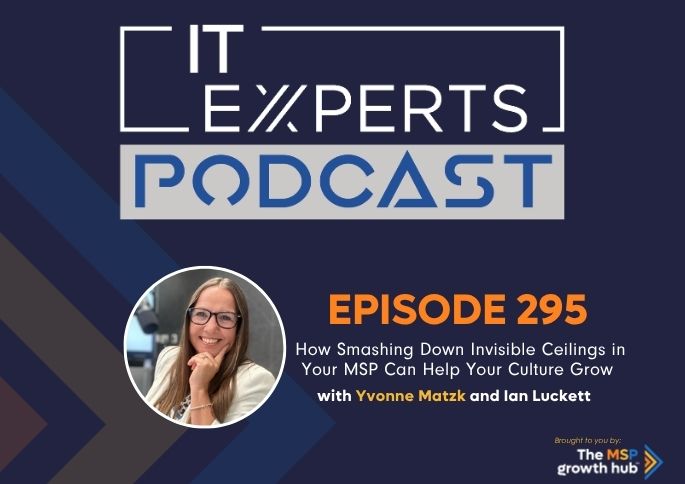
Click below to listen to the episode
In this episode of The IT Experts Podcast, I sit down with Yvonne Matzk to explore a subject I rarely get the chance to talk about on this show, the invisible ceilings that hold back talent, culture, and growth inside our businesses. Yvonne Matzk is the founder of Coachere, a coaching and consulting practice supporting leaders and the next generation of talent in the IT industry, and also the founder of the Channel Community, a free network built to help emerging talent find mentoring in a safe and inclusive environment. I loved hearing the story behind her book, Smashing the Class Ceiling, born from research showing that only nine percent of people working in tech came from a low socioeconomic background. Yvonne Matzk and her fellow founders at the Channel Community realised how many of them had come from working class backgrounds themselves, and decided to raise awareness of this gap by aligning with the Social Mobility Foundation. What started as a podcast grew into a book, designed to showcase people who started from humble beginnings and went on to build genuinely impressive careers.
Yvonne Matzk introduces the idea of the class pay gap, a concept she told me she had never heard of until she began this work, despite having lived its effects throughout her own career. She reflects candidly on her early years on a training wage, doing work worth considerably more, and later struggling even as a business owner to ask for what she was worth. She explains that people from working class backgrounds often carry a quiet sense of gratitude that stops them from demanding fair value, while those from more privileged upbringings tend to carry a natural confidence that opens doors more easily. Listening to this, I could see clearly how it creates a hidden pool of talent that most MSPs never think to look for, simply because they keep recruiting from the same familiar places.
Yvonne Matzk and I spent time discussing why this matters so much for MSP culture. Hiring people who look, sound, and think alike feels comfortable, yet it quietly limits how a business solves problems and challenges itself to grow. Yvonne Matzk argues that talent is everywhere, while opportunity is not, and I agree that businesses need to actively remove unnecessary barriers such as rigid degree requirements if they want access to that wider pool. She points to research showing that resilience, passion and work ethic predict success far more reliably than qualifications ever could, and these are the traits I encourage every MSP owner to recruit for.
We also explored confidence, or as Yvonne Matzk prefers to call it, courage. She describes confidence as a learned behaviour shaped by upbringing and environment rather than something people are simply born with or without. Overcoming that conditioning, she says, starts with recognising fear for what it is and choosing to act anyway. I found this links directly into leadership, where Yvonne Matzk made clear to me that culture always starts and ends with the owner. If a leader is not willing to be vulnerable, admit uncertainty and model the behaviour they want to see, no amount of clever recruitment will shift the culture underneath it.
Yvonne Matzk shared some genuinely practical steps I want every listener to try. She suggests MSP owners ask their own teams what the culture genuinely feels like, rather than assuming, and recommends simple anonymous surveys as a starting point for honest feedback. She encourages leaders to benchmark where their culture sits today against where they want it to be, then commit to closing that gap deliberately. I want to leave you with the same challenge Yvonne Matzk gave me, sense check your culture, ask your people what they really think, and rethink where you are looking for talent, because most skills are transferable and the right people are often hiding in plain sight.
Connect with Yvonne Matzk through her LinkedIn and websites: Coachere and The Channel Community. You can get her book here.
Make sure to check out our Ultimate MSP Growth Guide, a free guide that walks you through a proven process to take your MSP from stuck to scalable, without working even more hours. It’s 44 pages rammed with advice, insights and inspiration to help you decide what support is available to you now if you want to grow and scale your business. Click HERE to get your copy.
Connect on LinkedIn HERE with Ian and also with Stuart by clicking this LINK
And when you’re ready to take the next step in growing your MSP, come and take the Scale with Confidence MSP Mastery Quiz. In just three minutes, you’ll get a 360-degree scan of your MSP and identify the one or two tactics that could help you find more time, engage & align your people and generate more leads.
If you’re serious about growth and want to explore what this could look like for your MSP, you can book a Right Fit Clarity Call with us HERE.
OR
To join our amazing Facebook Group of over 400 MSPs where we are helping you Scale Up with Confidence, then click HERE
Until next time, look after yourself and I’ll catch up with you soon!
Check Out the Full Transcript Below:
IAN: In this episode of The IT Experts Podcast, we're going to help you work out why smashing invisible ceilings can not only help you build a more successful MSP, but a more diverse one.
INTRO: Welcome to The IT Experts Podcast, the only podcast to help MSPs scale to 1 million, and if already there, get to five and go faster. At the end of the day, isn't it all about building a business that works for you rather than you for it? I hope you enjoy the show.
IAN: So, Good morning, good afternoon, good evening. Welcome to The IT Experts Podcast. Today we're going to have an amazing and very interesting conversation. Probably one that you're not thinking you'll ever have in your life as we talk about smashing invisible ceilings, glass ceilings, as we talk to Yvonne Max. Hello, Yvonne. Welcome to the show this morning. How you doing?
YVONNE: Hi, Ian. Thank you for having me. I'm really looking forward to having this chat with you.
IAN: Great stuff. Yvonne is the founder of Co-Chair, which is a leadership organisation working in the MSP space, and also the founder of the channel community, which is an incredible community. Now, when I met Yvonne, we were chatting about leadership and all the other things we got in common and values very much lined up and et cetera, et cetera. And Yvonne's going to be pitching her book today. That's it. Shameless plugs. All the profits are going to charity and Yvonne's going to tell us all about that at the moment. But the reason that we're on the podcast today is we are going to help you to understand that kind of what got your business here today is not going to get it where it needs to be in the future. And that's from a point of view of diversity and the types of workforce that we use and the thinking that we have. And, we've been talking about class ceilings, glass ceilings, and any other type of limiting beliefs that MSP owners and other business owners can have or people can just have in life, right? That can hold them back from the opportunities that happen as cultures evolve, and all of that kind of great stuff. This is the conversation date. It's going to be really great. We're going to be touching on leadership. We're going to be talking about what's holding you back, and then the opportunities that MSPs need to embrace if they want to stand out from the crowd, attract the best talent, and survive this storm of what's going on with ai and how's the model of the MSP going to change. So enough from me. Yvonne, who are you? What'd you do? And who'd you help?
YVONNE: Thank you again, Ian. Yvonne Max said, like you rightly said, the founder of Co-Chair, which is a coaching consulting practise, helping leaders and next generation of talent in the IT industry. And also the founder and chair of the channel community, which is a free of charge community, which was designed to help support the next generation of talent through free of charge mentoring or an inclusive, safe, non-intimidating environment for them to come and network and meet their peer groups.
IAN: Lovely. Absolutely amazing. And I mentioned it once, I'm going to mention it again. You've recently written a book, haven't you, Yvonne, tell us about book and what was behind the book and what was the fire behind the
pen.
YVONNE: So when we launched the channel community as a CIC, we had to be aligned with a charity and based on some research that we did actually it was the tech talent charter that did this research that discovered that only 9% of people in the tech industry came from a low social economic background. And then we looked around the committee that was part of the founding organisation of the channel community and we discovered there's actually quite a lot of us that have all come from working class backgrounds. So we decided that we would try and help raise awareness of this with by aligning ourselves with the Social Mobility Foundation. So as part of that journey, we decided to do a podcast called Smashing the Class Ceiling, because we wanted an opportunity to showcase some of the most amazing talent that we have in our industry that have all started from very humble beginnings, but have all gone on to have amazing careers. And these are across various different roles and seniority in our industry. So we did the podcast and we came up this idea why don't we turn it into a book? Because if we can turn this into a book, then we can share these stories with people that we want to inspire and motivate. Yeah, the way you start doesn't dictate where you finish. And try and support the efforts that the Social Mobility Foundation were doing.
IAN: Love it. Absolutely love it. And for those MSPs listening who have been to any MSP event, you have all heard a story like this because you would've heard a famous rugby player, a Formula One driver, a successful coach, whoever it might be, the rags to Rich's stories. You hear it all around and we all get inspired by it and we go, oh look, we can do much more and all this. But what you are doing here, Yvonne, is really amazing, because you're actually leaning into that and you're going let's go and find more people that we can create some success stories with, right? Rather than let's just go to the usual pool of talent and see what we can find there. And oh, they're no good. And how many times do we hear people saying recruitment's a nightmare? Yeah, it is. Because you're probably looking in the wrong pond. You're probably looking in the wrong way because recruitment is a marketing exercise. So depending on how you market your business, depending on how you market yourself, depending on how you market, your environment and the industry depends on who we attract. So how does class ceilings, what does that look like in the business and tech space? How does that show up for people?
YVONNE: So the, the class ceilings particularly is aligned to the class pay gap. So I dunno whether you are aware of this or you might have heard of the gender pay gap. So the gender pay gap is all about the differences between gender male and female. I didn't even know that the class pay gap existed until the work that I was doing on the smashing the class ceiling and the work we did through the Social Mobility Foundation. And it was like an epiphany because I realised when I discovered it that I had been seriously impacted personally.
IAN: Okay.
YVONNE: I think when I look at the early part of my career, it was based on the company that I worked for. I was on YTS 35 pound a week, was an apprenticeship. And I was doing the job of someone earning probably 20K. So that was definitely on the company taking advantage of me. I was young, I was enjoying it, it wasn't an issue. But then really realising that later on in my career it was on me because I just didn't ask for what I deserved. And it was almost like people that come from working class upbringings, and this is consistent in the book by the way, these traits come out across everybody that we interviewed, you just don't value yourself in the same way that people from more privileged or opportunity do. So they, people that have come from more privileged upbringings that may have gone to private school, they have this natural sense of entitlement and confidence and value that people from working class upbringings just don't have. And it's not just about being in the workplace that this can impact you. It impacts you as a leader as well. If I think about my career. When I was in tech, it impacted me for asking for what I deserve from a salary perspective. But now I'm a founder and a business owner. I struggle sometimes to ask for money because it's that you don't value yourself in the same way.
Yeah. I don't, by the way, I've got over that, but I really, I did at the early start, really felt it really quite difficult because you're so grateful and I think this was the common trait that came out. You're so grateful for everything that you have to your peers. You are doing so well. You don't demand what you deserve.
IAN: So that, that's really interesting and I can resonate with everything like that, in terms of people that I've met in my life and how they work and everything like that. And I think it's very interesting because there's this, basically what you are saying is that there's this whole pool of potential talent that no one's even aware exists.
YVONNE: Correct.
IAN: Is that what we're saying here?
YVONNE: Yeah. I think to your point earlier you said if we keep fishing from the same puddle you are going to, or pond you mentioned, but I call it puddle because it's literally what it is. You're going to get the same results. There was another piece of data that really made me think, oh my gosh, that's ridiculous. Apparently if you hire somebody from a more privileged upbringing, they will of low talent, they earn 20% more than people from high talented people that from a more disadvantaged upbringing, but people will naturally gravitate towards people that look, sound like them. And it's natural, right. We all get on with people that are like us. It's human.
IAN: Yeah. Yeah.
YVONNE: It's nature. But we also know that if we just work with people like us, that sound like us, that look like us, that think like us, we are going to continually get the same results and not be challenged. We are not going to have somebody getting us think in a different way or approaching a project or a solution or a problem in a completely different demo like dynamic. Because you're all thinking and speaking and looking the same way at this project. But it does require effort and that's the difference. This isn't, you have to understand that people, there's huge amounts of talent out there, huge. Talent is everywhere. Opportunities are not. So getting people in early career that haven't come from the advantages, there's some challenges that come with that, that businesses need to be made aware of so they can help them navigate the corporate corridors. For an example, like how to might even be what to wear, how to behave, how to, they called it code switching where even, I joke, I went and had lunch with a friend of mine who's the CEO of an MSP, and I was talking to him about the book and telling him about my story. He goes, but Yvonne, you are too posh to be poor. And this like, and I nearly spat out my faris no.
IAN: And champagne darling,
YVONNE: And champagne, no. But I, because I, it was just hilarious because never in my life have I ever been called posh. I come from a market over spill town where we were cockney rejects. But I've spent my entire life. Changing my accent, trying to, fit into these environments. This has taken years of polishing, of fine tuning. Yeah. If you're, I certainly didn't sound and talk like this when I was a 17-year-old white TS student walking into her first job wearing a pretty much play suit that I would've worn clubbing and thinking that was a appropriate attire for the office.
IAN: Club to office where we used to call that back in the day.
YVONNE: I know. I think that's because we've just got in from the club. That's part of the -
IAN: Exactly that. So let's talk about the opportunity then, okay. Because basically what you are saying is there is a bucket load of talent out there that's not confident.
YVONNE: Yeah.
IAN: They probably have an interest in tech and, whether you are looking at the different social media platforms, whether you are looking at AI models, electric cars, whatever it is, the younger generation are built up with a more open view on what technology can do. Whereas if you look at people, I'm going to say people north of our age and I'll be polite about this it's, they're more looking at their pensions and they're looking at what do I need to do now so that I've got a good retirement. And, I've been saying to Stuart we've been talking in The Growth Hub about, about the age group of the members of The Growth Hub, which is a representation of the MSPs in the channel. And we're starting to see some younger ones, some, some younger business owners coming through. And it's quite funny because their challenges and their issues are no different really than some of the older guys and gals, which is absolutely great.
STUART INTERRUPT: Hey, just a quick one from me for everybody that's listening. Stuart here. If you're serious about growing your MSP, but you're not sure what help's right for you, then just grab our Ultimate MSP Growth Guide. It's a really simple way to check out what's out there for support that could really help you work. There's no fluff, there's no filler, just facts. Or alternatively, if you want to meet us face to face and see how we do things up close, come along to one of our events. They're regularly put on. They're all in the links below. Go check them out. And now it's back to the show. Thanks, Stuart
IAN: But the opportunity for the MSP here, what does that look like? Do they need to go and, find these people? Do they need to attract these people? If they want to test out to see whether or not this is something that's going to help them in their business, then how do they maximise this opportunity?
YVONNE: So there's lots of different ways that they can go and look at different talent pools should we speak.
IAN: Yeah.
YVONNE: In fact, one of the things that we've done at the back of the book, here's the book by the, another plug.
IAN: For those who have video.
YVONNE: At the back of the book, we actually have a guide for companies and it talks about all the things that they can do to help attract people or go out and look at different ways of a accessing this type of talent. As you probably are, fully aware and channel on the ice, the industry itself is one of those best kept secrets.
IAN: Yeah.
YVONNE: Because until you are in it, no one really understands what it is. So the first part is awareness and a visibility. And there's work, there's organisations out there like tech channel ambassadors that you can go and work alongside that go out to schools and help them make aware what the actual industry is and what the channel means that it's not just the piece of water that connects the UK and France. It's actually an amazing industry that we have. But also that not all the roles in our industry are technical because people get put off by the fact that, oh, I'm not techie so I can't come and work in this industry. As you and I also know that the skills needed today are probably more around soft skills, emotional intelligence, human skills that you can't replace with technology. And those are the skills that are in spades across the people that come from diverse backgrounds because they've not had the opportunities from the technology side. So they've doubled down on other types of, human behaviours that have managed, things like work ethic, grit, resilience, all of those things that you can't teach are ingrained with people from this type of environment. So go out, look at, think people, you know, like work with organisations like the tech channel ambassadors to go out to schools, rethink recruitment, remove all the unnecessary barriers, like take away the entry requirements as well. Stop saying you need a degree from a Russell group, ED- like university. Education is not an indicator of success. There's so much research out there that proves that, Angela Duckworth wrote about it in her book, Grit. The things that make people successful, our passion and resilience, perseverance, education was never a component. So look at work ethic. Hire on those types of skills, the things that you can't teach. Everything else is teachable.
IAN: It's interesting because, as I go back to the keynote speeches that we've all heard at the conferences about we had no choice. It was like, we've running outta money on Thursday and we need to eat on Saturday. What are we going to do? You've built that resilience, you've built that grit, that innovation, the way that they work. And some of the most successful people I speak to are people who have had those stories where they have been resilient. And you've just said something very interesting there, which is you can't teach resilient grit is part of the values, it's top part of their behaviour. And I think when you talk to MSP owners, when you talk to really anybody about recruiting you recruit around the values, recruit around their attitude, and you recruit around their, you don't recruit somebody for their technical skills unless it's a very technical role that you need. Of course.
YVONNE: Yeah.
IAN: Because you want them to fit in. However, the C word is a very different scenario, isn't it? Because confidence. Is not something that's inherited and brought up. And it's something that has to be learned and built, doesn't it? Talk to us about, the difference between the resilience and the values and the grit, and then you want someone who has the confidence to then go and tell people how great they are at these kind of things. Is that something that's going on?
YVONNE: Yeah. And that, goes back to that value piece, not valuing themselves in the same way. And that can be whether you are from a working class upbringing, your ethnic minority imposter syndrome comes from in different guises and affects a lot every, affects every single one of us. And people that say that it doesn't are lying. So I look at it in a different way rather than confidence, courage, because it's being brave enough to know that you're going to fail or everything that you've learned so far in your life or your career, you've failed at first. And I think it's the fear of failure, fear of embarrassment, fear of judgement that stops people from putting themselves forward. But once you realise that fear is just false evidence of appearing real, and it's just something that's been conditioned within you everything we are is learn behaviour. We all come into the world with a growth mindset, confident, willing to learn, grow. You think about walking, talking, eating, sleeping. And so what happens is as we grow up outside influences our environment, our parents, our carers, they have a massive influence on our thoughts going forward. And then shame comes in embarrassment. For females specifically, you're told, be quiet, be nice, be kind. Whereas young boys, they're allowed to be raucous and get away with being quite leery. But then they're not, they're told not to show their emotions. Yeah. So when it's an emotional situ, so everybody has this conditioning that's played upon them. So I think overcoming your confidence, overcoming that conditioning is just being courageous enough to see it for what it is that's just a label that someone else has given you. And just having the courage to put one foot in front of the other and just go for it. Because, you think about where you are now, Ian, you certainly weren't there 10 years ago.
IAN: No.
YVONNE: We all start somewhere.
IAN: Absolutely. Absolutely. By the way, we are not going anywhere on the script on this podcast, but this is a great conversation.
YVONNE: Sorry.
IAN: No. It's not your fault. This is my fault. This is my fault. It's my fault. So we've got this pool of people who we know have got this great potential. One thing that I see that's the blocker in this is vulnerability in leadership of the owner to say, you've, we've just talked about fear of failure. We've talked about getting outta your comfort zone. We've talked about doing something a little bit different. Bringing in some people, bringing in some, I can't remember what they call it now, tip of my tongue. Like some wild cards to see if this would work. But yet I think probably to 60 to 70% of the conversations we have in the growth hub about helping our members is are around leadership of themselves. So if we've got this pool of people that are untapped in the schools and universities and colleges and places like that, which I think is an amazing place to go. And I do hear our clients going and talking and doing, raising awareness and STEM and all of that kind of stuff that's going on out there. But if the leader himself of the business isn't comfortable in doing that, is that part of the problem we've got here?
YVONNE: Yeah, a hundred percent. I think they've got to embrace the change. And they have to lead the change as well. We spoke about it before different types of organisations gravitate towards people that are like them, that look like them. And the culture then is that culture. And that's okay. By the way, you if the leader of their MSP, it's up to they are the culture, it starts and ends with them. And you can't, it's a bit like value than purpose. It's all very well saying what you want on a wall, but actually being and delivering it and living that is a completely different dynamic.
IAN: Yeah. Yeah.
YVONNE: And you get worked out pretty quickly. If you don't, and the first thing is what culture do you want? What is the type of individual that you want in your organisation? What do they look like?
IAN: Great.
YVONNE: Because it's going to be very different for different people, right?
IAN: Yeah.
YVONNE: We they always, people complain, oh, we don't do enough about attracting women and we don't do enough about attracting this, but they might not be the right person for the role. So firstly, identify the type of culture that you want. Then look at the type of people that would fit that culture. What do they look like? What do they sound like? But also don't, I think, say classes and it's an invisible barrier that people don't discuss and hide because of embarrassment. If you are, say for example, have got an amazing work ethic, you've come from it, talk about it.
IAN: Yeah.
YVONNE: You can't, people, you can't be what you can't see. Be the role model. Don't wear it as a badge of shame. Wear it as a badge of honour and go out and use your, or, your credibility, your experience, your success to go out and inspire other people and support them on that journey. Because I think that's one thing certainly a lot of people do. They try and hide it. And we talked about that. It's invisible.
IAN: Yeah.
YVONNE: They try and keep it that way, but by doing that, you can't shine a light on some of the challenges and help solve the problems.
IAN: That's absolutely right. So how would a, how would an MSP know if their culture was. Was right to, to start looking outside of their normal pool of recruitment people or different areas or thinking kind of over and above. As you say, the values of the business are generally the values of the owner or the leadership team, who, whoever that might be vulnerability I think is one of the strongest leadership characteristics that you can have where you just, where you literally just stand in front of your team and go, Hey, I don't know all the answers to this right now. 20 years ago, God, if I'd had said that in a board meeting in one of my, one of my roles, I would've just been sacked because it would've just been, what are you saying? You're not a strong leader telling people what to do? And it's like okay, that's maybe not how it works now. So vulnerability and making sure you've got that open culture, you've got that all of that kind of thing. But how does, and we've talked about culture and other podcasts, but in your view how does an MSP kind of assess where their culture is and then work out how they, where they want it to be or how they want it to look like?
YVONNE: I suppose, ask the people that are working for you today, look at what they, their view of your culture is, because you might have one view, they might have a completely different one. Maybe work with a third party to get them to come and have an independent review of it as well. Because sometimes people will give them, you know, if you've done a great job of being vulnerable and built a culture of psychological safety where people feel that they can be honest and open and they're not going to be penalised or criticised for it, then that's a great start.
IAN: Amazing. Yeah.
YVONNE: But sadly not everyone has that. And not everyone is courageous enough to be honest about the true sense of where they feel the company is. Yeah, very true. Yeah. Because then they don't want to be reprimanded or feel like they're going to lose their job because they've not agreed with somebody. So if you have got psychological safety, you have got an amazing environment where people feel like can have courageous conversations, be honest about how the go and ask your team yourselves. If you don't, or you feel like there are pockets where you don't maybe work with a third party that can help you have those types of conversations and give you a true reflection of what your people are saying.
IAN: Love it. Absolutely love it. This is such a great conversation because it's absolutely one that's needed. Now, just something that just came to mind. If the MSP owner out there is sitting there going, yeah, I know my team is not going to be the team that's going to really take me to the next three to five years and I need to do something about it, but I don't know what I need to do about it. They know that. Julie, our leadership coach, she says that a lot of the time. She goes, what would you be, how would it feel for you if you were watching yourself on tv? So you sit down at night, you've got your cup of tea and a biscuit, and you're watching yourself behave on TV with these staff, with your clients, with the team and everything like that. What would that look like? I think that's a great reflection analogy, but one of the easiest things that the MSP could do here is try some of these cultural massages, I shall call them on their existing people, couldn't they? So if they're not having open conversations, if they're not having environments where people feel safe to talk, you've got no chance of recruiting someone and doing that if you are not doing it yourself. Oh so what are some of the tips that the MSP owner could do with their existing team today for free that can help them test out and stretch their kind of culture muscles?
YVONNE: I saw Julie at the MSP show when she talked about that.
IAN: Yes.
YVONNE: And I think it's a really great analogy around getting people to really look at themselves in the mirror and think.
IAN: Yeah.
YVONNE: What I project is what's, is that, what's coming back to me? So self-awareness is probably the most...
IAN: Yes.
YVONNE: Like most needed skill, self-awareness one, but adaptability two, because you cannot change other people - fact, but you can change how you get them to perceive you or how you let them affect you or how you interact with them, because that's on you. That's within your power to do that, but you can't change them as a person. So first go and have the conversation with your team and be vulnerable with them. Be honest. You could even do your own little 360 feedback, create your own little survey and say just, and do it anonymous. Do it anonymously with them. Say, look, I don't even need you to put my names. I just want you to set, get a set of questions and you want to know the answers to create yourself a Google form or whatever, whatever software you use. No, nobody's paid for Google, by the way.
IAN: Oh, there's a lot of people paid by Google. Don't you worry about that?
YVONNE: Yeah. I'm not one them.
IAN: I think we're going to tip, I don't think we'll tip the balance on this podcast.
YVONNE: Whatever, whatever software you use, go and create a form and go out and do it, and obviously, and then click that feedback. And then you've got a data point in which, where you're starting and then go and have the conversation. Are you happy with that one or is there a massive gap to where you want it to be? And what are the steps that you are going to need to take to get you there?
IAN: And, you could even and you probably will do use, use your AI tool to do that. The one that knows your business. Ask it, what are some of the best questions so that I can improve my culture so that I can open up some diversity and reach a different talent pool, because guess what, when you start recruiting in different places, you're going to get different people. You're going to get a different result and the business is then going to start to, to thrive and grow. It's a bit like a bit like Halo. They only recruit graduates from university. And they do that for a reason because they want everybody to grow up and they want everybody to know the way and how that business works. But that culture is very much like the Apple culture. You're going to the Apple store, but you know damn you walk into the Apple store, you're going to get yourself sorted, fixed when you walk back out again. The problem that you had when you went in's not going to get fixed. Now your MSP should be running like that and all the people should be swimming on the same team. And whether you call this podcast team building, whether you call it leadership, whether you called it, kind of recruitment, whatever it might be, it touches so many different areas of business and life that's so important, right?
Yvonne absolutely loves this show. We could go on for an awful long time, but we can't, unfortunately. MSP business owners out there who have been listened and have been tantalising and as Stuart would say they've been left salty where they want a little bit more of this. What do they need to do? Massive opportunity here. What's the top three things that you've got to for MSPs to walk away with today so that they can put this in action and really help their businesses and their people?
YVONNE: So, you know, we said sense, check their culture. Go and ask the people within their organisation
IAN: Yeah.
YVONNE: As to what they really think, not what they think.
IAN: Yeah.
YVONNE: Benchmark it against where you are today versus where you want to be in the future. And obviously they're not doing the work to do that, but also rethink your recruitment strategy and look at other places that you could be going and potentially recruiting this amazing pool of talent that is out there that is just not getting the opportunities because most skills are transferable.
IAN: Yeah. Yeah. Fantastic. Thanks again Yvonne, for not only rescheduling so many times that I think most of them are our fault but preparing for today's show shameless plug time. If people want to learn about the book, you or the community, tell 'em how they can get in touch.
YVONNE: So the book is available on Amazon so you can order that the profits go to charity's. It's called Smashing the Class Ceiling.
IAN: Lovely.
YVONNE: Where you start doesn't dictate where you finish the profits for the book go to a charity called Turn To Us, which is a organisation that helps people in financial difficulty. Join the channel Community and details, which you can find on the old channel community website, which we'll share afterwards. We have three events during the year. Our next one is on the 19th of November at Softcat offices in London. It's free. Everybody's welcome. And then if you want to understand more about my work and the work that I do as part of co-chair, then connect with me on LinkedIn or go to my website.
IAN: Lovely stuff. Thank you, Yvonne. It's been an absolute great show. Really enjoyed it. I wish you all the best of luck with the book, with co-chair and with the channel community. Yeah, that's it from us. We'll catch up with you on the next one.
NEXT WEEK TEASER: And in next week's show I want to talk to you about going beyond the money, what wealth really means for MSP owners. And what we're going to be going through is what's your why. If you've ever woken up and you're a bit fed up and you're a bit drained and your business is doing the same thing, day in, day out, month in, month out, year in, year out, this is the show for you. We're going to give you a bit of spark, we're going to give you some fuel, we're going to give you some motivation. So don't miss next week's show. It's going to be one of those ones that's going to lift you up. Look forward to seeing you then.
OUTRO: Oh, but one last thing just before you shoot off. And if you're curious about how this episode links with the ability to scale your MSP to a million or, or if you're already there, accelerate to five, then we want to invite you to come and take the MSP Mastery Quiz. And in just three minutes, you're going to get a 360 degree scan of your business where you can identify the one or two tactics that can help you find more time, engage and align your people, and help generate more leads in your MSP. It's really simple. Just click on the link in the show notes. And if you have enjoyed this episode, we'd love to get some feedback from you by means of a rating, review on Spotify or iTunes or your podcast platform of choice. We really appreciate every single one of them. Now you can go and enjoy the rest of your day, and we look forward to catching up and connecting with you soon. All the best now.