To set your MSP on the path to success, begin with a clear vision of your future organizational structure. Many MSPs start with a flat structure, but as you grow, it’s essential to plan where each team member fits in. This strategic planning will help you determine when and who to hire, ensuring that your team evolves in line with your business goals.
Don’t just keep your goals to yourself. Share them with your team! Quarterly goals give everyone a clear focus and keep them engaged. Whether you communicate these goals every 30 or 90 days, it’s important to ensure your team understands where the business is heading and how they play a crucial role in achieving those goals.
Your company’s values are the essence of your culture. They guide your actions, attract the right talent, and even influence the clients you work with. Make sure your values are clear and prominently displayed. You can use these values not only to reward good behaviour but also to address issues constructively, focusing on the values that weren’t aligned.
Stop being busy just for the sake of it. Conduct a time audit to identify tasks that consume your time unnecessarily. Delegate tasks that others can handle, freeing you up for higher-value activities like business development and strategic planning.
When you’re ready to change gears and pursue a deliberate growth plan, communicate this shift to your team. Resetting expectations helps redefine what’s acceptable within the organization. Remember, what got you here might not take you further; adapt to external factors and evolving market dynamics.
Identify your A-players, the enthusiastic and passionate individuals in your team. Nurture them, develop their leadership skills, and delegate tasks to them appropriately. Effective delegation means giving them the bandwidth, defining clear expectations, and allowing them to learn through both successes and failures.
Assess your team’s competencies, behaviours, and attitudes. Ensure that everyone is in a role that aligns with their skills and values. A well-structured team with the right people in the right roles empowers everyone to excel and contributes to a happier workplace.
Establish clear expectations for tasks, metrics, and performance. Ensure that both you and your team are on the same page regarding roles and responsibilities. Regularly check in with your team to provide support and guidance, avoiding the tendency to swoop in and take over when things go wrong.
Engage with your team through regular stand-ups and one-to-one meetings. Create an open, vulnerable, and collaborative atmosphere where your team members feel valued and heard. Encourage them to provide feedback, share their thoughts, and participate in team-building exercises to strengthen your company culture.
When it comes to recognition and rewards, make them personal and meaningful. Tailor your approach to each team member’s preferences, whether it’s time off, public praise, or other incentives. Recognize and reward those who thrive and provide ongoing training and support to help them continue excelling.
Implementing these ten tips will not only supercharge your team but also enhance your MSP’s growth potential. By focusing on leadership, communication, and alignment with your vision, you can create a thriving and motivated team that propels your MSP to new heights.
If you found this episode valuable and want to dive deeper into topics like team reconnection and more, make sure to listen to Episode 114 – How to Reconnect with Your Team.
And if you’re ready to take the next step in supercharging your MSP, take the Scale with Confidence MSP Mastery Quiz. This will provide you with insights and guidance tailored to your specific needs.
Remember, building a successful MSP is not just about working harder; it’s about working smarter and building a team that shares your vision and values. So, take it one step at a time, implement what resonates with you, and watch your MSP thrive.
Connect with me on LinkedIn and see what I’m up to by clicking HERE
To join our amazing Facebook Group of over 300 MSPs where we are helping you Scale Up with Confidence, then click HERE
Until next time, look after yourself and I’ll catch up with you soon!
INTRO
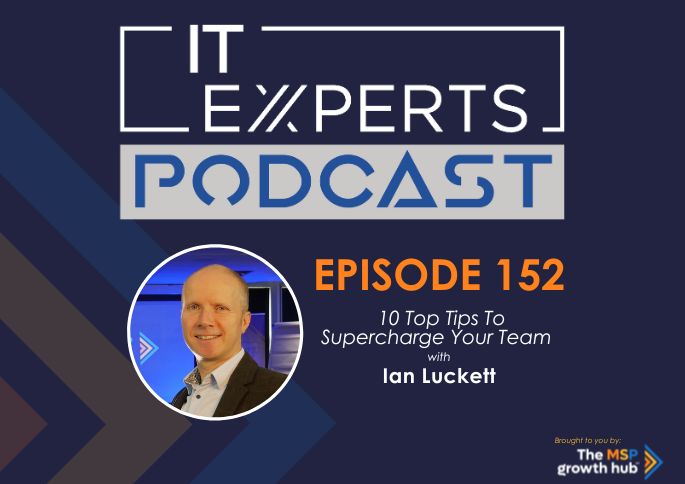
In this episode of the IT Experts Podcast, I'm going to be sharing with you my 10 top tips to supercharge your team.
Welcome to the IT Experts Podcast, the only podcast to help MSPs scale to 1,000,000, and if already there get to 5 and go fast. At the end of the day, isn't it all about building a business that works for you rather than you for it? I hope you enjoy the show.
IAN
So, good morning, good afternoon, good evening. Welcome to the IT Experts podcast. Hope you're all doing well today and today I thought I'd just do a bit of a quick blast, burn some things that we're hearing at the moment. Now we know that there's three things you need to create, build and run successful in MSP or business.
First thing is data. Understanding your data, your metrics, your KPIs, whatever you want to call them, what's working well, what's not working well, your profitability, your numbers and all of that jazz number 1. Otherwise you won't be to make any decent decisions on investments or anything like that. Second thing is a working sales and marketing engine, making sure that you've got fresh leads coming in. So yes, we've got an amazing opportunity to have some referrals, but it's all about the fresh leads to help supercharge the accelerate your growth in the profitability of your business. And the third thing is the ability to build a great team. Now, here we go. This is what this podcast is all about. \
So the ability to build a great team is sometimes a real clunky thing for many MSP because they come from a technical background and because asking people to do things, and particularly when they're different types of people referring back to this profiling and all that sort of thing can be a little bit awkward and it can be a little bit confrontational sometimes, and it can be quite difficult as well so. How do I get the best out of my people and on the back end of that as well is why is my MSP sometimes a little bit unorganised because if you're ever feeling like you're a little bit frantic, you're running around, you're doing all of the work and everything like that. Then that's probably because you are and as I say, if you think you're right, you think you're wrong, you're probably right. So in this episode, we're going to help you with our top 10 tips and I can ask Top 10 tips to help you supercharge your team. You know, at the time of recording, beginning of October 23, we've got, you know, good couple of three months left to the end of the year, hit those targets, make sure we're getting where we need to be. And in this episode, we're gonna be sharing with you some of those tips that can help you to get your business from being flat and unorganized to making it nice and structured and scalable. And it takes you from being herding your teams to help you leading the teams. We talk off awful lot about leadership and there's a reason for that is because it's the way to get a lot of information out of your head. The way to get your teams aligned, it's a way to help you get go faster, empower your teams, build your employee engagement. All of this great stuff that makes life easy, and it makes life a bit more fun because you'll be spend more time with your friends and your family.
So you know, we hear a lot, hear a lot of stories in the growth hub about clients that come in and there are, they don't admit it, but they are, some of them are are quite scared about handling conflicts. They're scared about how to have a difficult conversation. They're scared about how to actually approach one to ones and why do I need to do it? And I can't be bothered and I'm busy enough as it is. But lo and behold, normally after about two or three months after the conversation or two or three months after joining the growth hub, and they listen to other people and they understand the methodologies and the tactics that people are using to help get more out of their team. Guess what happens all of a sudden. You then start to build that confidence as a leader in your organization. You then start to have quality conversations and people realise that this change ahead and positive change ahead change that they should be enthused about change, that they should be excited about and change that they will be rewarded about, you know when things get not quite sure my voice went up in the high pitch there, but you know people get get rewarded cause they get excited about where the business is going and it's down to you to share with them where the business is going and it's also down to you to build, develop and grow your team so that they become that high performing team.
So without further ado, let's get stuck in. If you are, listen to listen there a pen and paper get it out so you can make some notes. If you aren't then get your phone out. If you're driving, don't worry. We'll put all this in the show notes and you'll be able to come back. And and we listen to it.
So number 1, always start at the top and it's always around planning out and visualizing your future structure, and many MSP's are I've got a flat structure and the reason for that is either when they start it up or when they brought their companies or whatever it might have been at the beginning. You normally line it up with technicians, you get busy, buy another tech, bit busy, get another tech busy, you get another tech. One person might bubble up as a bit of a senior tech. You might get to a boiling point where you think I can't manage all these techs, and then they'll start and then you you might bring in a an SDM or someone like that to help manage the the, the the team that tech team is normally the first one to grow, swell and scale as the business grows. However, what sometimes happens is you will end up with a technician and you might do a little bit help desk. You might do a bit of support and then you might do a bit of projects and you might do some quotes. And then you might bring someone else in and they might do, I don't know, a bit more an admin role. They might end up doing some triaging, of course, which is something that we hear a little bit about. But what you what the some of the traps that we sometimes hear and see and then people start to then blend across what we call discipline. So if you've got your help desk, you've got your projects team, you've got your you know your sales team, your account management team, you, you, you, the marketing, finance admin, that sort of thing going across the the typical MSP. But knowing where your business is today and knowing where your business you want your business to be in three years. Time is really important to make sure that you've got that future plan, because then you can bring people up from within. You can help promote them, train them, build up their skills matrix so they can either fit into a senior position or whatever, whatever that might be. Or you might know that you need to bring in somebody who's got those skills, who sits above. But it's really important that you understand where your next hire is going to be, where and how much it's gonna cost you and when you get to a certain level of, you know, clients, leads, whatever it might be, you know, endpoints, et cetera, et cetera. Then that is then when you're gonna need to bring those people in. And if you've got our structure planned out, then that will be the strategic growth for the structure which is really good. So make sure you've got that. Very clear. It's not a very difficult exercise to do in fairness, so make sure you've got that got that nice and planned out.
The next one is around setting your kind of quarterly goals and then rolling them back down to 60 and 30 day with any plan, growth plan, plan to build the House, plan to go on, whatever it might be, it's really important that you go far out to start with, get excited and feel what that vision looks like. Feel what the success looks like in all parts of the plan, but you need to set these goals and you need to share them with your team. And it's really important that they that that you share them with them because then they feel engaged. Now you don't, really, if you don't want to go into the nine, stay plan then you don't need a nine stay plan, but depending on how often you meet up with your your organization, your team share with them company updates and all that kind of good stuff. Then you might find that in actual facts you might just want to share in the 30 days. Hey guys, this is the focus for the next 30 days or you might go this is the next focus for the next 90 days. But when you tell people that you are what you're doing, where the business is going, they will get excited about it. They will feel excited about it and they'll understand all the hard work and the stress and the strain. And where it's going, and luckily some of the rewards as well, while they are doing that. So that's number two, make sure you're setting your 30/16/90 day plans.
Number 3 is around the values of your organization. We talk about this mainly when we're toggling it with the vision and the mission in the business. But I just want to talk about the values for a minute. So the values are really important because. It's kind of who you are. And it helps define the culture of your organization. Not only does it help you understand who you want to be as an existing business, but it also helps you understand who you want to recruit and what types of people you want to recruit, and also what types of clients you want to recruit as well. So make sure that you bring your values alive, make sure you've got them designed, make sure you've got them. You know, identified stuck on the wall so people know who they are and know what you can do with them is you can then do two things you can reward against good behaviour towards those values and always try and put this into your one to one and your your target setting your appraisal systems and all that kind of good stuff, but also if somebody doesn't meet or doesn't live the company values and it's rude to a customer for example, then you can say hey, you know rather than you saying something along the lines of, hey John, you know you you the work you did the other day, I'm really annoyed about it because you upset that customer blah blah blah. It's got the word I in it in case it gets really personal and people start getting very emotional about those sorts of things, whereas if you use your company values. You then turn around to go Joh, You know the way you spoke to that customer, they doesn't really line up with our company values. And the way that our business rates and I just wanna have a chat with you just to see if that was exactly what you meant to do. You know, put it back on to them. So bringing your values alive and you know, you could even have value champions and and all sorts of things like that. But it's really important identifying your values, keeping them alive, living values as well as a leader, really important, almost missed that, but I can't have at an 11 point. Podcast because I've got 10 planned out, but let's do this as 3A then which is around the shadow of the leader. So making sure that you know you are, you're leading that that team with those values as well.
Number 4 everyone's busy, right? Busy being busy. Why are we busy? We're busy cause a lot of the time we like to meddle. A lot of the time we as MSP business owners want to get involved in things because you don't trust other people to do a job. As good as you. You don't trust them to talk to that client because it's your longest serving client and if someone else there talk to them. My God, they're gonna leave. So number 4 is around assessing what's taking up your time and doing a bit of a time audit. Have a little look at what you're doing. Having a little look at, we talk about 1000 thousand pound tasks, £1000 task or £1000 per hour, value strategic tasks you know and £10 task obviously are the lower level emails and social media posting, answering, answering quick calls that sort of stuff. So understanding and assessing what's taking up your time, look at where you can delegate, look at where you can dump and things that you don't need to do. And just completely trash off a great little matrix we use sometimes, called the Eisenhower matrix, which is a very simple thing. What's urgent, not urgent, more important, and all of that kind of good stuff. So have a look at what's taking up your time and making sure that you're in a good place, cause then you can then pass on some of the tasks. Team help me get more excited. Help them take more accountability. Give them your ownership, but you can also keep hold of the, you know, the rains as well to make sure that you're not going to be detrimental in giving people things that they're not trying to do.
Another shadow of the leader. The thing about number 5 is actually communicating to the business and to your teams that we're going, we're going on shift change here. We're going to do things a bit differently. We're going on a growth plan. We're going on a deliberate growth plan to take this business from. Don't know. Maybe 750 to £1 million in the next year or next two years. And these are the things that we're going to be doing differently. These are things I'm going to be doing differently as leader and these are the things we need to be doing differently as a team. So we need to make sure that we're communicating again a little bit of the shadow that leads coming in there, resetting the ways that we're doing and what that helps you do is wipe the slate clean on what was acceptable. Before all, is not as acceptable now. One of my coaches, many, many years ago told me and said to me said what got you here is not going to get there. So the things in the systems and the processes and the way that you did things that got you to today is not going to be the things that are going to take you forwards because of a couple of things. Number one, you know, external environments, you know, look at the pandemic, what that's done, people have sometimes some people are now start to see a bit of a slow down buying patterns economies the way that people are. You know, we were talking the other day about millennials, which was really funny because in actual fact, many of our clients are now millennials as well as a few years ago. It was all the kids at school. But then that just goes to show how old we are. But, but you know, understanding and making sure that you're communicating is keeping it's all. It's number 1, it's free, right? And number 2 it's the best way to help build engagement and a good culture through your organization. Because when you communicate and be a bit vulnerable to your team. Guess what happens? That will come back the other way and they'll say hey, and I think that's something we could be doing a little bit better here rather than just sitting there going God, this is a load of crap. I don't want toa be doing this anymore. So that's number five halfway point.
Number 6, find your a players and correctly delegate and do not dump right. What are a players? A players are the players you weren't working in your organization who are just behind you in their enthusiasm, their passion, their love, their care for the business. You can imagine this. Can go down to any grade you want in particular, but you know if you do, we generally take it down to kind of a sea grade which people are just quite happy to come and do the job. Go home, watch EastEnders, play a bit of Call of Duty, whatever he's coming the next day and do exactly the same thing. Don't have a lot of, you know, driving them, which is fine because you do need people like that in your team, but your A players are going to be the ones that you want to be nurturing your a players to be the be the ones that you want to be developing into leaders because as soon as they start to become you know the little leveraged version of you then that means you can be doing less work. You can pass more work on to them. You can pass £100 tasks on to them where you then focus on £1000 task. And if you spend every day on business development, strategic relationships, sorting out all your commercials and all that great stuff, how amazing and how quickly do you think your business would grow rather than you getting stuck and caught up in the weeds all day. So find your a players delegate correctly. Please delegate correctly, don't dump dumping is when you're just trying to get rid of stuff. If you go through the matrix I talked about a little bit earlier on the eyes and the matrix that will help me to work out what you what you don't need to do. What's on you to do. Is that just is not going to be serving you so correctly Delegate. Make sure they've got the skills to do the job. Make sure you've given them the bandwidth. Make sure they know what winning looks like and what. Like and make sure that they're really comfortable with them, with the task that you've given them to do and you know, and let them fail as well. I was talking to Dan Scott a little while ago at the managed service summit, and he was he, He was given the last him a couple of questions and he gave me some great little tips from his point of view. And one of the things was about don't all of a sudden when things start going wrong after you've delegated some, don't all of a sudden start to become a superhero. Let them make your failure go in, or let them you know. Let them let them fail or make a little bit of a mistake. Go in and offer a bit of advice and then step back and I know it sounds really simple, but so many so I'll do that. Leave that with me. You can't do that. I'm going to deal with this. I'll finish it off. And I've literally just got off a call with some of our clients and saying exactly the same thing. Now you know. And let people fail. Let them make mistakes. Let them know. Where their boundaries. Are, but don't go in and just all of a sudden become the 4th emergency service. If nothing, that is the A, isn't it? The 5th Emergency Service then. You know, make sure that you're giving people the opportunity to, to, to recover and to step back from when they, you know, when they make a bit of a mistake or they make a they don't do something the right quality. That you want them to do.
Number 7 is make sure we got the right people in the right roles. We see this so many times when people come into the growth hub. They come in and they got a bag of licorice, all sources, their team and their organization structure. You've got some good guys, you've got some bad guys. You've got the like when I say guys, I mean men. And women, you know, different, different types of people. And so now is the time to assess the roles you want in your business. Guess what? Go back to number 1 where you're planning out your future vision. Make sure that you're looking at their competencies, technically. Make sure you're looking at their behaviours. How they're lining up against the values now I realize I'm absolutely fire hosting you, but I'm sure you can stop this and rewind it and take some more. Take some more notes. And also their attitude as well. Their attitude to learning, innovation, getting things right, going over and above with that customer who's and systems gone down on a Friday night and everyone stayed late to go and fix it rather than all Rush home to the pub, right people's, right role, absolutely critical. And we get those people in the right place, they become empowered and your engagement. Goes up and everyone starts making their place a happier place to work. Now you know, we've kind of started this podcast off saying that you got a couple of months left. You can run this over quite many, many, many months. But treat this as a little bit of a project when you're changing and when you start all of a sudden doing things with with leadership, particularly if the one thing you take out of this podcast is I haven't said it yet, but I'll say it now and ruin and not ruin my whole stroke structure. It's about 1:00 to 1:00, which we're going toa talk about in a minute. Just do one thing at a time. Do one or two things, even, maybe three things well, rather than try and do everything all at once. And that's the most important thing, just take a couple of things that are resonating at this podcast and just do those one or two things. And I'd love to hear how you get on. Just drop me a message on linked In and get quite a few messages about the podcast on LinkedIn. So make sure that you, you know, set it up as a bit of a project. Don't set it up. Don't set yourself up to fail as a as a leader on these all on these things here, set up expectations exchanges. I know what I want you to do. You know what I want you to do? We're clear on that. We had a conversation on it. You've read it back to me and we're really clear. What good looks like and what bad looks like and you know and within those metrics make sure you set those times when you can. You can check in with them to to check in to see how they're doing, see if they need any help, see if they need any support. The worst thing you could possibly do is when you ask someone, hey, what help do you need? And they turn around to you after they've made a mistake and after they've turned and gone. Ohh well actually need this help this help myself and it's like going. Why didn't you ask for that help before? You know this is the this is the time we all need to work together rather than just, you know, making mistakes. And then all of a sudden realising we've got them backtrack and get a whole load of training to do the thing right in the first place.
So number 9 is yes engage connect with your team, have regular stand ups and one to ones communication again absolutely free individual communication they love it, why, because they feel valued, they feel valued, they feel cared about. They feel that you, you've got their back. You're interested in them and all of this kind of great stuff. Engage with them, ask the, you know, some run some exercises with them, you know, ask them. Hey, what do you think's going really well in the business? What's not going well, what could we be doing better and have that open and vulnerable relationship with them so that you can build them, these great, great relationships that will stand the test of time, people will come into the organization and then all of a sudden they'll start behaving the way that people are behaving, you know, in the organization. And that's how you build cultures. That's how you build great culture. You must see some of these MSP's who class themselves all over LinkedIn. And they're all out, down in bowling or going doing some charity work or going doing something, you know, for the the local community. And they look like they're enjoying themselves and they're all a great team. And that's because they are, because their leader has spent a lot of time in getting everything organised and making sure that they focus on the culture, goes back to the, goes back to the values that one. So if you're having regular stand ups or monthly meetings or quarterly meetings, make sure you do it. If you say you're going to have 1:00 to 1:00, make sure you do it. Do what you say you're going to do is one of the best bits of advice someone gave me when I was about 26. When I started my leadership so try. When I started my leadership journey. Just do what you say you're going to do. That doesn't mean do everything that everyone asks you to do. If you say you're going to do something, then do it. Because if you don't, it's the easy way for you to lose trust and report with your team and customers as well. In fairness, we could probably pick that one up and drop it into a sales and marketing webinar podcast.
We probably will anyway, last but not least 10. Reward and recognize those who thrive and support them and train them as and when you need to. Now the thing with reward and recognition is making sure it's appropriate for the individual. Now some people would love to be rewarded on stage with a raucous applause. And a bunch of flowers and a bottle of champagne and all this sort of stuff. Other people would run to the hills if they thought they were going to be rewarded like that. So the thing about reward is make sure that the reward you're giving them is valued and it's something that's interesting. If it's time off. If someone just had a new child or a new baby or something like that, that's going to be much more valuable to them than any money. Making sure that if you're going to reward people in the office in an open office, that they're going to receive it, they're going to be comfortable. Otherwise, they might not even go that hard to try and get that reward. In the future, so make sure that you recognize them again. This is really easy. Just pin it back to the values and get the values back on what you need to do with that. So reward and recognition is the final one and that is your top 10 tips on how to supercharge probably supercharge you and your team.
I just want to share a little bit of a story with one of our clients who's literally just per and it wasn't by accident, it was by deliberation, although it wasn't kind of planned in terms of this, just leave she put 400K on his bottom line in the last year, three new team members because he focused on getting excited, falling back in love with his business and understanding what he needed to do as a leader, No sales and marketing. No, you know. No, no deliberate going out there and doing all of that kind of good stuff which we know works so well. But he just he just backed down on his vision on his mission on what he wanted out. Of the business. How he was kind of going to influence that and then supporting his team. They've just worked really, really hard. On doing the one to ones even though start with it didn't believe it was right. Setting the targets even though it was the clunkiest thing he'd ever done, and he hated doing it. But now everybody it's like autonomous. He kind of like goes in the when he goes in the office, he gets time to breathe and work people are taking ownership accountability. They're smiling. One of our clients says. How many teeth have you seen today? How many? People are smiling. As you can see their teeth, you. Want to see more teeth? It's all about the smile. So there's always a nice, you know, opportunity there to just work through these sort of things that Stuart and I'll talk about every single day on a step by step basis, pick them up even if you've only taken one thing out of this podcast, then it's been an absolute brilliant use of my time and your time listening. So the opportunity, you know, get the organization in place. Build the resilience structure you know, it's going to help you to become build accountable people and have that system flow. People know what they're going to be doing. They're going to enjoy it. They're going to come into work. Remember, if you give someone a pay rise, the influence sort of pay rise only lasts all the impacts of the payers only lasts for the three months. And then they get used to spending that sort of money, and then they're back off doing what they're doing again. You know, your team's going to flow. You're going to get less involved. You're going to b happy. Because you're not going to be so stressed. Getting caught up in stuff that everybody else should be dealing with. And then you'll be ready to scale your MSP with a bucket load of confidence.
Just before I shoot. Off I just want to. Share with you a an episode we we recently recorded which was how to reconnect with your team and this would basically be shot this after the holiday period. So how do we reconnect? How do we, So you might find that you're doing some of this stuff, but if you go and listen to episode 114, I'll share with you how to reconnect with your team and build those great connections that build the report. And trust within the within your business.
So that is it from me today. If you have loved this podcast and taken some great value from this, but also it's kind of resonated in a couple of things and you know you need to do something to help get your business ready for, you know, success in 2024. Then I'm going to put a link to our scale with confidence MSP mastery quiz in the show notes hit that link, take yourself a quiz. It gives your score shares with you what you need to be doing helps you understand what those one or two little tactics you need to be doing to drive your business forward. Be interesting to see you know how you think you'd score against how you actually do score. It's a lot of intelligence in the back of there that we've that we've built in to help it become massive value for yourselves and as always, if there's a needle in your head again, if you think you're wrong, you think you're right. You probably right and you want to get in contact and just have a chat with myself or Stuart. Then just reach out to us on LinkedIn and or hit the website. Themspgrowthhub.com hit the contact button. And we're more than happy to have a conversation and see what's going on in your world. So that's it for me today. I hope you you enjoyed the show. I hope you're having a great week when you come out Monday. Hope you had a great weekend. So I'm going to say and have a great week ahead. If you listen in the middle of the week. Have a great week. Looking forward to catching up with you soon. You take care and be good. See you soon.
OUTRO
So I hope you enjoyed the show. If you did, I'd love it if you could leave a rating and review on your favorite podcast platform. If you want to know more about how to take your MSP to a million, or if you're already there, go faster, then come and join Stuart Warwick and myself in the Scale With Confidence Facebook group. The Link is in the show notes. You go enjoy the rest of your day and I look forward to connecting with you soon.

The MSP Growth Hub is designed specifically for IT & MSP Business Owners who want to build a profitable IT & MSP business.
The MSP Growth Hub
Suite 215
Jansel House
648 Hitchin Road,
Luton, Beds
LU2 7XH
OUR TRUSTED FRIENDS OF THE GROWTH HUB