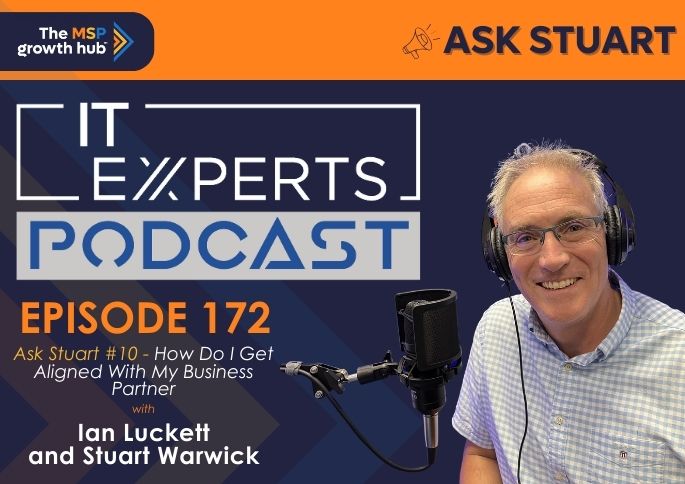
Stuart kicks off the discussion by highlighting the enormity of this challenge, especially for MSPs with multiple directors or partners. He emphasises that alignment isn’t just about being on the same team; it’s about sharing a vision, strategy, and direction. With various dynamics at play, from differing skill sets to diverse personalities, finding common ground becomes paramount.
As Stuart delve deeper on the matter, he sheds light on the common scenarios encountered in MSP partnerships. Often, there’s a techie partner and a business-savvy one, leading to clashes in priorities and approaches. However, he stresses the importance of complementary skills and clear delineation of roles, whether it’s between partners or within a husband-wife team.
One of the key takeaways from Stuart’s insights is the necessity for a shared vision and growth plan. Without a clear roadmap, partners risk pulling in different directions, stunting the growth of their MSP. Stuart underlines the significance of defining success measures, whether it’s revenue targets, client acquisition goals, or product penetration rates.
But it’s not just about having a plan; it’s about regular communication and accountability. Stuart advocates for a rhythm of review, where partners meet regularly to assess progress, tackle challenges, and recalibrate strategies. This structured approach ensures that partners stay aligned and focused on achieving their shared objectives.
In addition to communication, Stuart stresses the importance of holding each other accountable. Partners mustn’t shy away from addressing issues or avoiding uncomfortable conversations. By confronting challenges head-on, they can overcome obstacles and propel their MSP towards success.
Wrapping up, Stuart gives us a straightforward advice: get on the same page.
For MSP partners struggling to find alignment, Stuart suggests seeking external help if needed. Ultimately, by aligning their visions, goals, and actions, partners can unlock the full potential of their MSP and navigate towards greater heights of success.
Alignment isn’t just a one-time task; it’s an ongoing journey that requires communication, collaboration, and commitment.
Connect with Keith Hayes on LinkedIn by clicking HERE
Connect with me on LinkedIn and see what I’m up to by clicking HERE
To join our amazing Facebook Group of over 300 MSPs where we are helping you Scale Up with Confidence, then click HERE
Again, if you’re ready to take the next step in supercharging your MSP, take the Scale with Confidence MSP Mastery Quiz. This will provide you with insights and guidance tailored to your specific needs.
Until next time, look after yourself and I’ll catch up with you soon!
INTRO
In this episode of the IT Experts Podcast. We asked Stuart how do we get aligned with our business partner?
Welcome to the IT Experts Podcast, the only podcast to help MSP's scale to 1,000,000 in if already there get to 5 and go fast at the end of the day. Isn't it all about building a business that works for you rather than you for it? I hope you enjoy the show.
IAN
So good morning, good afternoon, good evening. Welcome to the IT Experts podcast. Wherever you are in the world. And today we've wheeled Stuart out again out of the coaching machine that is at the Growth Hub to ask a really important question. It's one that we get asked quite a lot of the time and we also have to unravel quite a bit of relationships, communication process, all sorts of stuff. How do I get aligned with my business partner? This is a really big thing for us, isn't it?
STUART
It's huge and it's a great question and it's great to be back, because out of the country.
IAN
Could have been anywhere.
STUART
Coaching hub with all our clients and you know, having the last intensive that we have, just a couple of weeks ago and you know they are so intensive because we designed them that way, but it's an intensive delivery of goodness. And this question of structure is a massive one, particularly if you're not a solo business partner, because if you are two or more business partners and we've got some clients with you know three, sometimes five.
IAN
Yeah.
STUART
You know the complexity of agreement on strategy and direction is. However, you know the majority of business, you know, MSPs are either a single director or two of them, you know, 22 founders. But the complexity beyond that is such that you might have two founders that started the business 5-10-15 twenty years ago, so they're equals or you've got an older founder and a newer founder. You know, that's both in age. You might have someone in their 50s who's brought in somebody who's in their 20s or 30s. They may have come up from within the business and started as a techie. You may have different shareholdings, so therefore one's got control. One hasn't got control from a shareholding perspective or you've got a husband and wife team and that has its own advantages and complexities as well. So it's not just are we two, are we three, are we one? It's a whole range of, you know, flavours within.
IAN
Talk to us about some of the most common things we see, is that when you've got business partners, you can have one business partner who is the techie, the OG techie and then you have somebody who would be more business savvy around you know, one in the business and one on the business type of thing. And we hear quite a lot of the time about, well, don't see, they don't see things the same way that I do and they always want to stay in the technology and they're generally normally they're quite reserved, a little bit more reserved. Whereas the riskier business owner with a bit more of an entrepreneurial flair might be the other business owner and they kind of can clash quite a bit or can get stuck. Can't they talk to us about that dynamics, it’s really interesting isn’t it?
STUART
Yeah, it is. It is. And I think going back to the flavours, you know, of structure between directors is that I suppose it depends how lucky you get in terms of who you go into business with. If there's two or three of you, because, well, let's just start with, you know, two men or women that that set up an MSP together, is, are they equal in terms of types of personality, so are they both very technical and very detail oriented and less people orientated? Generally though, you find that two business partners tend to be complementary, so one their skills fit well together. So whilst they both perhaps come from a technical background, one is more people initiative. One is more detailed and processed. They can both do it all, but there's they've got preferences and that's probably the best formula for access and if we think about husband and wife teams, you know our partners, you know, they're in a relationship together. You've got again. Usually they make quite a good team because that's the whole reason they're in a relationship because they're not identical and they've they're making life work, you know, through marriage or partnership. However, there needs to be clear delineation of roles and responsibilities for that husband and wife relationship to work and that, you know, business partner or relation to work. And generally you find that you know the one partner is the leader and the other is kind of supporting our back office admin and administration. So it's not a like for like equal business partner relationship. But they're both beneficiaries of the success of the business.
IAN
And a lot of that's around trust, isn't it? Because you know, generally they wouldn't trust anyone else with the finances, wouldn't trust anyone else with that part of the business. And it's great because you've got control on it, but it also can stifle the speed and acceleration of the business. But it's scaling, can't it?
STUART
Ohh completely. Well for sure, but at the same time, regardless of husband and wife, two directors, three directors, there is a ceiling that we all have of confidence. So getting started was one thing.
IAN
Yeah, okay.
STUART
We’re three or five-six-seven hundred million. The next step is out of our comfort zone. It has to be by definition, and so comfort zone in terms of how much you know investing putting 2-or £3000 a month into marketing, hiring a technical person at 40-50K when you've never paid more than 20 or 30K, hiring a sales and marketing or BDM. They're scary decisions when effectively the business up until now has probably been lifestyle, taking it to the next level of a proper structured business, that's an, is a big leap, especially if you've never done it before.
IAN
So how do we overcome that Stuart?
STUART
It's always quite a simple answer. Is if you're frustrated as well, there's two things. Are you frustrated with the success of the business today, you could have achieved more than what you're already achieving and is the business working for you or are you frustrated with each other because you want different things? So the starting point is getting on the same page whether it's husband and two business owners, an employee that's become a director with the founding partner. You guys have to be on the same page because if you're not, you're going to want different things. And so you're going to pull in different directions. And the business is going to plateau. And the most frustrating thing for us that we see is when people talk to us about. Yeah, we want to grow, we want to grow. There's two of us or three of us, and it's clear that 1/2 or one of the third doesn't want it. And maybe they're the found. And they're more risk averse and you can see that the newer directors shareholders want to grow, but obviously they want to take their business partner with them and their frustration is that they have to adjust dumb down their ambition.
IAN
Yeah.
STUART
And you can see that in their eyes and it's like it will either lead to one walking away from the other options of saying, well, I'll buy you out. We'll know. I won't let you buy me out. And they've got control and you kind of get end to end up stuck in a relationship that just isn't good for anyone. But no one knows how to get out of it and no one's prepared to you know, call it, you know, get divorced.
IAN
The challenge is when they're not on the same page, you know if you've got, so you've got two or three business partners. And one of them is quite happy just sitting there, plodding along, the other one was ambitious to grow, but then when we want to grow the business because it's going to cost me more money when I buy it off the other partner. But there are ways around every single situation like that in terms of your shareholders agreements and making sure everything's in place and how you're going to value the business. What does it look like and just being open and upfront, we're having this conversation with probably with about four of our clients at the same time at the moment, aren't we about, what does exit look like for all of you? And then once we've kind of agreed and everybody's on the same page with that, we kind of put that in the drawer and then we go right, let's get on with the task in hand of growing this business.
STUART
Totally. And that aligns with, you know, the boring word of vision, you know, husband and wife or just fellow directors. What does success look like for us in three, five, to ten years time. And how do we achieve it? And if we agree on that outcome or even if one wants to get off sooner, at least it's out in the open and let's work towards it. Let's invest for the next five years so that you can, you know, step out, retire, whatever it is you want to do or you know, not work in the business. If it's husband and wife and you know, go and do what you actually wanted to do.
IAN
I mean, we haven't got time to go into the full detail of it, but our genius model is something that we put our clients through and the actual fact more and more of them are going through this, this model at the moment and it helps you to identify what you're good at, what you're not good at. Give us a quick minute blast on what people need to do to help them identify what their roles should be. You know how to how to get started a little bit.
STUART
I think deep down, each individual knows what they ought to be doing or what they're good at, and I think it's having an honest conversation with yourself and then your business partners say, look, you're great with the technical and operational side of it. I can do it, but it doesn't float my boat. As much I'd much rather be out in front of clients, you know, talking to them about. You know the next step of all, you know digital road map and selling and then handing it over to you. But you know, because we haven't got enough engineers. I have to do the engineering stuff and it frustrates me you have that conversation because it's very clear what you should both focus on husband and wife. Again, we've had it recently that you know the wife, it tends to be, you know, the experience of the nature of the MSPs is that she's supporting her husband, in his business, tends to pick up the admin and the invoicing and the quotation side of it. That may be in their skill set and if it is, let them run with it. And what you sometimes find is that they actually enjoy the people side of it and so letting them into the management side. You know, the people management side, like doing one to ones disciplinaries really great success with that. So sometimes your partner can be you can take over the bit that you don't enjoy cause so many MSPs struggle with that whole performance management, thinking that one to ones are about conflict and confrontation when they're trying to set expectations and yeah.
IAN
Yeah, had some real good success. Yeah, yeah.
STUART
Good APIs which it doesn't, but it feels like that, so who actually doesn't see those conversations as conflict or confrontation, and we have seen in many cases it's the business partner or the wife.
IAN
Exactly. So when we've got there, we've got the roles. Agreed. And we've got, you know, you kind of got your boundaries set and what measure, what measures and successes looks like in each of those, how do we then anchor this back to the Growth Plan?
STUART
Well, first of all, have they got a plan? You know, so do they know what success looks like? Are they in agreement? That is something they both want, is there a plan for them to move towards it? And I know this is all just cliche business stuff that everybody knows, but they are the foundation. So Bill is saying, well, I want a, you know, I want a five bedroom bungalow or five bedroom townhouse.
IAN
It all works though.
STUART
And but I'm not going to put the foundation in it. It’s never going to get beyond, you know, 6 layers of bricks, so they need that growth plan in place and then they need to know what those individual success measures look like for the growth plan. So it might be how many endpoints. How much revenue, how much recurring revenue because you know we don't want to just stay a Break Fix, you know project based business because again that's only scalable through bodies and selling your time. You know the MSP model is so powerful and so there's so much value to be had on it both for clients and for you know the MSP owners themselves. You know, building out that plan and then agreeing on what you're going to invest in, who's in the right role, what's right for them. I think just getting on with it, but easier said than done.
IAN
Yeah. And you know, with the measures of success as well, you know can be shooting some more podcasts, which we'll be talking about KPIs and things like that. But with a typical growth plan where, what does the standard success measure for an MSP business look like in terms of, what should I be measuring?
STUART
Well, you should be measuring growth. So what does that look like? How many endpoints do we want to add this year. Well, first of all, are we profitable? Are we as profitable as we could be? Are we selling as much as we could be to our existing clients? So what's the penetration figure? So in many cases, you look at your products, have you got a product stack? Have you got a product offering and are all of your clients buying that product stack from you or are they buying? Are you helping them buy it by identifying to them what's missing in their business to optimize its security and its productivity, that's your job. That's the relationship between you both. So I think, you know, looking at where your business is and where you want it to be and what success looks like in the next 12 to 24 months and working back from there, looking at your existing clients. What are they buying? Were they buying and then looking at if you have the opportunity, looking at new business but new business is harder than talking to your existing client and optimizing pricing and packaging.
IAN
And finally, the T word you just mentioned it. Then the glue that sticks this whole thing together is around regular communications and talking to each other.
STUART
The rhythm of review. You know, as business partners, you know, you've got to talk and if you have got a plan and you have got, you know, measures of success month by month, then talk about it and when some of our clients, we say look just meet up every week, weeks for an hour in Starbucks or Costa's not in the business and talk and work on the business talk about operations, talk about sales, talk about marketing, talk about clients and set some actions aligned to the monthly, you know, plan about what you're going to do between now and next week and not just in the business. You know, what are we do on the business on the growth plan to move it to the next level we don't have to both do it. One of us can lead whatever project we're working on. So that rhythm, we'll review as we call it, is just to stop, sit down once a week, once every fortnight, but make sure that we step back and say, are we on track? Are we headed in the right direction? If not, what do we need to start doing or stop doing?
IAN
And with those meetings as well, it's going to sound really bizarre. But you know you're eating up in Starbucks or other coffee outlets and, you know, having a meeting, but make sure it's a structured meeting. Make sure that you've got an agenda. What you want to talk about, any issues that have popped up that have that you know that, that have come up in the period and one of the frameworks we can't use you know what's gone. Well, let's have a discussion what you think's gone. Well, what I think's gone. Well, what could we have done better and what we're going to do in the next, you know the week, month, whatever it might be, that we're going to upgrade and, like, really make sure that we either finish project off or make sure that we upgrade and we raise our standards basically, which is kind of really key thing.
STUART
Well, I'm going to be a bit controversial. Is the other thing is, that as business partners, you need to be able to call each other out. And I don't mean falling out and having a having a rock in the car park, outside Costa's other coffee shops are available is being able to say because we have a tendency to revert to our comfort zones. You know what we're comfortable with and you know, for many technical owners, it's the technical side and avoiding. The things we ought to be doing that's in the plan. So if your business partner isn't, you know you can, that they are avoiding talk about it because otherwise it becomes an elephant in the room and it's that elephant that is the friction in the progress of the business. So you've got, you know, we do it, we kind of go. No, no, no. I think we need some more structure around that thing doing because we've created it because we love creating new stuff. But when we've created it, we need to follow through and beat it in and communicate it. And you know we've refresh it, revise it. So it actually becomes something of real value, not just something of passing interest. And that's key. So with the review, hold each other accountable. Don't allow the elephant in the room to step in, you know. Be there. Tackle it, and ensure with that rhythm review that you're on track on your plan. Have a plan and be aligned, and they are the foundational elements to success. Then we just have to execute, which is easier said than done as usual.
IAN
Thanks very much for that, Stuart. And before we come back for our final comment in a minute, I just want to just reach out and just share it with everybody that if you are listening to this and you may have a business party, you may not, you may be struggling with your MSP. You may be wondering what we've got to do things a little bit differently then I'll invite you to come and take the MSP master. Please, if you hit the website themspgrowthhub.com and at the top there's a button, orange button, and the quiz that we've put there basically takes 3 minutes to fill out. It will give you what the next steps are for you, give you a personal life plan and it will help you to understand the maturity of your business as it is today, very high level. What you need to do, the things you need to focus on. We talked about the vision and the mission and all that sort of stuff. That's all within there as well about how to grow the three pillars of how to grow. So go and take that quiz and we know it would be really, really insightful. So Stuart, wrapping up, what are the listeners got to do when they come off this podcast if they've got a business partner and they're not aligned?
STUART
Get on the same page, simple as that. And if you're not aligned, work out why you're not aligned and how you could be aligned. It's as simple as that. And if you're struggling, get some help. Yeah, get someone to facilitate it.
IAN
Fantastic. Lovely stuff. Nice one. Thanks very much.
STUART
You're very welcome.
IAN
Looking forward to it. See you in the next one.
STUART
See you.
OUTRO
So I hope you enjoyed the show if you did, I'd love it if you could leave a rating and review on your favorite podcast platform. If you want to know more about how to take your MSP to a million or if you're already there go faster. Then come and join Stuart Warwick and myself in the scale with confidence Facebook group the link is in the show notes. You go enjoy the rest of your day and I look forward to connecting with you soon.

The MSP Growth Hub is designed specifically for IT & MSP Business Owners who want to build a profitable IT & MSP business.
The MSP Growth Hub
Suite 215
Jansel House
648 Hitchin Road,
Luton, Beds
LU2 7XH
OUR TRUSTED FRIENDS OF THE GROWTH HUB