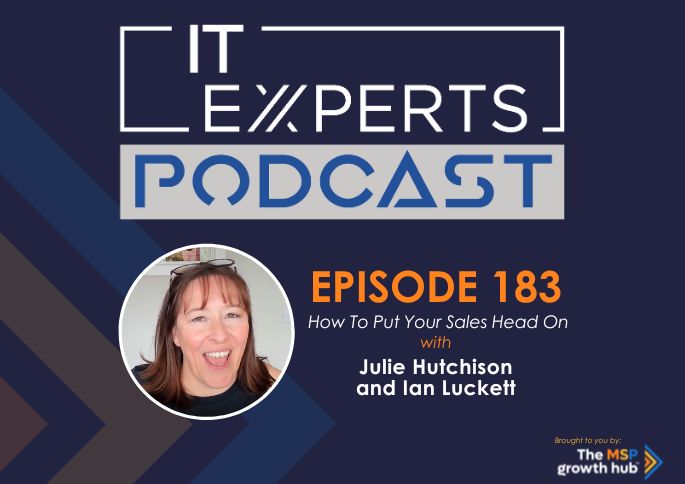
Julie Hutchison joins us to simplify the concept of selling for those who find it intimidating. We start by addressing a common misconception: the belief that technical expertise and selling are mutually exclusive. Julie emphasises that selling isn’t about having the gift of the gab or being inherently extroverted. Instead, it’s about understanding the needs of your clients and offering solutions that add value to their businesses. This mindset shift is crucial for MSPs who typically feel uncomfortable with sales conversations.
One of the key takeaways from our discussion is the importance of being “interested” rather than “interesting.” Julie explains that the crux of selling lies in understanding your client’s pain points and addressing them effectively. Rather than overwhelming clients with technical details, focus on asking the right questions to uncover their needs. This approach not only builds rapport but also positions you as a problem solver rather than a salesperson.
Julie Hutchison shares tips for practising these skills. She suggests starting with role-playing exercises within your team to build confidence. By simulating sales scenarios, you can refine your questioning techniques and become more comfortable with the sales process. Additionally, she recommends engaging with a friendly client to test your new approach. Framing it as a way to improve your service can make clients more receptive and supportive, turning the exercise into a mutually beneficial experience.
Another significant point Julie highlights is the need to address the client’s pain. She advises not to shy away from digging deeper into the client’s issues to understand the full impact on their business. This method not only clarifies the value of your solution but also helps the client see the urgency and importance of addressing their problem. By identifying and emphasising the gap between their current situation and their desired outcome, you make your service an invaluable asset.
We also discuss the concept of self-worth in selling. Many MSPs struggle with pricing and undervalue their services because they lack confidence. Julie Hutchison stresses the importance of recognising the value you bring to the table. She encourages MSPs to challenge their limiting beliefs and adopt a value-based approach to their services. This involves understanding the cost of the client’s problem and positioning your solution as a worthwhile investment.
One practical tip Julie offers is to compile a list of open-ended questions that can help uncover client needs. These questions should focus on understanding the client’s current situation, the challenges they face, and the impact of these challenges on their business. By practising these questions, you can develop a natural and effective way of steering conversations towards identifying solutions.
Throughout the episode, Julie Hutchison reiterates the importance of practice. Selling is a skill that can be developed with consistent effort. She advises setting aside time regularly to practice with colleagues or even clients. This not only hones your skills but also builds your confidence, making sales conversations feel more natural and less daunting.
By shifting your mindset, focusing on client needs, and practising regularly, you can transform your approach to sales. Remember, it’s not about being a stereotypical salesperson; it’s about being a trusted advisor who provides valuable solutions.
And to help you learn more about selling and getting more from your existing clients, listen to this episode with Stuart Warwick.
Connect with Ian HERE on LinkedIn and also Stuart by clicking this LINK
If you’re ready to take the next step in supercharging your MSP, take the Scale with Confidence MSP Mastery Quiz. This tool is designed to help you understand where your MSP stands and what steps you can take to scale profitably and effectively. This will provide you with insights and guidance tailored to your specific needs.
OR to join our amazing Facebook Group of over 400 MSPs where we are helping you Scale Up with Confidence, then click HERE
Until next time, look after yourself and I’ll catch up with you soon!
INTRO
In this episode of the IT Experts Podcast, we help you put your sales head on so you can close more business.
Welcome to the IT Experts Podcast, the only podcast to help MSPs scale to 1,000,000. And if already there get to 5 and go faster at the end of the day, isn't it all about building a business that works for you rather than you for it? I hope you enjoy the show.
IAN
So, good morning, good afternoon, good evening. Welcome to the IT Experts podcast. And today we've reeled in our wonderful leadership, coach Julie Hutchison, to help us out understand why this sales thing can be so hard for so many technical business homes. Good afternoon, Julie. Welcome to the show.
JULIE
Hello. Hello. How you doing?
IAN
Very good. Thank you very much. After completely giggling start, we've now managed to compose ourselves to be serious for the listeners for this Julie, today, we're going to be talking about around your personality, how it can affect your pricing, because I'm a techie business owner. I've really get uncomfortable with you know how do I overcome this, how to become, how do I you know change the way that I need to be to talk to different types of people all of this kind of like confusion, cloudiness, and confidence, you know, limiting beliefs and all this stuff around sales and marketing. We're going to smash all those myths this afternoon. So once you've finished listening to this show. You will know why you do what you do and how to do what you need to do, did you like that, that was pretty good, she completely just rolled off quite easily. But before we do, for people who don't know who you are, Julie, would you? Like to explain who are you? What do you do and who do you help?
JULIE
I certainly can. Yeah. Hi. I'm Julie Hutchison. Leadership communication and soft skills coach. And I work with technical experts. I would say people in tech with technical experts who want to communicate better, either that's for their team or to get more buying from stakeholders, clients and all those things we need to actually influence and impact on people in a positive way.
IAN
Fantastic. And you work with some of our seven figure clients. Don't use late six and seven figure clients helping them unravels the complexities of the human mind and all of this kind of great stuff as well. So you're part of the team we love having you here and that is why we have brought you back in today to talk about this subject, which actually came up at our eight week alignment sessions that we were having with our clients a little while ago do. You want to put a bit of context around what we're talking about today, Julie, and kind of how this subject came bubbling up.
JULLIE
Yeah, if I can remember rightly, but that I think the question was is like ohh you know we don't charge enough or we find these conversations difficult or no, I've got to go and speak to people about putting my prices up and all that's awful. And so there's a lot of tension, a lot of stress around. How do I have those conversations? Can I even have those conversations? And all. I'm not a salesperson. I don't feel. And so the question arose was, well, all is that why is it because we are technical people? Is that why we can't tell? And I think I think at the time I got on my high horse in about it and said no, that's not actually and no, I mean it'll be the case but. It's not totally the case. Because what we were talking about was that actually, you know? Everybody and anybody has to put their sales head on. To be in sales because if you are good at what you do, which Ian, I'm sure you are and everybody listen. I'm sure you are in your technical expertise. Whatever it is, then if you are good at what you do, you're in delivery mode. You're doing your thing at that point. Whereas when you're in sales mode. You're trying to convince somebody of the value that you bring and why they should come and use your service or whatever it might be. But that's a completely, it's not a different skill necessarily, but it's a completely different mind to a different thing and a different, what you're trying to do is different and so everybody needs to be able to do that. And so it for me, I think what we just need to do is to make sure that we actually put the right head on rather than just be salesperson. Don't get me wrong, there are some people whose job in life is to be a salesperson and they could sell any of these things. Your stuff, my stuff, anything. As by you name it and and they're just naturally good at that. But even they have to practice doing it so everybody has to put a sales hood on. And I think what we need to do is to understand that we might have limiting beliefs around what we are or are not when actually. What we can think about is. What do I have to do, how do I have to show up to be able to be having these sales conversations, how do I have to be different? Doesn't mean I have to be a salesperson. Does that makes sense.
IAN
Yeah, absolutely. And it kind of reminds me of a of a time, you know, my back in the day, a guy who taught an awful lot of guy called Matt Howell from the elite closing Academy. He's not listening to this. But if he did, he would shout him out. And he always talked about having your, are you having, are you wearing your sales cloak or are you wearing your serving poke. Yeah. And you know when we're in coaching mode and we've got a room full of clients in here, you know, we've got our serving the most important thing in that room right now is to serve our clients, serve, serve, serve, give them everything that they need. And yet when particularly yourselves out there maybe doing the keynote speech, I'm not in sales mode, but I'm in education in a different type of serving mode. You're helping and supporting and I think it's, you know, literally you've got to have those as you say it's not. But it's it don't have to be one or the other, but be understanding when kind of need to do that is really important. Talk to me about how we can build self worth. So you said at the beginning, you know I'm not worthy. I'm only a technical guy. You know, I can't sell, but when most MSPs that we talk with who are techies and we appreciate that some of them aren't. But most of them are techies. And they get a referral and they get in a happy place and they talk about the they sell the they sell the they sell the service and they're kind of happy and it's great and it all works then their comfort zone, right, but they've then got to come out of their comfort zone every now and then and they might have to go and do an event.
They might have to go and do a, you know, a learning lunch or an educational talk or something like that. And, you know, they don't say it as much, but we know that they wants to listen to me. I'm not that important. Why should I be that person that they've chosen? Or should I do that? I'm scared. I'm not. You know, let's have a let's have a little bit of a conversation about how. Where does this kind of self worth come from? How do we help build that confidence? What does this, how did this kind of like show up and how do we identify it. So I think if you know.
JULIE
Okay. You know, what you do, you're great at, let's say, you know. The tech side of things for you guys. Then you are often to the point where you're unconsciously competent about what you do, okay? And that means that you probably do one of two things which you know you kind of like, gloss over all the detail. And you're like oh this is just, I'm going to try and embarrass myself now, but this is just putting some cable in or the doing the thing or whatever and it's.
IAN
The thing is very technical I know.
JULIE
Yeah and you swing the other way, which you give everybody every single like detail level of detail. And the problem is, is that well actually if we want to, whether we're selling literally. Like ohh do you want to buy one of these? Yes or no? Or we're speaking at an event and that's selling away. What? Really. What we need to do is be thinking about what do people need from us and how can I give them value and so. But because we put pressure on of like I need to be interesting. I need to be knowledgeable and the only thing what happens I think is that we put so much pressure on ourselves instead of thinking ohh I need to do it what we really need to be thinking about is to be interested as opposed to be interesting. And what I mean by that, is if you think about it the people sat in front of you. If you're talking, you know whether you're talking at a networking event or whether you're talking at. You know on a stage, or if you're talking one to one with somebody and sat in, like literally sitting down and selling them something selling isn't about having, I'm going to call iy the Mars bar again and trying to tell them a Mars, are selling is about finding out what they actually need.
IAN
Yep.
JULIE
And so whether you're standing in front of them on the stage, really what you're trying to do is to find out what these people need and talk about, what they actually need and give them the value of what they need so, that's what I mean by being interested instead of interesting because it takes the pressure off. And so if you think like, well, what do they actually these people sitting in front of me, what do they really need? And I don't need to worry about whether I'm good. It's more about how can I serve them still, and therefore if I can find out what they need, all I've got to do is match up what we've got to their need. And I'm exchanging value rather than giving them the entire detail about my Mars bar or whatever it is I'm talking about, giving them all the, you know, I mean, we are good old classic of like features, not benefits, you know like. Ohh, I'm saying it's, you know, it's brown and it's sticky and it's this. And you know, I don't need to tell you of that. What is it that you want? From what you know, what's your problems, what's going on? And so I think that a lot of the time we feel like not we're not worthy. Because we're trying to be interesting when we should be interested. Yeah. Take that pressure off of ourselves though we've. Said like it's not about that they don't really care. Whether you got brown hair white hair. L ong hair. You know it. It's much more about how you serve their need, okay. And so the problem happens is that we are we, ‘cause I'm not a techie you I've got an engineering degree, but I'm not a techie. The same way but like because we know a lot, we feel like we need to give everything all of the details of that Mars bar that we've got. Yeah. And so we, yeah, we justify and what that means is that we'll also start going into all this detail about like how many hours of stuff or how many this, how many ones of these things I can't even they don't even know what they are, but like it goes into all this like lists of details. And things of what you get and everything else and we forget to look at what does the person actually. Indeed, and then we get ourselves tied up in knots because it , you know, we try to be interesting and actually it's hard work when we change it around. I think what's the value? How can I actually consult? Ask them, find out what people need and it still works. When we're doing that, you know, they're standing on the stage because we should be looking at who's in that audience and what is it that they, what's their problem? Or do they desire? Which one of those I don't know probably both and so I think if we can focus, because on being more interested, would have to be worthy.
IAN
Because you're leaving the pressure then, aren't you? You're taking away the pressure of I've got to give, give, give, give, give in this conversation. I've got to talk, talk, talk, talk, talk. When in actual fact. You know the basics. You know, the basics of sales at the beginning is listen only mode. You know, I'm just going to listen to what you're saying. I'm going to hear the words that you're picking up. I'm going to resonate with the language that you've got. I'm going to miss. Your words that you're using in that language, and when I when I, you know when the thing pings and says ohh what I do here can solve that problem that you've currently got then you start having you know that more of a you know a conversation cause you're interested as you kind of say when you're into that and what that means is that on the search person then sees value in what you do
JULIE
It's not just a list of services. It's not just a bunch of stuff. And because they see value, we've solved their problem. They're willing to pay more, and they're much more interested in paying you good money for the problem you solve with the value you can give as opposed to just live to service. And so I think that what happens is, is that when we're, you know, that initial question of like is it are we, you know, are we charging low prices because we are techies, it's like – No, but maybe you get yourself tied up and not because you think that's what you need to give techie when actually you know the people buying off. You are probably not as techy as you. You don't even want to know that they want you to solve the problem that they have. And so we need to get out of those weeds and start being able to ask better questions and being consultative and then being the ability to match that and match their needs. Now when you think about if you ask that question, if you attack, it's better at that or not better than that. I think sometimes we've got people who are perhaps a little bit less extrovert, less communicative sometimes, and therefore might that doesn't mean that they can't do it, but it might mean that they don't feel like they can do it let's say, and even if you've got people on the other end scam, we know that in in the MSP growth hub, we've got people who are much more outgoing and are more confident in that. But again, they might still need to think about well, if it's consultative and if it's listening, I need to be able to listen and match and mirror and use those communication skills. So I don't think it matters so much about where you are. But about understanding what is my style, where am I and be mindful of that, that's saying ohh it was going to be my other point was is that I think a lot of the time the reason we feel we're not worthy is because it we hide from it.
JULIE
Because we don't like it because we're uncomfortable when we feel like, oh, look at this and I don't know how to do this, so I can't be salesperson, but that's just a belief. And I think it's wrong because actually when you look at it as your chap said, I can't remember his name. Now, you said about every salesperson, even if they're selling that Mars bar. And I used to work for Black and Decker being sales. And even if I was selling a drill or a lawn mower, I had to practice. I had to get good at understanding what value did my product bring? What are my customers problems? What do they need and what are the good things about? What are the benefits of my, my or whatever it might be? And so I think the belief is I either am or I am not good at sales. But actually you are only good at sales, but there's probably. Like the more point more 1% of people that are good at sales just because they've got the gift of the gab and they actually can listen because it's not just about gab, it's about listening. But the rest of us, even if you're in a sales role. Need to practice to work on it, to have training and so nobody really got that. But say it was just by being like that apart from that little tiny walk and not want it. So I think often people think ohh I'm not a salesperson. And it's like you're one you. Don't need to be in two. What do you expect? You know, like, we're never going to get good at something that we don't do or we don't practice and we don't try and I think that's why we have to talk about it and in the great club, we talk about it a lot. Because people like. Oh, I can't do it. But actually when they start to do it when they have a go. They're like ohh, that worked. You know what you told me, Ian? That worked or what you said to you that worked and then they get more confident and then they start to do it so I think actually you know in relation to that question of like put your sales head on, put your big girl or boy pants on as well. And be prepared to practice and to get it wrong, not to be perfectionist in it, because obviously that's a little bit inherent in in where we are in in sort of tech industries. But if you are willing to do that, then you can overcome all of it by actually just getting out there and trying.
IAN
And it is just like a sales muscle, isn't it? The more you exercise it, the more confident you're going to get, the more, more likelihood you're going to stand in front of people and command their expertise and that whole thing there, what have you seen over the years? You know people. I can see people now driving down the motorway. Listen to the poll. Cost. And they're thinking about practice. How about practice is what do I need to do? What are the things that you've seen worked well over the years when somebody is practising or methodology that people have helped practising because some people might find that might be a bit weird.
JULIE
What the actual...
IAN
Yeah. What would I practice with? But I yeah, it would be someone within the business, obviously. I don't want to go and burn up any prospects. Cause if I'm practicing on someone and they say no, it's like. Ohh, that wasn't the plan, Julie told me. I need to practice on you, can I come back next week and have another go? You know it's not going to work like that, is it? So how would somebody practice within a, for that.
JULIE
I think if you've got like a few people who are in that area or you're in that area, you need, if you, if you don't feel that you can go out, I might say I challenge that a little bit, but there would be a caveat on that. But if you don't you know the dreaded word role play, you know, and nobody likes to role play, do they? But everybody likes a practice because let's just say you got two people in yeah, actually just did go through and said, right, I'm going to practice my listening skills. And I mean we did something in Golf Club. We're going to be doing a bit more of it around like the coaching model,we've talked about it before, but like about how do you actually do consultative, you know what? How do I ask the right questions? Well, why don't you make a list? And I'm sure we will have a list somewhere and we'll create it if we don't have it. If you want a list of the questions that you could ask somebody, the information that you really need to be able to answer those problems and get practising, open up asking. Open questions asking. And in you know, I was a police officer in a previous life. It's a bit like it's a bit like a police interview in a way, but in a nice way. It's about getting that person to feel comfortable. So building the poor, helping them to feel like they want to be in the room with you in the first place, and then asking questions that show and I said before interested. Not interesting. It is not about you. So tell me about the business, tell me what's going on for you. What's working? What's not working...
IAN
Brilliant question, yeah.
JULIE
in your IT. And all those kind of things, right. And So what you're doing then is you're practicing that muscle that you talked about of asking, opening question open questions. And as you can see, there's nothing there that needs me to spout a whole load of stuff at anyone and then, if you think about it what we're trying to do is, to help them and you understand the gap between where they are and where they want to be, okay that's what sales is. If there's no gap, then we'll buy anything. Okay. So when they're telling you this is where I am, this is where and it's like, okay, where do you want to be on that again? That's another question. It's not an answer yet. So it's like, well, what's wrong with that? What's not working for you? Where would you like to be? And they're like, well, I just want to be. And no, I want my Internet to work. This is me. I want my Internet to work without dropping out. And I want my, you know, all my passwords to be sorted out. And I want my thing, you know, all those things. And you're like, okay, so what's not working about that? So. You're still understanding the problem. And still talking about that. And then eventually, what you're going to be thinking is, yeah, actually, is there a fit? Between what I have, what I can give and spend in the IT would solve their problem and be of value to them and what we know is that people will always pay money. If you can solve that problem because the question that I probably should have asked you before this is what does that cost you, right. So if I give if I'm the customer and I've talk to all of that about all of my problems. This is what's going on this that costing you? Ohh. You know, I had to sit for two hours and not do anything in the day because nothing was working and that, you know, three day three days we were couldn't use the phones or whatever it is. And then whatever you're offering, if it's going to solve and take away that cost, as long as it's not, you know you're not charging them more than it's going to cost, then you're going to be a return on their investment. It's going to be a value. So you're offering a value. So what I would do is I would practice those kind of conversations with everybody in anybody. Your tech staff, even if they're not in sales. It would be good for them to have those kind of conversations, those kind of coaching consultative conversations with people, because if something comes up, then maybe they will be more confident to actually ask questions, cause you can see that there I am not having to remember every service and having to be on about my technical expertise, what I'm doing is understanding the needs of my customer.
IAN
And as you say that you know the key thing for there that's just popped for me is, is that what's the impact of not doing this? So we're not going to have a secure network. We're not going to have an efficient network with. It's going to go down. We're going to lose money. We're going to lose money. How much money going to lose? Well, if that all goes down, we could lose 30 grand a day, okay? All of a sudden 1000 LB, 2000 £ a month money service doesn't sound too bad, does it? But obviously that's in your head. It's not there just yet because you're not finishing the proposal. It's interesting, Julie, because it reminded me of a conversation. So I'm going to absolutely spill my guts now and give your listeners some amazing advice. I gave one of our clients this week, which was really cool. So he done some surveys before trying to get people to come in and do some surveys so they come up with 10 questions. And just where Julie just mentioned about what's the gap, where are you in that gap? How do we close that gap? All my service closed that gap.
Great. And then it gives you the outcome that you want the value based outcome that you want. And it was interesting because he'd this this this guy had said. Yeah, well, the survey didn't work on the website. So I said okay and what were the questions? So show me the questions and I thought they were really, really great questions, but the problem was so I said to myself, okay, so if somebody got, if you got. Somebody on the phone and you offered them the security audit check up whatever you want to call it, and then you actually talked through those questions like the script we were just talking about, how do you think that would pan out? And he said, well, probably close them to right. So if we go back to your website, there is nothing there compelling to take the quiz, what's the value in me filling this quiz out? Why do I need to do it or this assessment? I don't understand what I need to do it and where you know, Julie's just talking about being interested, you know, in what in what they're doing be interested by asking these great questions all of a sudden you're moving them, building rapport. Mixing it all together just by a simple 10 point quiz that you're going to score 1:00 to 5:00 and just say where are you on this scale?
JULIE
Yeah, because what you're doing there, Ian, is that you're where I said, find out what's going on for them. What you're doing is just using the framework in the specific area of what's going on for them. And you can expand or, you know, when they say, oh, I don't have that's a zero on that point. And you're like, okay, tell me a bit about that. So you kind of dig in. It's exactly the word, but you're probably going through a specific area in terms of security, that's perfect. And to use that I think that's great. And also when you use something like that, it also gives you confidence a little bit really because if you're feeling you're not so confident it because you've got a dare I say a script I mean a list of questions structure, a structure that's a beautiful one because you've got that. You can feel more secure in that, but it's not just to ask those questions, it's actually to ask around those questions. Have a conversation, have an interested conversation about them or about them, and therefore, so if it says, you know, have you got one of these and they go. No, you don't want the next question. It's like, okay, so tell me about and what's going on? So you learn to ask those digging in questions. Imagine if they committed that crime. You want to know what was going on at the time having you know it's a bit like .
IAN
You got to go back to bannings with you, I know you always, always, always.
JULIE
But that's the thing we never just, never just, but you better never just let them just answer that question because you need the products. Saying what you're doing is understanding their pain and you might see it a little bit as like if I were prodding you on that question because it's painful. Yeah. So I might it does dig your knife in a little bit, but really. If you just dare I say it, twist the knife a little bit, because if you're like older, what does that cost you? What's happening there, tell me more about all of the difficulty starts coming out. That's where you can solve their bigger problem, but then more problem where they're more aware of how much it's costing them, and that's where they're going to be like. Please save me.
IAN
Yeah. And if there's no pain, there's not going to be any sale. There's no sale.
JULIE
Yeah, there's no gap. There's no sale. Yeah. So just going back in just to that one other point that you said about, like what should we be practicing? So I think everybody should get together with a partner and have a. Go at this and have a laugh, OK? I always say that you got to laugh with this stuff, right? So get out there. Don't just think it's horrible, play with play with it. Okay, so so maybe if you have half an hour on Friday afternoon and let everybody have a go. But the other thing I think, this is perhaps a little bit more scary for people, but I think it I think it works really, really well with a potentially friendly client for example is start with them and if you frame it right, they will be very accepting of you practicing on them. Okay, so what I mean by that is like, hi Bob, you know what we're trying a new a new way of finding out about clients needs and how we can serve people better. Okay, selling. Yeah. It's a bit clunky at the moment, cause we've only just designed it. But actually, given that you're one of our best clients. I'd really love to try it out on you. Do you mind if I actually go through it with you? And that client now is going to feel super special, super engaged with you and probably really helps really wanting to help you to help you get your process right and help you because people do they love to help. And they're going to feel you know extra special, and they're probably going to be like, yeah, come on, then. Let's give it a go. And what that means is you can have a laugh with them. And say, like, oh, okay, I've got like this question, cause Julie told me, you know, you somebody else? You don't know or who told me.
IAN
I'm Julie.
JULIE
Ian and Julie said I have to do it like this. So the question is this and then ask that question. So it's almost like, you've been given permission to ask that question and they've given you permission to be a bit not that good and this will render, and therefore the barriers come down, the pressure comes off because you've been given permission to actually play with them. Yeah, and they'll probably buy.
IAN
I always advocate that when we're when we're going through our new client runway, which is the kind of the sales and marketing framework that we use when our clients have gone through the hardest part, which is like the 1st, 10% is actually worth 80% of the effort. It's one of those horrible things. But once you've done it, you kind of got your framework and your messaging and your language and all this together. And then I, that's exactly what you just go to your best client and say to them this is, you know, we just did a bit of market research. Is this what we help, you do. Is this how it kind of like works and you know the light bulbs pop on all over the place it's it's absolutely brilliant so.
JULIE
Because your best clients will want to help you. Because they already see that value and so they're going to help. They're going to help you sell more anyway. But if you think about it, you're solving a problem, don't think of it as selling. Say, well, how much? I mean, more problems and if we do account management. You know, and you're going back in and all the client, it's like, well, I'm doing this because actually we want to find out if you know how things are working. But then we'll uncover all these needs, and then it's much, much easier to upsell them on something not because you want to sell it, but because they have a need. And if we focus on that, you know it's not about me trying to clearly you do want to sell something, but if you're focusing on, I'm going to. I'm going to help them solve a problem by offering them something of value to them. When I find out what that is that's a whole different mindset. About do I need to be good at self. Does that means? I don't need to be the ********, who you know is the most outgoing person, it means I don't have to be, you know, super a bit of a D on. This, I don't have to be outgoing and you know. Yeah, you can just be you as long as you're interested in somebody else. That's all it is something.
IAN
Thanks very much for that, Julie. And just before we come into summary, now your dog stop barking. I want you to go and have a listen back to a previous episode 157 where it was the ask Stuart Series number 7 and it was all about how do I get more from my existing clients. So before Julie gives us, as I say, our top tips for the podcast today, your action points so you don't just go off and start getting involved in other things. You get some value from the show and acceptable value as well. Go and listen to that show. Think about your existing customers. Think about how you could use some of these techniques. You could do some practicing around these techniques and. And all that kind of good stuff. But go and check that show out because it's all related to how do we sell more, how do we increase the profitability and the you know the size of our MSPs and Julie, what's the final thoughts on today's show?
JULIE
First of all, understand the mindset that you have around pricing and sales and just realise that you do not have to be a salesperson. You can just be you. Okay, so challenge those limiting beliefs about like icon or it's not me. Okay. And then think about how do I take a value based approach. My products and services by writing down a list of the questions that you think you can ask to uncover the needs of your clients or where are you now, where you want to be, what's and what's that costing you, so as we were talking about in there. And then I want you to go find somebody, whether that's your client. Yes, please do that or it's somebody in your business and or and then put your big girl and boy pants on and practice, practice, practice. Brilliant question, asking. So that they are not alien to you and then just give it a go, and get hold of us on LinkedIn.
IAN
See what happen. Thank you very much as always for your insights, expertise and wisdom. Sometimes on a bit of a police scale, but we're absolutely fine, no problem at all. It's been great fun, massive value, loads of good tips there to help the MSPs in the community out there. Yeah, look forward to catching up you soon on the next show.
JULIE
Thanks for having me.
OUTRO
Just before you shoot off. And if you're curious about how this episode links with the ability to scale your MSP to ignite your all of your already there, accelerate to five and one invite you to come and take the MFP marketing quiz. And in just three minutes, you're going to get 360. If you scan of your business, where you can identify the one or two tactics that help you find more time engaging along your people. Help generate movies. It's really simple. Just click on the link in the show notes and if you have enjoyed this episode, we'd love to get some feedback from you by means of a rating review on Spotify or iTunes or your podcast platform, your choice. We really appreciate every single one. Now you can enjoy the rest of your day. And we look forward to connecting with you soon.

The MSP Growth Hub is designed specifically for IT & MSP Business Owners who want to build a profitable IT & MSP business.
The MSP Growth Hub
Suite 215
Jansel House
648 Hitchin Road,
Luton, Beds
LU2 7XH
OUR TRUSTED FRIENDS OF THE GROWTH HUB