Many MSPs I speak to know something isn’t quite right in their business, but they don’t always know where to start when it comes to fixing it. It can feel overwhelming trying to juggle all the different moving parts – managing a team, focusing on technical work, and attempting to drive sales and marketing efforts all at once. In this episode, I break down the proven MSP Scale System we use at the MSP Growth Hub to help you get unstuck, refocus, and ultimately achieve the MSP success you’re aiming for.
The first key step is all about building a growth plan. This might sound basic, but you’d be surprised how many MSPs struggle without a clear, documented plan. Understanding your numbers, your vision, and your business’s maturity is crucial to making informed decisions. A strong growth plan keeps you on track, even after disruptions like holidays or major projects. It helps ensure you’re not constantly pulled in different directions by your team or shiny distractions, but instead, you’re working towards a clear goal.
Once you have your growth plan, it’s time to share it with your team. This is about bringing the plan to life. It’s not enough to have it in your head – you need to communicate it clearly to everyone involved in your business. Engaging your team in your vision and getting them excited about the journey is critical to your success. A motivated, aligned team can drive your business forward, while a disconnected one will hold you back.
Knowing your numbers is the next step. When I say “knowing your numbers,” I’m not just talking about what’s in your bank account. I mean understanding profitability on a granular level – from each client to the efficiency of your systems. Many MSPs miss out on profitability simply because they don’t fully understand their financials. Understanding where your business is leaking money, where you can be more efficient, and where you can invest will set you up for MSP success.
Next up is optimising account management. So often, MSP owners think they need more sales leads, but in reality, their existing clients could offer significant untapped revenue. By nurturing your relationships, becoming a trusted technology partner, and understanding your clients’ needs, you can uncover opportunities within your current client base. Picking this low-hanging fruit can provide substantial growth without the need for new leads.
Building a dream team is another critical factor in scaling your MSP. You can’t do everything yourself, and a solid team structure is essential. Too many MSPs operate in a flat structure where the owner is constantly interrupted by staff looking for answers. Developing leadership within your team and giving people clear roles will help you gain the headspace you need to focus on high-value, strategic tasks that will drive MSP success.
Operational excellence is another key step. If your processes aren’t streamlined and connected, you’ll struggle to scale. It’s easy to get caught up buying new tools, but without strong processes in place, those tools won’t help much. Focus on connecting your processes, reducing bottlenecks, and making sure your operations run like a well-oiled machine.
Improving team performance follows. Once you’ve built your dream team, keeping them engaged and accountable is vital. Ensure they have clear targets, understand their purpose, and are aligned with your company values. This step is about motivating your team to not just meet expectations but exceed them, helping your MSP grow and succeed.
Next, you need to focus on creating magnetic marketing. Without strong marketing, your MSP risks becoming just another faceless provider in a race to the bottom on price. Consistent, value-driven marketing will set you apart from the competition and bring in the right clients. You don’t need to do it all at once – start small and be consistent.
Finally, eliminate friction in your sales process. If your marketing has done its job and educated potential clients, closing deals should be simple. By streamlining your sales process, ensuring potential clients understand your value proposition, and maintaining consistency in your messaging, you’ll find that scaling your MSP is much smoother.
These 9 steps are the foundation for achieving MSP success. Whether you’re building your first million-pound business or looking to scale to £5 million, following this system will help you grow faster and more sustainably. If you’re ready to take action, reach out or start by working through these steps on your own – either way, you’re well on your way to MSP success.
For full details of our Business Blueprint Workshop on Tuesday 3rd December, click HERE.
Connect with Ian HERE on LinkedIn and also Stuart by clicking this LINK
If you’re ready to take the next step in supercharging your MSP, take the Scale with Confidence MSP Mastery Quiz. This tool is designed to help you understand where your MSP stands and what steps you can take to scale profitably and effectively. This will provide you with insights and guidance tailored to your specific needs.
OR to join our amazing Facebook Group of over 400 MSPs where we are helping you Scale Up with Confidence, then click HERE
Until next time, look after yourself and I’ll catch up with you soon!
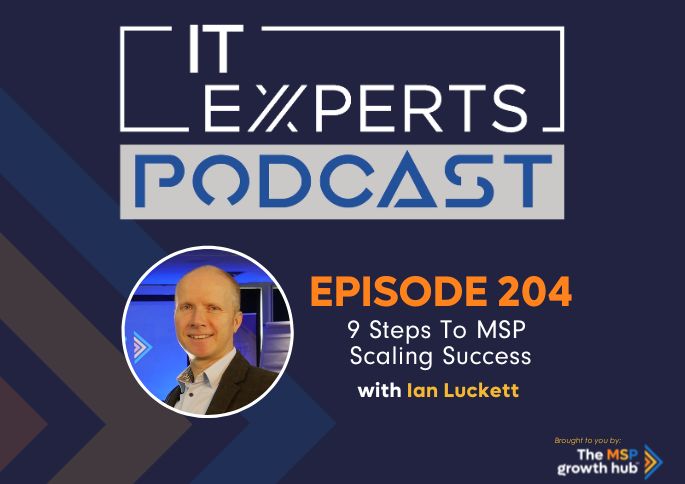
INTRO: In this episode of the IT Experts podcast, we help you understand the nine key steps to MSP scaling success.
Welcome to the IT Experts podcast, the only podcast to help MSPs scale to 1 million. And if already there, get to five and go fast. At the end of the day, isn't it all about building a business that works for you rather than you for it? I hope you enjoy the show.
IAN: So good morning, good afternoon, good evening. Welcome to the IT experts podcast, wherever you are. Great to have you here. And I'm on my own today, unfortunately, because I want to run through with you the nine key steps to MSP success. Now, why are we doing this? What's the purpose of doing this? Now we have the scale with confidence model here at the Growth Hub, and we have just kind of revamped it a little bit and turned it into the MSP scale system because MSPs, inherently, when they know that there's something wrong when they know that they're not going fast enough, their team aren't performing as quick as they should be. They are in a bit of a rut. They may have built a decent multi six-seven seven figure business lost a couple of clients and then fallen back down like a game of snakes and ladders, but where you're not where you want to be in your business, you may even have hit rock bottom, you want to do something about it, but you don't know where to start.
So you start talking to the team and you try a few things out. You look at doing some marketing, you put out a few blogs, you put out some webinars, but no one's really interested. You just tumbleweed like flowing through. And the reason for this is because inherently as a techie business owner, strategy and understanding the whole sales and marketing planning accountability and all of that kind of great thing, are not really things that you wake up in the morning and go, great, this is me. I love it. I'm in flow. I'm going to get involved. And this is what I'm going to do effortlessly today. It's normally the technical side of things. And even if you are a typical kind of MSP business owner, and you're not technical, there's lots of things going on. There's lots of different moving parts in your business. And it's important to stay on track, and it's important to stay in place. Now you might have tried some marketing. You might have tried some pre written collateral, and that didn't work. You might have tried using some LinkedIn. Getting somebody to do some lead generation lead generation is a really interesting one for the MSP space because it's around when you're securing a new client, it's around building that relationship, getting them to know and trust you. And if there's somebody on the phone who's on a sales quota and they're selling, selling, selling, and all they want to do is get that contract signed, that's not going to come across as your company values, as if you're going to be caring about things, as if you're going to be, really getting involved in their business and understanding how technology can actually help their business. And it's making sure that you understand and know what the next process is and what the sequence of order is because You could go into GPT How would I grow my business? But when you're asking it to grow an MSP, it might be a slightly different.
So today I'm going to run through these nine key steps so if you're stuck in a rut, if you're bogged down, if you're not making money, if you've got 5 years left and you want to work out how to double the size of the business and your profitability so you can get a really great exit, then you need a framework and you need a way to move things forward. So let's run through those key steps now.
And number one really boring this one, you're going to love this one. It's going to be around building that growth plan. But there's different elements of a growth plan that are really important to understand. You've got to understand your numbers, you've got to understand where you're going, you've got to understand the vision, you've got to understand the maturity of your business. And I'm going to score every element of the business so that you can see which area you focus on. When you have a plan when you have a growth plan then it helps you to stay on track many conversations we're having in the Growth Hub right now is, I've come back from holiday. Everything's been okay while I've been away, but I've got to get back to my plan and isn't that incredible? They've got to get back to their plan because they got a plan and they know what they need to do. So the best thing about having a plan is that you could actually go back to after having a large client delivery or a large client, project delivery, or something like that or a holiday or a bit of disruption. You can actually go back to your plan and pick it up where you left off if you don't have a plan then what's going to happen is you're going to end up just wandering around working out what's the next thing to do and you might bump onto LinkedIn and someone might show you a little shiny ball probably a bit of technology and you'll go off and you'll go and do that and you'll be distracted or your team might be pulling you in pillar to post but your team might be pulling you for their priorities rather than your own priorities. So setting that plan is really important. Understanding what's in that plan, how you're going to measure that plan, but more importantly, what are the frameworks and what are all the different things you're going to do to achieve the goals in the plan. Because you know what success looks like. So you've got your plan in place. Number one, great stuff, right? We are off. The runway is off.
Number two is how you bring the plan alive. It's a great job having a plan in your head, isn't it? Wonderful stuff. You're going to run a really successful business in your head. No, we need to share it with your team. And there's strategic frameworks. Ignite strategy is one of the frameworks that we use here at the Growth Hub. And it helps you to encapsulate your plan, encapsulate the vision, the mission, the values of the organization. And understand how you're going to get everybody to get excited and get your staff engaged. Many people have teams are doing okay, and I used to say when I was in corporate, the team's okay. But are they the team that you would have if you actually paying your own money for it now, you are paying your own money for it. In this space, you are paying absolutely your own money for these people. So we want to make sure that everybody's delivering a return. Everybody's engaged. Everybody's living the values. Everybody's understanding what the organization structure is going on, where are you going and what success looks like. And inherently, this has normally been quite a scary thing for most business owners to do because you're going to feel a bit vulnerable, right? Sort of telling them how much money you want to make. But don't talk about profit, just talk about turnover, or just talk about clients if you want to take it to a less granular level. How many clients you want, what sort of technology you're going to be using, what sort of systems you're going to be using, how you're going to make their life easier. But it's really important that we get all of this information into a plan that they are going to get excited about, the team are going to get excited about, your suppliers are going to get excited about, your account managers or your vendors are going to get excited about, your shareholders, whoever they may be. And you know what? Your friends and your family can get excited about it as well because that's what's going to help you build that business that works for you rather than you for it. It's going to help you afford the lifestyle that you deserve for you working so hard for this MSP.
Number three, knowing your numbers. We mentioned this quite a bit. This isn't just about knowing your numbers, knowing what's in the bank, how much you may have in your VAT account. Yes, we seem to be okay. What we're talking about here is intrinsically knowing. how much money and profit and gross profit and net profit and profitability of each client, understanding what your systems costs are, making sure you've got no waste in the costs, taking data from your PSA, crashing it against your accounting software. What does that look like? Is that an explosion of joy or is it a big hole in the ground? Have you got a problem? Because unless you understand, the levers of the business that you need to pull because of the different accounting frameworks of your costs. The value coming in and all that kind of great stuff. How do you know where to focus? How do you know what's the best tool to use to make the business more efficient? What's the bottleneck in your processes that's going to make the business more efficient and more profitable? Because guess what happens when you become more profitable then you can invest in you can invest in the right tools, which is going to make your life easier, which is going to make the business more, attractive to people who might want to come along and purchase it off you in many years to come. So knowing your numbers is ever so important. Even down to cashflow, the amount of people that we see who don't do a proper cashflow. How do you know you can invest? How do you know you can afford to invest? How do you know you can afford the right people if you don't actually know your numbers properly? If you don't know your numbers, there are many people out there who can help you understand your numbers. And many people who are working predominantly just in the MSP space doing that as well, which is really cool.
Number four is optimizing your account management. Many people, MS business owners. I just need sales. I just need leads. I just need sales. I just need leads. Not really interested in this marketing bit in the middle because it's a bit complicated and it takes too long. You don't, most MSPs don't lead you leads. And I remember Stuart writing a blog many years ago called “What Would Break First”. If we put one, let's go all in, two new clients into your MSP a month. Could your operations handle it? Could your people handle it? Could your systems handle it? Could your account management process handle it? And most of the time the answer would be no. One client a month for many MSPs is an absolute major result. But if we actually go back and we have a look at the account management that you're doing here. So we're nurturing the clients. We're going back and we're not just talking to them and doing QBRs and TBRs. We're actually understanding their businesses. We're becoming their technology partner. We're working out that we're their trusted advisor and that they come to us for all the technology. Then you start to have a much different relationship and many MSPs can use a really great account management process and maybe some tools as well. And they can just every single year just generate I'm going to say it generate hundreds and thousands of pounds worth of revenue that's sitting there in your client base right now And as soon as you go and get a nice suite of packages together that suits them with the right security that's protecting your business and all of that kind of great stuff. Then guess what's going to happen? You're going to start untapping and picking that low hanging fruit. So making sure you've got that account management process. And when we talk about account management, this is the end to end process, right? This is from when, literally when somebody just about becomes a client, just before they become a client, all the way through their life cycle to when they leave. And it's not. Although it is the many times it's the owner's excitement of actually doing this job doing this work because they enjoy talking to their clients, they enjoy making people happy. And they also joy bringing in new business. The thing that we need to remember as well is that once you start to leverage your process, so you give your help desk manager, you could even have a special account manager, you could have a project manager for professional services and you give them parts of that process as well. Then all of a sudden, you're then picking that low hanging fruit, probably when you're sleeping or maybe even when you're on holiday. So low hanging fruit is the absolute golden goose that is there for many MSPs. So making sure you've got a good account management process.
Number five is building the dream team. We run webinars on how to build the dream team and different things all around the sales and marketing. If you want to know about that, shameless plug, go and check out the website, MSPGrowthHub.com forward slash events, scroll to the bottom, and you'll see there's a whole load of recordings, but you can't do this all on your own. And many MSPs have a flat structure and many MSPs operate what we sometimes call a parent and a child relationship. So you're the parent being the owner and everyone else are children, metaphorically speaking. But they are following your shadow. They are doing exactly what it is that you're telling them to do. They are not thinking of themselves. So they're interrupting you constantly. They are not coming up with solutions because you're the one who always gives them the answers and just by deploying a few little tips and tricks and making people wait and making people think and giving people a really good quality kind of skills matrix so that you can see and they can see as well where their role is going and where their skill sets are going. Many people want just on a skills matrix thing, slight digression here. Many people do a skills matrix, and they go, oh, go and fill out some training. So it's all green. And so that we, everybody's all compliant to their level one, two, and three skills. No wrong. Go and work out the skills matrix and then work out what you actually need in your business to get you some headspace. The first thing is about getting you as a business owner, some headspace. Otherwise you're never going to spend some time on what we call the thousand pound tasks, which are all around the strategic tasks and the really high-level tasks that are going to move the needle and going to make some really big things. So looking at your team, making sure we understand, have you got the A players in place? Have you got a senior leadership team or even senior people being developed? What does the structure look like? Because we need to get you some headspace. That's what this one's all about.
Number six is then. Embedding operational excellence. If you're not careful you are going to be sold to by all the vendors by all the little shiny tools by all the little oh, you can do this and oh you can do that. But every single week we have interactions with our clients and every single week they have coin a phrase here overbought certain tools because some of them haven't been deployed properly. Some of them have been deployed properly, but then there's features on there you didn't even know that you use. So you went and bought another tool to solve that problem with the quoting tool on it or whatever it might be. You might buy another tool for your remote monitoring or can actually bring that into my PSA. But the most important thing with this is that if you haven't got connected, consistent and accountable processes that are aligned back to your dream team. Forget your PSA, forget your RMM, forget any technology because all of those technologies will help you operate your RMM. Systems better more efficiently and probably with a bucket load of automation, but they won't build it for you. they won't help you create that ethics of what does a good ticket closed look like. What does a good number of tickets closed look like? How many hours a day? Should I be working on the help desk or should I just be sitting there texting my mates all day long and just book it down to a client. So it's understanding who owns the processes. Are the processes connected? How are they connected together?Where's the bottlenecks, normally bottlenecks in operational processes happen at handover points. So between sales and operations, between projects and the helpdesk, between account management and the helpdesk and making sure that you've got all of that in place. So when you get your operational processes in place, your customer satisfaction is going to roar. Your account management process can be even more powerful. Your team are going to be super happy because they're going to be nice and efficient and everything's going to be working well and your ability to scale faster improves.
So talking on improvement, we have now got number seven, which is around improving the team's performance. So you've built the dream team. You've got the right team in place. You've got the right people in the right roles. How do we now engage the team? Motivate them and get them really embedded into the business. So this is with accountability, making sure people have got targets, making sure people have got a purpose. There's a reason for them coming into the office every day. There's a reason for them caring about the customers going over the extra mile. Are you measuring them against your, what does that look like? Have you got company values? And also we want them to grow and align with your clients as and when your clients grow. But you also want them to grow and align with the team as well. So you could have some emerging people, you're thinking of them right now, who will make great A players. They would make great senior leadership people. And if we can actually bring those up, and if we can identify people who are going to be potential A players, going to be potentially those senior people, then we can start to help and support them. Because it's all around their behaviors that's going to help them to drive the business forward and drive the teams forward and help go over and above with their day to day roles as it would be.
Then and only then do we get to stage number eight, which is around creating magnetic marketing. If you don't do any marketing at all as an MSP, then you are, it's just going to be the race to the bottom on price. That's all it's going to be. You're going to look like everyone, you're going to smell like everyone, you're going to sound like everyone, and you're probably going to do everything that the same as everybody else is doing. And that's fine because do you know what, if that's what you want to do and you've got to this stage in this podcast, then you're doing pretty well to still be here. But it's all around how do you stand out from the crowd? How do you stand out for the competition, understanding your client's needs, partnering with your businesses. We've mentioned before you might be working in a business sector. You might be working in a location where you are known as the technical expert for this size business, that size business, this location business, whatever it might be. The number one thing around marketing. It's about being consistent. It's about building an audience. It's about regularly communicating with them. It's around adding value, but more importantly, educating them in why they need what you do. Educating them in why they need what you do is the most important thing. And it's the hardest thing that MSPs can get themselves together and in terms of in terms of understanding, because as a technical brain, you're not wired in the way to work creatively with all these great images and videos and blogs and all of that kind of great stuff. Break it all down, put it into a little model, put it into your way, understand what your system looks like, and then start talking about it. The easiest way to really get started with your marketing is spin yourself around in your car seat. Go and have a chat with your customers. Go and have a chat with your existing client. What is it you do? How do I help you? What does that help you overcome as a business? What does that help you do as a business? And make sure that you are then using that information, using that language and that tonality in your marketing. And when you've got your marketing up and running, then you're going to get more eyeballs on you. You're going to get more people hitting your website. You're going to get more people connecting through LinkedIn. You're going to get more people coming to any events or listening to you if you're doing any speaking or anything. Because then it's around building your sales engine. Now, sales for MSPs, if you do your marketing right, should actually be pretty straightforward. Quite straightforward process, as long as you've got a sales process, that is and moving you from, a trickle of leads to installing a sales engine that's going to constantly deliver new business is the last thing.
The stages on this, the steps of this system, they are, this is number nine, but it's around eliminating friction. So when people come in, people come into your world and they're at the, they're at the final stages of closing, they've already been educated. They've already understood what you do. They already understand how you work, what results you get for your clients, how much it costs and all of this. So closing should actually be really quite simple process. It's the beginning of your sales process. And if the beginning of your marketing has been effective and you've educated properly, believe you me, this absolutely works. And if you get a good sales and marketing engineer that could deliver you one lead a month, and you could get your referrals that are coming in at one lead a month. Guess what? Or even two leads a month, then all of a sudden you're going to be looking at bringing in one, two clients a month. You're going to really start to take the doors off.
So look, this was a really short, sharp blast on the podcast today. What I've just explained to you. Is the MSP growth hubs MSP scale system. This is the process that we use to help our clients build a million pound business profitably. And if they're already there, we help them get to five and go faster building a business that works for you rather than you for it.
So if you've got to this stage, if the title's been interesting, you're at this point in this podcast and you're feeling, uh, oh my God, you know what to do. Hit the website, book a call, reach out to myself or Stuart on LinkedIn. And if you're not ready to get any help right now, go through these individual stages. Please just write them down on a piece of paper. And each month just focus on one of them. Focus on one of them. What does good account management look like? What do I need to do with my team? What do I need to do with my growth plan? Do it yourself. Absolutely. Give it a go. Do it yourself. No problems whatsoever. You will transform not only your life, you will transform your family and your friends lives. You will also transform your business and the people who are working with you. That's it for me today. I hope you enjoyed this show and I really look forward to catching up and connecting with you soon.
So remember, if you want to scout and grow your MSP, there are no secrets out there, but are there some systems and some processes that you need to follow? Follow this one, give it a go and please let me know how you get on. See you all soon. Enjoy the rest of your day.
OUTRO: Wait, wait, wait, wait, wait, just before you go And if you're curious about how this episode links with the ability to scale your MSP to a million or if you're already there Accelerate to five then we want to invite you to come and take the MSP mastery quiz and in just three minutes You're going to get a 300 seats with a free scan of your business where you can identify the one or two tactics that help you Find more time engaging along your people and help you grow Generate more leads in your MSP. It's really simple, just click on the link in the show notes. And if you have enjoyed this episode, we'd love to get some feedback from you by means of a rating, review on Spotify or iTunes or your podcast platform of choice. We really appreciate every single one of them. Now you can go and enjoy the rest of your day, and we look forward to catching up and connecting with you soon. All the best out there.

The MSP Growth Hub is designed specifically for IT & MSP Business Owners who want to build a profitable IT & MSP business.
The MSP Growth Hub
Suite 215
Jansel House
648 Hitchin Road,
Luton, Beds
LU2 7XH
OUR TRUSTED FRIENDS OF THE GROWTH HUB