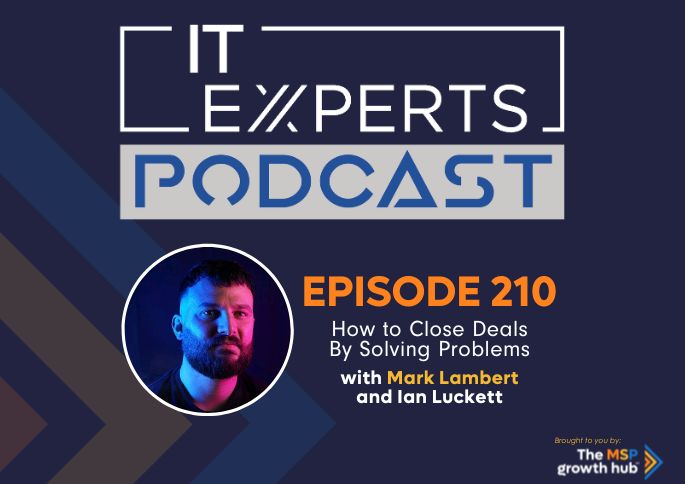
Mark Lambert shared practical insights into why selling the tech alone won’t cut it in today’s market. Instead, he stresses the importance of focusing on outcomes that matter to your prospects, such as improving productivity, enhancing security, and solving tangible business challenges.
As Mark explains, clients don’t care whether you’re using Office 365 or the latest security stack; they care about how you’ll help their business thrive. This shift from a tech-focused to a problem-solving mindset is critical for any MSP aiming to scale sustainably.
We also discussed the right time for MSPs to invest in a dedicated sales function. For businesses under £1 million, Mark emphasised leveraging low-hanging fruit within existing accounts by deepening relationships and improving client retention. However, once an MSP is on the path to £5 million, building a dedicated sales strategy becomes a priority. This includes hiring the right salespeople, integrating them into the business culture, and aligning them with your values and goals.
Mark highlighted the dangers of hiring a salesperson too early or without the proper alignment, which can lead to short-sighted sales tactics that undermine long-term client relationships.
One of the key takeaways from Mark Lambert’s approach is the concept of consultative selling, which he believes should permeate the entire MSP—not just the sales team. Consultative selling is about deeply understanding your prospects and clients, their challenges, and their goals. Mark stressed that this isn’t the job of one person; it’s a company-wide mindset.
Whether it’s your service desk collecting insights from clients, your marketing team creating educational content, or your leadership team championing values, everyone plays a role in creating a culture of trust and value-driven relationships.
Mark and I explored the challenges of navigating cold outreach in a world where traditional methods like direct LinkedIn messages often fall flat. Instead, Mark advocates for a more tailored and personal approach. By leading with value—perhaps highlighting a productivity gap or a security concern specific to the prospect’s business—you can initiate meaningful conversations without resorting to salesy tactics.
Mark shared that while cold outreach still has its place, it’s most effective when backed by thoughtful preparation and a clear understanding of the client’s needs.
Another golden nugget from this conversation was the importance of discovery in the sales process. Mark stressed that a thorough discovery process helps uncover the true pain points of a business and builds trust along the way. He shared how asking the right questions—and going deeper when needed—can identify not only the problems but also the urgency behind them. This positions you as a trusted advisor rather than just another salesperson.
Mark’s advice: don’t be afraid to ask questions and listen actively to uncover the core challenges holding businesses back.
One of the most memorable moments of the episode was Mark Lambert’s reminder to always create urgency without applying pressure. It’s about helping prospects see the value and importance of solving their challenges sooner rather than later. By presenting yourself as a problem-solver, you’ll naturally guide the conversation to a point where prospects ask, “Is this something you can help me with?”—a clear invitation to close the deal.
Mark’s practical tips and insights were incredibly valuable, and his perspective on embedding a consultative selling approach across the whole MSP is a game-changer. If you’re serious about scaling your MSP, this episode is packed with actionable advice to help you move forward.
Before you go, don’t forget to check out another related episode, EP174 – Ask Stuart #12 – Why You Don’t Need a Salesperson Now… Or Ever with Ian Luckett & Stuart Warwick. It’s a brilliant companion piece to today’s conversation, exploring how MSPs can maximise their sales efforts even without a dedicated salesperson in the early stages.
To continue the conversation with Mark Lambert or chat with him on how to get started closing deals by solving problems, book a slot directly on his calendar by clicking HERE.
You can also connect with Mark Lambert on LinkedIn, simply click HERE.
Or you can also check out his website HERE.
Connect with Ian HERE on LinkedIn and also Stuart by clicking this LINK
If you’re ready to take the next step in supercharging your MSP, take the Scale with Confidence MSP Mastery Quiz. This tool is designed to help you understand where your MSP stands and what steps you can take to scale profitably and effectively. This will provide you with insights and guidance tailored to your specific needs.
OR to join our amazing Facebook Group of over 400 MSPs where we are helping you Scale Up with Confidence, then click HERE
Until next time, look after yourself and I’ll catch up with you soon!
INTRO: In this episode of the IT Experts Podcast, we're going to help you work out how to close more deals by solving more problems. Welcome to the IT Experts podcast the only podcast to help MSPs scale to 1 million and if already there, get to 5 and go fast. At the end of the day, isn't it all about building a business that works for you rather than you for it? I hope you enjoy the show.
IAN: So good morning, good afternoon, good evening. Welcome to the IT Experts Podcast. We've got a cracking show for you today, all around how to get more sales by solving problems. And we've got Mark Lambert in the house. Mark is a MSP sales strategic expert. Welcome to the show, Mark.
MARK: How you doing, Ian? Nice to be here.
IAN: No, that's absolutely great. Thanks very much for your time and, not only preparing the show, but for today as well. So what are we talking about? We're talking about how to close more deals by solving problems. And many times you hear me bleat and rant on and many other people about stop selling the tech people are not buying the technology, they don't care whether you use Office 365 or you're using any particular vendor for your security stack or whatever it is. They want the business outcomes. And today, Mark is going to help us to put a bit of a framework around how do we actually do that? How do we remove the ability to talk technically when you're talking to a prospect, why you need to talk, non-technically and all of that great stuff. So we've got a real bumper of a show for you today. So Mark, before we get cracking, just give us a bit of a headlines. Who are you, what'd you do and who'd you help?
MARK: Yeah, sure. So yeah, Mark Lambert, been in business for 12 months now. I help people to grow their MSPs. I've always been in technology. Absolutely love the scene, love the fact that it's ever evolving. And sometimes technology goes too fast for even sales. So I basically go to MSPs and I talk to them about their business, their strategy, how that merges into the sales arena and how well that's going. Sometimes it's going great, sometimes not so good. And yeah, just all about helping people to expand their businesses.
IAN: Fantastic. And congratulations. You've just won a local business award, haven't you?
MARK: Yeah, really excited, just on Wednesday. Actually, it was start up of the year for the Burton Chamber of Commerce. Yeah, it's flying around right now.
IAN: Congratulations for that. We'll work on a national award for you next time then the international and then we'll be working, we'll start from there. So congratulations. Well done on that. Let's just talk about what is the problem here? So we've got sales. Most MSPs need new sales. Okay, need more seat, need more leads. We did a podcast recently about why you don't need a salesperson in your MSP. So it's great that we're now going to talk about why you do need a salesperson in an MSP. So let's put some caveats in a little bit of context around that, that podcast was all around MSPs under a million pound and the fact that you don't need to have to go out and worry about getting salespeople in and hiring salespeople, training salespeople, because you should have enough low hanging fruit and opportunity to improve relationship and revenue and turnover within your existing account base. What we're talking today is when you get to the point of when you're normally a kind of a seven or multi seven figure MSP, you've got a really great solid account management. You've got a great operational base and the business is working really well and you want to supercharge it. And the way to supercharge it is getting out there, get your shoe leather on, get out there from a sales point of view. And that's what Mark's going to run through today. But this is where, some of the dangers that we see, Mark, isn't it? With sales in MSPs is that if you're not careful and you hire the wrong salesperson, they're going to be very driven on just selling when this is actually a really personal relationship, isn't it? With no and trust. Give us a little bit of context and what you feel around, what type of when is it the right time for an MSP to think about a salesperson in your view, or at least a solid sales strategy?
MARK: Yeah, sure. It's a build on what you said, really. In that sort of naught to a million phase, it's about having the retention within your existing clients. It's about building trust within those existing clients. And it's all about making sure that those clients are serviced well enough to grow. And people do put that sort of pressure on themselves when they get to that seven figures. And in my experience nothing really changes to be honest with you. You just got to think a little bit further ahead rather than doing your quarterly business reviews and going and having a cup of coffee and a packet of biscuits with your existing clients, it's got to be repeatable on a weekly basis, a daily basis from an outbound sales perspective. And that doesn't mean that you're sitting there call calling everyone to the cows come home. It means that you're building the same trustworthy relationships with new people. You've got that trust in your existing base and you should have the confidence of that to take that forward and to speak to people about their business challenges. Because sales, like you say, it can be a dirty word, in, in modern day, it's about building trust. It's about building relationships and it's about building the foundations for that to overcome that business challenges because every organization out there has got a challenge in some way, shape or form.
IAN: So let's just talk about some timescales to start with, just to put some context around this. And I'm probably going to walk through your the structure for the show today. I go to a networking event. I'm a new salesperson. MSP, I'll go to a new networking event. And I'm starting to talk to people. This can be a. 6 to 12 month thing, can't it? Before someone's ready to buy in your relationship. What's your view on the time scale and setting, setting expectations on from when you see someone who's cold from a cold outreach point of view. They don't know you, but they don't know like they don't like you. They don't trust. They don't know that they need you. I think that's the most important thing. What's your view on patience with sales?
MARK: Well, networking is probably the longest game that You know, I've ever played in my life. I don't think that anything's really happened for networking even in the last 12 months from a coaching and consultancy point of view. People know what you do, but they're hesitant to dip that's her into those deeper questions because They're anxious that they're, you're going to get them, so to speak. And
IAN: Right. Okay. They're going to get sold to?
MARK: Yeah. And from an IT point of view what works really well is, don't mention IT, don't mention IT. I find that when we start to introduce topics like productivity data loss prevention those types of topics, peak people's curiosity, because They don't, they're not thinking about data loss because they're in their business. They're not thinking about productivity because they're in their business.
But when you have real world problems, like recently the budget it becomes a real world problem really quickly. And they're thinking okay, where do I get this extra bit of cashflow or extra little bit of profit just to perhaps cover my overheads, let alone
IAN: Yeah.
MARK: And that's a really interesting point because IT now for me is a standard in any business. If you want to grow, you have to be utilizing IT. Simplifying that IT journey is what's crucial to small businesses moving up to 250 seats because they'll have a grasp of some of it. But they won't have a grasp of everything and building that trust from a business level is fundamental in my opinion.
IAN: So, whether you're putting out content around, lead magnets to start conversations off or whether you are talking to people at an event or whether you're speaking at a local chamber of commerce or a learning lunch or something like that, don't mention. So we're actually going to a different level here because I've always said don't sell the tech, but what you're now saying is don't even mention IT, don't even mention IT. Just talk about productivity data loss can we can we mention the security word cyber security?
MARK: Yeah, definitely. It's huge, obviously, I think I'm seeing two things, really. I'm seeing the late comers talk about it as cyber security, but I'm also seeing the sort of the pioneers drop that back into an expectation level. Now, we see on the news probably daily, if not, maybe a little bit less frequently, but cyber attack this cyber attack that and there's an expectation there now from some end users that if you're a managed service provider, that you are going to take care of me. I'm effectively unloading all of my issues onto you, the managed service provider, and that can bring its own challenges within itself, of course.
IAN: Yeah. Let's talk about what we call consultative selling. And I'm interested in getting your viewpoint on this because your point is that this isn't just for one person, this isn't just for the salesperson to do this, isn't it? This is the whole business needs to understand this. So how would a number one was consultative selling and number two, how does who needs to champion it across the business and how do they champion it to for it to become? I guess it needs to become kind of part of the culture, part of the company way, doesn't it?
MARK: Yeah, so you've got, Jack, the loud white boy going around in his car, zooming around, seeing people dropping off papers at the office and then running off to the next one, the world's massively changed. We even can use technology now to not have to go back to the office of salespeople. But I think what a consultative sale is, we're able to understand the person that we're talking to and that's really complicated in some aspects anyway, because we could be speaking to a CEO who has a different agenda to a CFO who has a different agenda to a CTO, we could be speaking to influencers, managers, and not actually get into where we need to be within the hierarchy. Consultation is understanding who has what role within an organization and essentially bringing them all together to have this topical conversation. And in 2024 that really is all about the whole business. So the whole MSP talking about their values, their route to market, their ideal customer and having that into the marketing piece and storytelling there's a lot of content out there on the web and there's lots of video platforms, lots of blog platforms where people are reading and consuming content and making up their own mind, who they align to because of their values, and brand value is a big part of that. And depending on what you're looking for as a consumer, because let's face it, all businesses are consumers, whether they like it or not, they've got to align or feel like they're aligning to somebody to be able to carry that conversation forward. And that's when you start to get into the, we've got a problem with phishing emails. we've got a problem with backups, not backing up on a slow internet because we back up at the wrong time and things like that. And obviously all of those business challenges.
IAN: I think what you've just laid out there, I think is a really, there's a chart here for you, Mark. I'll give this one to you for free. What you've just explained to what I've just heard is that not only do we have multiple levels in the MSP on, senior middle management, lower management, help desk, on what they all on the conversations that they're going to have, but if they can then map them to, a prospect or their existing clients or their prospect, depending on where they are on that scale, then there's this, who wants what and who wants who wants what and who needs what from the business that, that then gives a different level of language. So normally is that a, we're going to talk a little bit about the process of, about consultative selling and how that goes is obviously the first bit, there's a little bit about discovery on who we are, what we do. And you've mentioned the V-word three times this morning before me, which is incredible because I bleat on about it all the time, but you're talking about brand values, the value, who are you? How are we going to behave when we work together. What's it going to be like, is it going to be fun, is it going to be trustworthy. And all of that sort of thing. And it's lovely to hear you say that because, we truly believe as well that's so important. So once the I'm going to make the wild assumption, this needs to be led from the top. So it's either from the owner or the senior leadership team, and they need to behave in such a way across the business develop this consultative selling once they know they need to do it and that this is the way of this storytelling and all these other things you've just mentioned, how do they build that into a process? What does the process of that look like? Because, as we said at the beginning, it's not just about bringing in one guy in a Ford Escort. I'm going to show my age and go out and do some selling. This is everybody's job. So how does that now work within the MSP?
MARK: I think if you look at your technical people, they need to embrace it. You've got a service desk of However, many people that may be and that they're looking at tickets. They're looking at constant client interaction. That's a real good resource of knowledge, it's important that the business embraces that. It's important that the business is able to take what they say and put that into a, into either a brainstorm or some sort of roadmap or talk about it at that senior level to get some real world feedback as to where the problems are and where they can potentially, talk about that and educate to attract new users.
IAN: I think that's great. And we always say one of the hardest things in marketing and sales is getting content, but one of the easiest things for an MSP is Friday lunchtime, go and get some pizzas, sit down. We helped us and go, guys, what's gone wrong this week. How did that make them feel? What was the impact on that business and record all of this information? Cause that is your business problems. That's the business issues that they've had that you've solved. They don't know that they've solved it and just keep asking and digging the questions in there. So I think the technical I think that technical knowledge is absolutely, it's absolutely critical for them, which is a great point . So we're mixing a little bit of the account management and the new sales here because we were talking, we've got an opportunity here within the QBRs and TBRs to make sure that we're doing that as well. But If we're going out to a cold lead, or I'm going to say an unknown lead rather than a cold lead actually, no, let's just dig into that one for a minute. What's your opinion and view on cold outreach, cold calling, cold, literally going out to people. Does that still work these days? Is there, is it still a numbers game or do we need to get a bit warmer with the leads before we start approaching people?
MARK: My personal approach is more of a personal approach, as a sort of, a third party within an organizations that I'm working with it. I have to have that personal touch almost a trust before I've even, met them. But there is definitely a place for, cold outreach because before that warm intro or that referral or whatever it may be, you've got to have built some value somewhere.
IAN: Yes. Yeah.
MARK: And by doing that, it's about what that holdout, which looks like, you've gone on the days of, yellow pages, A to Z. Hello, my name's Mark. I'm calling from X, Y, Z company. I'm here to sell you IT. It needs to be a little bit more defined. It could be hello. It's Mark, I'm calling from company XYZ. I was looking to speak to the person about your data loss prevention or it could be, did you know that on your website that you've got a contact form that enables you to, be phished because it's not compliant and that not scaremongering, but that informational led opening will at least get to the point where someone will, Talk back to you and it's not an exact science. I think that people will just ignore you, ‘cause that's the numbers game that you refer to. We're talking about service clients here that are spending, a significant amount of money on a per month basis. A managed service provider is not a, it shouldn't be, I should say, a high and wide scattergun approach of let's just get people through the door because if you're on board in that's no good for your service desk. If you've got different tech stacks, if you've got different people with different requirements from different industries, it's diluting your technical ability. It's diluting your in house ability to become streamlined. And that would be contradictive to the consultative sale and being able to actually turn around to people and say, we can manage your IT in a streamline. In fact, we can increase your productivity. And so on and so forth.
IAN: So what we're saying is that there's always, you always need to start at cold because they don't know yet, but go from cold. You're going to like this one, mate. Go from cold, but not cringy. So tailor the approach, personalize it, find something on their website, not to scare them, but to add value to them so that when you have a conversation with them, you can resonate with them. where they are, who they are, what they're doing, who they know, who they're connected with or anything like that. Because this is just about a right fit at the right time, isn't it? At the end of the day. And that's all you're trying to establish. I'm not trying to, you are trying to sell stuff to them, but we don't sell on the first date.
MARK: No, it's pipeline. It's pipeline at the end of the day. I'd be very lucky to pick up the call this morning and someone say, come and sell me services straight today. And I'll sign up, I'll sign up over the weekend. It. It's multiple conversations on multiple levels at all times that are relevant. About this morning, for example not related to business, but someone that I do work with, I'm speaking to them at quarter past eight, managed service providers don't really have that mentality. My experience, but if that calls the right time for that, for the person do it. I'm not saying that we don't work. Round the clock because of obviously you've got to find that work life balance. But I think that people appreciate to be readily available and to have that conversation when they're ready.
IAN: Absolutely, your go to advice or strategy if someone's got this kind of concept all lined up and they know what they need to do, but they just need to go and find some people, they need to go and find some prospects, what are you hearings working right now? Because since the pandemic, before the pandemic, direct messaging on LinkedIn was bad, pretty successful to be fair, but it was a lot of industries, but now everyone's been sitting in the bedrooms over the pandemic and they've all now decided that I'm just going to get on LinkedIn and just spam everyone. It's just ridiculous how many messages you get and you get sold to every single day. And that's like a change in the evolution in the time, right? So what are some of the ways that working right now to go and find. those cold people and start those conversations.
MARK: I think it starts with the marketing function. Your marketing function is basically your ammo and your sales team are the ones that need to integrate to that ammo and use the gun in the right way. So to speak analogy, but...
IAN: I get it.
MARK: Yeah. And I think things that are certainly working out there are not those spammy LinkedIn messages, but building a relationship. Putting out there what the business offering is why you've contacted them, why that, why you feel there's value in a conversation and understanding your target market play into those strengths, because if you've got case studies in a certain area. It will attract people, for myself, most of the time I work from referral because I've got a case study of people that I've worked with it to their organization and they'll have the same similar challenges, but in a different context and from a technical perspective, from a simplified and a technical perspective. Also a business just wants simplicity, to simplify what they do from an IT perspective and to not have to worry about it. It's worry free, it's stress free.
IAN: So what you've basically just said is build the relationships, build value in, in us connecting, not sale not being a salesy, smash it in your face sort of thing. The one that just, I will keep screaming for about until there's no sound. No air left in my lungs is understanding your target market. And if you can then develop, as we talk about the marketing side of things, some lead magnets and some off some value based lead magnets, so either the, like the case studies or some quizzes or some assessments or things like that, where people can then resonate and move a bit further forwards. I think the latest stats I heard was that 70 percent of the buying decision, will be made before they've even contacted you or before you've even spoken to them because of, so it's around that content journey and understanding that, that target market, which I think is which is great.
MARK: Yeah, definitely. And, like technical world's massive on the back end. So you could be utilizing your vendors, you could be working with your channel managers to have. behind what you want to talk about. Obviously, Microsoft right now, it's all about copilot productivity, things that are cyber all about, how you take those levels of cyber security and use them for, cyber credentials. So that those types of outcomes where people are looking to so to speak in able to, in order to gain new business cyber essentials is something that is really quick, really simple. But if you can show as an IT organization that your cyber essentials and you're working towards the higher levels of cyber essentials, that gains value, gains trust, copilot, the same thing, Microsoft is an enormous beast now, with the whole three, six, five stock. And I feel like if you're educating your clients on how they can make it work for their business again, you're in a really good place.
IAN: Just before we wrap up, Mark, it's been very interesting talking to you and just reinforcing, but also a few little, a few new golden nuggets in there when let's just talk through the structure of a conversation. If someone was having with somebody who might know what they need, but rather than selling it on the technical side of things, what sort of guidelines have you got to help identify an opportunity to solve a problem and then how you'd solve it? Because many MSPs go I'm not going to tell him how to do it. It's Yeah, but they're not going to do it, are they? Because I don't know what they need to do sort of thing. So how do if you were in a conversation with someone and you were talking about, productivity, for example, how would you see that conversation develop into a, oh, that's what we do with technology, oh, tell me more about that. What does the lead up to that kind of sound like?
MARK: So I've devised a discovery document. It's all about discovery. If you discover everything, every little nook cranny about their business, where there's a challenge. Then they follow as long as you're building trust and you'll get, and they believe in what you're saying, but let's assume that we're on a second meeting, we've had a good chat around whatever that may be for that business challenges that to invite you back, that's a, probably a big step in a business ownership type of cycle because the time is valuable. Yes. So just like I say, it's all about the discovery and how they follow. You want to be talking about security measures. You want to be talking about existing infrastructure. You want to be talking about real simple ones at the moment, like the window, Windows 10, it's all over LinkedIn. It's everywhere. Like it's, and people are trying to use that as a, as an in again. Productivity is another one with like pink things out of budget, hiring, increasing costs. So I find that when you've done a discovery and you've got everyone there that there's a, it is an influence or a decision maker and they're agreeing and they're bouncing ideas off each other in the rooms. The more that they talk, the more you can just slot in a solution and part of being a salesperson, nowadays is great active listening. Again, back to the sort of old age of Jack, the lad talking sales is actually flipped. It's about listening and it's about finding the right solution to the business's issues.
IAN: And as we said, right at the top of the show, it's about that salesperson understanding the MSP, who they are, what they do, who they hel like in the deeper depths than anybody in the organization so that you can then go and build that trust and not sell and add value. And then it, as you say, it leads into those conversations when they are inevitably going to say the prospects is inevitably going to say the line. Is this something you can help me with, which in other terms means can you sell to me please?
MARK: And it's quite funny actually because you just used the word then people may have not caught which was intrinsic. When I was setting up my business I actually wanted to call, the business intrinsic consulting, because I wanted a lot of that part of that business embedded into that business. And that's how I like to operate with my clients. Unfortunately it was taken and I'm not the best at marketing. So it just came up with Mark Lambert. I'm sure we could have worked out as a site differently. Yeah. But yeah, again, it's just that the ability to hone in on what the actual issue is, and don't be afraid to ask questions either, if you think you've spotted an issue. But you're a little bit hazy as to what that issue is. You need to ask maybe two or three, four questions more to get to that pain point.
IAN: So making sure that you've got a discovery document, a good script that you can run through. I was actually talking to someone about this week, who's who I'm doing a bit of mentoring for actually. And it was just, he was about his confidence. He said I'm just not confident when someone rings up and stuff. I said just get a script. Let's just talk for a script. So we went through a script and it's exactly like your discovery document, not necessarily for confidence building, but from a point of view of making sure I haven't missed anything off and make sure I explore every single rabbit hole and every single, avenue I want to dig in because it is. It's about finding the yeses, but it's also about finding the nose. If they're not a good fit for you, get them out of your pipeline. If your discovery document and the conversation is going to be a bit clunky and they don't get it and they haven't got a budget and they think they can do it all themselves, then get them out of your pipeline, stop following them. And it's that, the method, the measurement on that, sorry, is very simple, isn't it? Good stuff.
Mark, what a great show. Thank you very much for this. And also congratulations on your first podcast. I'm sure this will not be the last because the channel will be listening to this. And before you know it, everybody will be reaching out saying, Mark, I need to get you on to talk about this great subject. Just before we wrap up. Top three things. What do you think the biggest takeaways need to be from this show from the listeners today?
MARK: Yeah, no, that's good. Thanks for having me on first. No problem at all. That was great, really enjoyed it. So yeah, so number one, I'd say definitely, embed consultative selling across the whole of your MSP, everyone's got to be on board. No silos right the way through service desk, marketing, senior leadership, sales plenty of conversation creating that buzz around sales.
Number two, you've got to nail your discovery. We touched on it throughout. It's about knowing what you're going to ask. It's about not being afraid to go deeper on certain topics because you're not going to hit all topics straight away. So you know, your discovery process and then continue until you get to where you feel you've got enough that is qualified. Because what you're trying to do there is it brings me on nicely to point three, which is you're trying to create urgency, but without pressure you're trying to create compelling reasons you're trying to you know, relate to the owner or the decision makers challenges. They'll want to grow, they'll want to make, be more profitable. They'll want to have more people that's the nature of business worldwide. So not being that salesperson, but having the urgency and the ability to turn that I need to be listening to the salesperson in order to get the solutions that I need in order to be successful in my business and to help my staff and so on and so forth.
IAN: Mark, once again, thanks for that. It's absolutely some massive golden nuggets. Just before we say goodbye just let everybody know how they can get in contact with you if they want to continue the conversation.
MARK: Yeah, I'm on LinkedIn. So there's a link below where you can connect with me. Drop a message into my DMS, but nothing salesy.
IAN: Don't sell to me.
MARK: We've been speaking about how it needs to be a little bit more subtle. I've created a link for a free half an hour discovery call. So if anybody didn't speaking to, to myself about furthering the conversation on today, you can also see that link below. And yeah, I've also, there's a link to my website. If you'd like to learn a little bit more about our background.
IAN: We'll put all those links in the show notes for the podcast and also in the in the show notes onto the website as well. So if you want to have a chat with Mark about some of the great work he's doing to help him get that national award, then that would be absolutely amazing. Once again, Mark, brilliant. Love the show. Loads of golden nuggets. Great stuff in there. Good luck with you and the business only for the rest of this year because we're cracking towards the end of it now, but in 2025 and I look forward to catching up and connecting with you soon. All right, Mark. Cheers now.
OUTRO: Just before you go, and if you're curious about how this episode links with the ability to scale your MSP to a million or if you're already there, accelerate to five, then we want to invite you to come and take the MSP mastery quiz. And in just three minutes, you're going to get a 360 degree scan of your business where you can identify the one or two tactics that can help you find more time engaging along your people and help generate more leads in your MSP. It's really simple, just click on the link in the show notes. And if you have enjoyed this episode, we'd love to get some feedback from you by means of a rating, review on Spotify your podcast platform of choice. We really appreciate every single one of them. Now you can go and enjoy the rest of your day and we look forward to catching up and connecting with you soon. All the best now.

The MSP Growth Hub is designed specifically for IT & MSP Business Owners who want to build a profitable IT & MSP business.
The MSP Growth Hub
Suite 215
Jansel House
648 Hitchin Road,
Luton, Beds
LU2 7XH
OUR TRUSTED FRIENDS OF THE GROWTH HUB