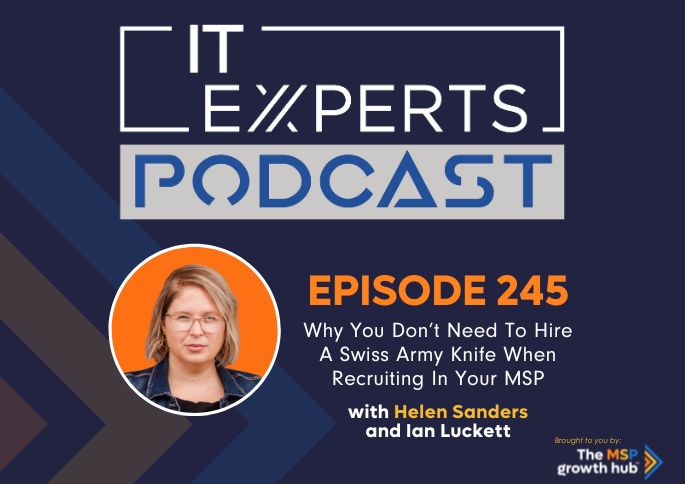
Helen Sanders brings over 25 years’ experience in recruitment, working closely with MSPs and tech businesses both in the UK and the US. Helen has built her reputation on helping owner-managed businesses move from frantic, last-minute hires to building confident, structured recruitment processes that allow owners to grow their teams with purpose and clarity. Her passion is helping business owners become great at hiring and creating environments where both owners and new recruits enjoy the process and stay for the long term.
One of the biggest problems we see in the MSP world is the temptation to bring in someone who can do a bit of everything. This “Swiss Army knife” mentality can seem appealing when the team is small and the need is urgent, but as Helen Sanders shares, it often leads to burnout, lack of clarity, and a team culture where people end up firefighting rather than thriving. Panic hiring is all too common and often ends in tears, both for the owner and the team. Helen is a firm believer that you are always better off taking your time, defining exactly who you need, and being prepared to wait for the right person.
Helen Sanders emphasises the importance of hiring for the person first, and the skills second. The strongest MSPs are those that are crystal clear on their culture, their values, and the kind of learning mindset they want in every team member. Helen’s advice is to look for people who are hungry to learn, who are actively seeking out new skills, and who naturally fit the business’s way of doing things. The technical requirements are important, but these can be trained if you get the values fit right. If you build a team of the right people, the skills and roles will take care of themselves as the business grows.
Another key insight Helen Sanders shared is the idea of always being on the lookout for talent, even if you are not actively recruiting. Rather than collecting CVs and waiting until you are desperate for a new hire, she recommends building relationships, keeping a warm list of potential candidates, and treating these relationships in the same way you nurture prospects in your sales pipeline. By keeping in touch and offering value, even when there is no job available, you position your MSP as a place people want to work, and you make it much easier to hire well when the need arises.
The conversation also explored how recruitment is no different from client onboarding. Helen Sanders points out that too many MSPs invest heavily in client experience, but then neglect the onboarding and experience of their new team members. This can result in a disconnect between what was promised in the recruitment process and what is delivered on day one. Helen recommends building a robust, people-first onboarding process that starts before the new hire arrives and continues throughout their career with you. This not only sets the tone for a great working relationship but also encourages new team members to refer others, strengthening your recruitment pipeline for the future.
Building trust throughout the hiring process is vital. As Helen Sanders highlights, trust is created through multiple touchpoints and involving the wider team in the process. This could mean inviting potential hires to informal team coffees, shadowing days, or non-interview meetings to see how they interact with the culture and values of the business. It takes the pressure off the traditional interview format and allows both sides to get a genuine feel for each other. Helen also shared that showing vulnerability as a business owner and being open about the journey can make a huge difference in attracting the right people.
We finished the episode reflecting on the importance of succession planning and building a business that does not rely solely on the owner. Helen Sanders offered practical advice on creating a deliberate, step-by-step plan for removing yourself from day-to-day roles over a three-year period, focusing on spinning fewer plates, and empowering others to step up. This is the key to building a scalable and sellable MSP, where the value lies in the team and the systems rather than the founder.
Connect with Helen Sanders through her LinkedIn profile by clicking HERE or send her an email directly at helen@talentjetgroup.com
Make sure to check out our Ultimate MSP Growth Guide, a free guide that walks you through a proven process to take your MSP from stuck to scalable, without working even more hours. It’s 44 pages rammed with advice, insights and inspiration to help you decide what support is available to you now if you want to grow and scale your business. Click HERE to get your copy.
Connect with Ian HERE on LinkedIn and also Stuart by clicking this LINK
If you’re ready to take the next step in supercharging your MSP, take the Scale with Confidence MSP Mastery Quiz. This tool is designed to help you understand where your MSP stands and what steps you can take to scale profitably and effectively. This will provide you with insights and guidance tailored to your specific needs.
OR to join our amazing Facebook Group of over 400 MSPs where we are helping you Scale Up with Confidence, then click HERE
Until next time, look after yourself and I’ll catch up with you soon!
IAN: In this episode of the IT Experts podcast, we help you understand why you don't need to hire a Swiss Army knife in your MSP.
INTRO: Welcome to the IT Experts podcast, the only podcast to help MSPs scale to 1 million, and if already there, get to five and go faster at the end of the day. Isn't it all about building a business that works for you rather than you for it? I hope you enjoy the show.
IAN: So good morning, good afternoon, good evening. Welcome to the IT Experts podcast. Hope you're all doing good today. We've got a really interesting show today. We've got Helen Sanders, who's an MSP recruitment expert. Welcome to the show, Helen.
HELEN: Hi Ian. How you doing?
IAN: Great to see you, and thanks very much for everything we've done so far, preparing for the show, don't need us to hire a Swiss Army knife. What are we talking about here? We're basically kind of saying that your, in a position where many people just hire somebody who just does lots of different things, rather being specifics. And what we're going to do today is we're going to run in the show about being really deliberate on who you are hiring, deliberate about how do you identify the right people, the people that you're going to trust and that are going to slot into that three year growth structure that you have got. But before we do that Helen, give us a little bit of a introduce yourself. Who are you, what do you do, and who'd you help?
HELEN: So my name is Helen Sanders. I run a company called Talent Jet Group. I'm based in Bristol, and for the last 25 years or so, actually longer than 25 years...
IAN: We can blur that one out.
HELEN: Yeah, I know. I don't look old enough. Thank you. You're very quick, you're saying that. Late nineties, I moved from a previous career into recruitment and started in tech recruitment. So hiring SAP project managers, which is really exciting at the time. And now the last 10 years or so, helping owner operated companies, primarily MSPs, but also in other tech spaces like robotics. Where I'm an embedded talent partner for one company in robotics. It's not that I do a lot of robotics, just one company. And then lots of lovely MSPs both here in the UK, but also a couple in the US as well.
IAN: Okay, cool. How's the landscape in your view right now? With everything that's going on, particularly talking around, a lot more AI and automation going on. We are hearing scampering of people saying it's going to get harder and harder for the smaller MSPs because some of the tasks for the smaller MSPs are going to be automated and the number of people working in MSPs could potentially be reduced. I don't know, is this real, is this not? What's your kind of view on the landscape for tech versus people versus we need some thinking and we need proper thinking. Where's your head at with this one?
HELEN: And I can think about that from a recruitment point of view as well. Yeah. They're saying exactly the same, but aren't, they say they...
IAN: They the same saying it's
HELEN: Every single industry that, oh, you're going to lose jobs are going to be wiped out. The thing is, I think, and this is, I'm being small business specific here, in any industry, not just for MSPs, but if we all use AI in an intelligent way. So can it help us with our marketing? Yes, it probably can. We probably still need someone to look at the copy. No matter how well you train your AI. Will it do first line support calls? Will your clients really want to talk to AI? I don't think we are there yet, but I did listen to some voice AI the other day and some big recruiters are looking at it.
IAN: Yeah.
HELEN: Can we transfer that into MSPs? I'm not sure that a legal firm in Robury really wants to talk to AI when they can't log into their systems. Not yet. It's not good enough yet. In terms of candidates, they're not particularly worried about AI? The people that are looking for jobs are looking for jobs and they're using AI to either help or hinder their job search.
IAN: Yeah.
HELEN: But that's for a whole other day.
IAN: That certainly is, that's a whole another podcast. Something that came out when we were talking just a minute ago, was around your love for helping the business owner become confident in great at hiring, which is counterintuitive as a recruiter, right? Because you could potentially, if everybody does their job properly you'll be out of work. I'm sure you'll find something else to do and I'm sure that's never going to happen. But what's your, kind of value set and thinking around this need to help the business owner.
HELEN: There, well, it's on a spectrum, those points of thought, aren't they, in terms of helping business owners become really competent, perhaps enjoy recruitment a little bit, perhaps? My ideal is that the people that I help, the business owners essentially, and their teams enjoy hiring, and then the people that join, like the experience. So not just the hiring bit, which I take care of most of the time, but, actually, once they've joined their experience within that company is as I said it was going to be. And if everyone's part of that process and everyone enjoys it that bit more, they're inherently going to become better at it because they're enjoying it. Something you don't enjoy the amount of people, I'm sure you speak to them. Oh, I hate recruitment. If you say you hate recruitment, you are not going to enjoy it. And that is going to come across. I know that sounds super simplistic. But it's true. If you are giving off that vibe, Bob, oh God, we've got to hire again. Because Bob left and he was brilliant. Second line for us that will come across for sure.
IAN: And isn't it funny how it's changed? Particularly kind as we've been getting deeper and deeper over the years into the channel that, when you are recruiting for someone, they're not coming to work for you. You are the business that they've chosen to work for. Which is two very different things because if you don't meet up to that expectation, they're off. And that's an expensive off, isn't it? If you are not careful. And so many times we, see it and hear it and I'm sure you do as well. And something you just said there triggered me was just around, that onboarding process and, if you had a client, recruitment is just like marketing. It's just like getting a new client. You have to attract yourself and you attract, become attractive and people come towards you. And if a client comes towards you, you look at your onboarding process, your account management processes, an MSP, and it's should be on point. And what they got sold is what they got delivered. But we don't do this when we recruit, do we?
HELEN: No.
IAN: We just let him in the front door. There's the tea, coffee, computer. Go and press some buttons.
HELEN: Yeah. You know how to be a second line over there, so therefore you know how to do it over here. No. When you go on holiday, the pool is always in a different place. So do you know what I mean? So just because and they're different rules, do you have to run down and get the sunbed at 6:00 AM. No. In this place, we take turns making the tea. I've seen some MSPs just companies generally have, pictures on the wall of the type of, the color of the tea of different team members. It's quite fun. They don't hold people to that, but it's just a fun part of it. Anyway, I digress. But yeah, it's yeah, the onboarding. And it's funny you should say this, because this morning I was working on it is a lead magnet. It's part of my marketing. But an absolute ultimate checklist. And it's literally a checklist based on one that I did for one of my robotics company. It is long, but it's so thorough. It's just brilliant. And it is a checklist. It's not paragraphs and paragraphs. And if you can do as much of that as you possibly can. You are going to stand yourself in better stead for the candidate as well as the team, and as well as for you. Because really the team should take care of more of that onboarding than you should as the business owner.
IAN: Yeah. Yeah. What are some of the things we talked about, you are on a mission to help the owners become good at hiring. What are some of the things that you see that make you cringe and make you think on earth, have you done that? You are running a really successful business. You are supporting 15 or 20 people's mortgages, and you've gone and done, ah, why did you, what are some of the common mistakes?
HELEN: Panic buying, panic hiring.
IAN: Okay. Interesting. Yeah.
HELEN: Oh yeah. We need someone. We need someone. So we better take the best of a bad bunch because we just need someone, because my team is starting to burn out. My team are getting stressed. It's worth waiting because if you panic by or panic higher.
IAN: Yeah.
HELEN: It will always end in tears. Plenty of yours. And your team will lose faith in you and trust in you. Very interesting. Trust is everything in business.
IAN: Yeah. Yeah.
HELEN: And your clients, you know that if you're hiring because you have to please wait, please find the right person. But a step before that, make sure you know who the right person is first and foremost. And notice I say the right person, not the right skillset. Hire the right person first and in small, MSPs that are four to 10 people. That is all about finding people that love learning, don't just say they do, but they do, they are doing Duolingo, they are looking at, a Harvard IT course that they can do over 10 weeks. They are learning, they're sponges. Those are the people that I find and identify, and then I work out. Whether they're right for that particular company. So that's not even personality, that's the sponge bit, the learning bit. You can't do everything.
IAN: Let's challenge that or not challenge that, but let's discuss that for a minute. A great thing that every business owner should be doing is a three year structure. What does it look like? How are we going to grow? And we do that based around roles and functions, don't we? Which is like around the skills. But you've just said we need to hire the people because we want the values and the culture and the behavior and everything like that. When does, you know this business owner wants to grow the business? They know that they're going to need probably another couple of techs and maybe a senior SDM, something like that. Maybe an account manager in three years time. When does that transition happen between, these are roles and these are the type of people that I need to put in these roles when I want to recruit. Does that make sense?
HELEN: I think the people bit comes first because I'm pretty sure that you and I have never worked with an MSP business owner who sets up the business going, do you know what I'm quite happy to have a bunch of a-holes in my team as long as they do what they, my clients need.
IAN: Yes, absolutely. No, I haven't met anything like that.
HELEN: So the people bit first.
IAN: Yeah.
HELEN: You know if you're a two person MSP at the moment, so you've got more than a job, but you're still on the tools essentially.
IAN: Yeah.
HELEN: I'm pretty sure you're not going, let's just hire someone who technically can tick everything on that job description.
IAN: Yep.
HELEN: If they're not the right person, if they rubbed me up the wrong way, I can deal with that. No one's saying that. No one's doing that. And if they are, that's a red flag. A massive red flag. If we take it back to something you said earlier about marketing, when you go out to find that new law firm that you want to be supporting. Where do you start? You start with your ideal client avatar.
IAN: Yep.
HELEN: It's the same with a candidate. So where do you start with your ideal candidate avatar? You start with who they are first and then what their pain points are. So if you translate that marketing piece over to our ideal candidate, everyone that works in your business, you want them just to be a solid standup person. Doesn't matter whether they're a part-time admin taking care of your proposals or any of the client success stuff. Or your, did you call them BDM or no? You call
IAN: Yeah, SDM look, they're slightly bit like a service delivery manager sort of thing.
HELEN: So delivery. Yeah. So you want everyone, I'm not saying that everyone's homogenous and that everyone's just, oh, I'm just a really nice person, that's rubbish. But what I'm saying is there are certain values that you want every person in that business to chime with.
IAN: Yeah.
HELEN: That's the person bit first. And that's the same with a client. There's no MSP that would put up with no. We do know MSPs that put up with really horrible clients. Because it's their biggest client. And they pay the bills.
IAN: Yes, that's right.
HELEN: But none of your team like working with them. Don't make the same mistake with a candidate who comes in who no one really likes. And I'm not saying you have to have lunch with them or meet them at the weekends, and families grow up together. That's not what I'm talking about. But having those values, the human values first, that's the key bit of your ideal client avatar is your ideal candidate avatar. You start there.
IAN: Okay.
HELEN: And then you add the skills in.
IAN: One of the things that you talk about, Helen is always be recruiting, isn't it? You've got this structure, you've got this structure out there. And yeah, we are always a big advocate of making sure that you've always got a new website that you're recruiting, level 1, 2, 3, whatever it is, text they are, because you never know who's popping up. You never know when you're going to sign that whale of a client and you need some support. And one of our clients actually holds an almost like a waiting list for people. Like a really great thing. He's just turned around and they've said, look, the job's not for you right now, but it could be if something else pops up and he has gone back into that list and created, a great opportunity for someone who's said, yeah, do you know what? I've joined someone, but I don't really like it. Can I come back and come work with you? Is that a good practice for MSPs?
HELEN: Without a doubt. What I would say, just to check the language on it, is not always be recruiting. But always be looking.
IAN: Right.
HELEN: Because yes, I agree on your website. Say these are the types of people we hire. We'd love to hear from you. Use that kind of language.
IAN: Yeah. Yeah.
HELEN: But equally when you're out and about, if you're networking and you meet someone maybe not from your absolute direct competitor, because that will get back to them and that's never good in the same town.
IAN: Yeah. Never works well.
HELEN: But yeah, always be looking Google Sheets or actually no MSPs don't use Google. But, always have an Excel spreadsheet. Where you add people on and say to them, look I'd love to, can I add you to our weekly newsletter?
IAN: Yeah.
HELEN: It's about us and what we're doing. But I love to network. I love to keep in touch with people that potentially could come and work with us, or you never know. You never know how our paths might cross in the future. So always be looking, which also means that if someone does come through your website, through your AD that you have on there at all times, please go back to them and say, thank you so much. We've got your CV. Would you like to have a quick chat? Don't just collect CVs. So even if you are not recruiting. You are always looking. So the way to do that is someone sends you their CV, they look quite interesting, and the whole CV thing's for another day. But don't take everything on the CV. This person might be really good for you in three months when Bob from first line leaves, or in two years when you need a really good second line where this person's moved on to someone else and they might be really good for you. So it's worth an investment of time, either of yours as the business owner. But building trust, who in the team would be a really good person to have a cup of coffee on a zoom call, with someone for 15 minutes and be able to say, look, we don't have a vacancy right now for someone like you. I saw something on a CV that was interesting, so I thought it was worth us having a coffee. And have a conversation with them because then you are building a relationship, while we're here, can I add you to our newsletter? Bob, the guy who runs this place, he'd love you to be a part of that, so you get to know us that way. And then that, so you're not just keeping us an Excel spreadsheet, you are making connections and that then, and the trust and you are involving your team and it adds value to that person who's applied for you, who goes away going, do you know what, there are 10 MSPs or 10 companies, because they're not all just applying for MSPs. There are 10 companies I've applied for. They're the only one that came back. They didn't have a role for me, but they were really nice. I'd be interested and they will more often than not, look out for jobs with you and it's going to be easier for you to reach out to them instead of just collecting their CV.
IAN: And you need to treat them like you would do at any prospect, don't you? You're keeping them warm.
HELEN: Any client.
IAN: Keeping them nurtured. And then one day they'll become an employee. Like your clients become your clients, weren't they really? Which is the key thing.
STUART: Hey, just a quick one from me, for everybody that's listening, Stuart here. If you're serious about growing your MSP, but you're not sure what helps right for you, then just grab our ultimate MSP Growth Guide. It's a really simple way to check out what's out there for support that could really help you work. There's no fluff. There's no filler, just facts. Or alternatively, if you want to meet us face to face and see how we do things up close, come along to one of our events. They're regularly put on, they're all in the links below. Go check them out, and now it's back to the show. Thanks, Stuart.
IAN: Any other kind of advice on, building trust because it is such an important thing that when you are in that courting phase for want of a better phrase. God, that's show.
HELEN: Oh it's like dating. Yeah.
IAN: It's dating, how do you, because everyone turns up for a job and on day one they, at the interview, they're amazing, and on day one they're brilliant, and then they really, then they start working and realize, I was a bit further than I thought. I don't really like the atmosphere in this office, and they're a bit weird and this is a bit quiet and blah, blah, blah, and all that sort of thing. And I know you can't avoid that. Because it's changing people's behaviors, but how do you build that trust and I guess be a bit vulnerable with them, during the recruitment interview phase, that can really help you increase that certainty that this is the right person.
HELEN: Yeah. So multiple touchpoints during the hiring side of things. That includes not just interviewing, so assessing, but also have a coffee. If they're going to be more senior, if you're investing more time and money and effort in them, have lunch with them. It's worth the investment because you're taking them out of an interview scenario. For some reason when we put interview in there, it does something to everyone's psychic.
IAN: It puts walls up, doesn't it?
HELEN: It does, we then all act on our best behavior. Take them to lunch and you'll see how they behave. It was actually really interesting during COVID, one of the silver linings from COVID, certainly from a hiring point of view, was I would do interviews like this and I would say, look, don't worry if your cat walks across, or don't worry if your child walks in while we are doing this meeting. I would call it a meeting, not an interview. I'd almost want someone to be interrupted so I could see how they behave, because it takes them out of an interview mode into mum mode.
IAN: Yeah.
HELEN: I want to see that. So as part of the, going back to your question about how do you build that trust, make sure you have more than just interviews. Invite them into the office, not for an interview. Come and have a chat with a team and literally have a chat with a team. I might be the business owner, but you're going to be working with them more so day to day. Have a chat with them now, don't just put that on your team. Building trust within the team is really important.
IAN: Yes, love it.
HELEN: And their experience of recruitment may well be exactly the same as this candidate. So we have to get them liking, knowing, liking, and trusting the process and you and their role in that. So this might sound really weird, but teach them how to have a coffee via Zoom with a potential candidate.
IAN: Yeah.
HELEN: Show them that it's just a conversation in a 15-20 minute coffee with someone who sent their CV to us where we don't have a vacancy right now. I'd really encourage you to have an outcome of just make friends with them. Just get to know them, see what makes them tick. Tell them a bit about yourself. And make sure that you get in there a bit about what we do and how we do it. So they get, so the candidate gets to know you as a human being, not you, head of service desk at this particular MSP that they applied to.
IAN: I love that. I love that involving the team, come in and do a shadowing day. Get them out of a that interview process as, as quickly as you possibly can. And get them into those conversations and those value led conversations. Do you want a funny story about interviews and back in the day, I was working in the city and I heard this guy was coming in and he was in one of the big banks and this guy coming for an interview. And he walked in all his shirt suit and tie. This is a true story, suit and tie and everything. And they turned around to, I said, oh, brilliant, are you coming for the interview? I said, great, let's go out for lunch. And this bloke's going go out for lunch. We mean going out for lunch. Took him straight out for lunch and he thought, oh, this must be the interview. And they plied him, this is not, obviously not a very great thing to do, but they plied him with so much alcohol after about three hours. This guy was almost like paralytic. And they turned around to him and they said, oh, fantastic everything's, it's really good, you're great fun and all. Let's go back to the office and do the interview. And he, this guy's going, what? So they took him back to the office and he went through this interview and he says, I don't know how it happened. He says, actually got the job. And they said that was deliberate. He says, because when you are out and you are with clients and you are having a drink and you're having a bit of fun and you're going out and you're doing all of this, it was like one of the stockbrokers type things. It was like, whoa, what a great job interview to get. Imagine being taken back into the office and that's taking what you just said. Yeah, but isn't it...
HELEN: That's dangerous.
IAN: Isn't it? Dangerous? We've all heard of people who are, high flying. You know what we used to call back in the days, the yuppies and all of the stockbrokers and all of that, but...
HELEN: The wide boys.
IAN: But you still got to make a business decision and that could be a really big business decision once you've had a few glasses of wine and you're a little bit, well-oiled as they say, it's funny little story there for you that just popped in my little head, so I thought I'd share it for the crack.
HELEN: Yeah, at what point do we include alcohol in our recruitment process? I don't technically, you never know, if it's part of your values statement, then go for it.
IAN: It's 2025 now. You probably have to add a whole load of drugs in there as well, just to make sure it's all okay. No, we won't worry about that bit. Right. Okay.
HELEN: It's a yoga or something.
IAN: That's a whole another level. Let's try and bring this back to tracks. One of the most powerful things that any business owner can do is recruit somebody, either an A player or somebody who's going to step into their shoes so that they could either move back, they could either, do a management buy out, they could go and become a sleeping partner, whatever it might be. And I remember experiencing succession planning early on in my career, and it was a bit weird because my boss said to me I want you to be able to do my job. I said, yeah, but doesn't that mean they could get rid of you? And he said, yes. And that's a good thing because then that means I can then go and do other things and stuff like this. Now, how do MSPs approach this? Do they approach this? Do they even think about this? What's the best way for them?
HELEN: There has to be a deliberate consciousness around this. It can't be, okay, it's December, we've celebrated Christmas. Next year I'm going to get out the business. Or I'm going to be, come off the tools first, so I'm going to move myself away from the technical side first. Everyone has to be part of that succession plan. Everyone has to be not amenable to it. Because some people don't like change, especially in small businesses. Any size business.
IAN: Yeah.
HELEN: But there has to be a consciousness around it. So let's say it is a three year plan, so 36 months, what's the outcome? The outcome is I'm not going to be heading up the technical team anymore, or I'm just going to be an MD. And I say just, there's still a lot to be going on there. And obviously it depends on the size of the MSP at that point and what that growth plan looks like, over those three years. So I would start at the 36 month point and work backwards. And work backwards in terms of your boss saying to you, I need you to be able to do my job. Yeah. But do you need me to do your job as it is now at month zero?
IAN: Yeah, good point.
HELEN: Or what does your job actually look like in month 36? And work backwards from there, because who you are replacing is not month zero.
IAN: No.
HELEN: It's what the business and what you are doing in the business is at that point and then work backwards. It can be a 24 month, it could be 12 months, but I haven't seen that be as successful at all, because you're still getting pulled into things.
IAN: That's a really good point. And remember that there's the good old fashioned phrase that we use back in the corporate world of secondment. If there's a certain part of your job that you want them to take over, like the operations side or the reporting side, you can just detach that bit of your job and say, look, I want you to run this bit for the next six months, 12 months, whatever it might be. While I'm still here and deconstruct the role as it would be, which is another cheeky little trip trick.
HELEN: Yeah. So the way that I look at it is an MD of an MSP spins a hell of a lot of plates and they need to be getting rid of those plates over the years essentially. Even if you are not planning to leave the business, that still needs to happen. Because the business cannot rely, you don't have a business if the business relies on you. So if you are doing your sales, it doesn't, yeah. You don't have a business. You have a job.
IAN: Yeah. That's right. That's right.
HELEN: Essentially. So look at all the plates that you're spinning and potentially looking at that 36 month plan and going actually, it's not that I want to leave by then, or I want to have sold it or have a management buyout, or whatever it is that you're looking to do, but I want to be. I want this business to not be me led. I want it to be a business that functions in and of itself
IAN: Yeah.
HELEN: No matter who's in the business. And then work out which of those plates the easiest one to get rid of is admin. You should not be sending proposals. The hardest one, I think is actually the sales side.
IAN: Yeah. They love it, don't they? Bless them.
HELEN: Sorry.
IAN: They love it. And they're good at it as well, aren't they? Many of them.
HELEN: They're really good. And clients, love you.
IAN: Yeah.
HELEN: They sign with you because they like you.
IAN: Yes.
HELEN: That's really hard. But an easy part as well. If you look at all the professionals that can support your MSP, you've got your accountant. I'm pretty sure you're not doing your own management accounts.
IAN: No.
HELEN: Your accountant should be doing that. Z ero certainly helps with that kind of thing. Any kind of legal stuff, you're not doing your legal stuff and you're certainly not relying on AI. Hopefully.
IAN: No. No.
HELEN: HR, that's prob that shouldn't be outsourced. You shouldn't be using HR. You shouldn't be doing HR yourself. Definitely not as an MSP leader. You might have someone who's doing an admin HR role, which is great, but still need external. From time to time. And then recruitment, partner with the recruiters that get it essentially and give them some of that and allow your team to get to know and trust how to hire well as well.
IAN: Love it. That's been brilliant, Helen. Some really good insights there. For MSP for everybody, to be quite honest with you, it's always good to talk to different people about the same thing and see the different angles that people come from. Just before we close off the show your kind of top tips for taking away that some of the areas that we talked about this afternoon.
HELEN: We've covered a lot, haven't we?
IAN: We have.
HELEN: We could carry on for another three hours or more. My top tips for every MSP business owner is don't just focus on the hiring when you are recruiting, which sounds really weird, but there's a pre-hiring bit, which I know you talked to your community about. There's the hiring bit that you need to get right and really focus on the post hiring, and that's from pre-day one. So before they start. All the way through their career with you and even the offboarding. Because if you offboard them really well, you've got someone who can reliably send other people clients or prospective candidates to you.
IAN: Absolutely love it. Thank you very much for your help this afternoon, recording the show, Helen. It's been absolutely brilliant. Loads of, as I say, insights and actions for people to take away with. If people want to have the conversation with you about how you can help them get the right people in their MSP, how do they get in contact with you?
HELEN: Really easily via LinkedIn? You can email me helen@talentjetgroup.com. Helen is H-E-L-E-N. Really easy. And I like talking. You may have noticed that. So I'm always up for a conversation and I'm a helper first and foremost. Yeah. So if we have a conversation, I'm not going to be pitching me. If you've got a query, ask me and I'll gladly help.
IAN: Amazing, great help there. Everybody needs it. Reach out, have a chat with Helen and I'm sure she'll be able to help you out. Thanks again. Good luck everything for this year and catch up with you all on the next episode. See you later. Take care.
OUTRO: Hang on a minute. Just before you go, and if you're curious about how this episode links with the ability to scale your MSP to a million or, or if you are already there, accelerate to five, then we want to invite you to come and take the MSP Mastery quiz. And in just three minutes, you're going to get a 360 degrees scan of your business where you can identify the one or two tactics that can help you find more time, engage in, align your people and help generate more leads in your MSP. It's really simple. Just click on the link in the show notes and if you have enjoyed this episode, we'd love to get some feedback from you by means of a rating review on Spotify or iTunes, or your podcast platform of choice. We really appreciate every single one of them. Now, you can go and enjoy the rest of your day and we look forward to catching up and connecting with you soon. All the best day.

The MSP Growth Hub is designed specifically for IT & MSP Business Owners who want to build a profitable IT & MSP business.
The MSP Growth Hub
Suite 215
Jansel House
648 Hitchin Road,
Luton, Beds
LU2 7XH
OUR TRUSTED FRIENDS OF THE GROWTH HUB