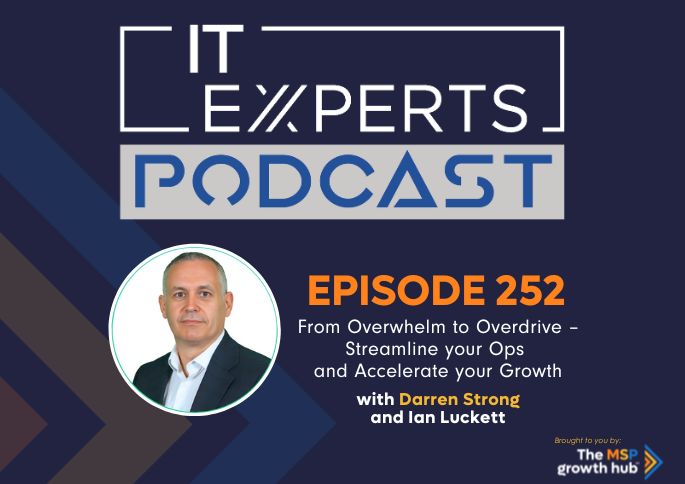
Running an MSP can feel like a whirlwind of tickets, meetings, and decisions. This episode sets out a calm, workable route to operations that hum. Start with a clear plan that covers financials, growth, structure, and how each role fits. Communicate it well. Give every person a role profile, a scorecard, and clear expectations. When people know what they own and when to seek support, accountability rises, and your MSP becomes consistent and easier to lead.
One of the key themes in this conversation is how important it is to have a clear plan. Without a plan, everything in the business defaults back to you and that is the fastest way to become stuck in overwhelm. The plan has to cover financials, growth, organisational structure, and how each role in the business fits into that picture. From there, it is about clarity and communication. Everyone needs to know what their role is, what success looks like, and how their contribution connects with the bigger goal. This is where simple tools like role profiles, scorecards, and clear expectations come in.
When your people understand the boundaries of what they can own, and where they need to seek help, you not only empower them but also create consistency and accountability.
We also cover the challenge of marketing for MSPs. Marketing is often seen as something mysterious or even unnecessary if referrals are coming in. Yet the MSPs that are really building momentum are the ones who are treating marketing like a serious business function. They are committing time and money to it, understanding that marketing is not about instant results but about building an engine that delivers leads consistently over the long term.
Many MSP owners are highly technical and want to see immediate returns. They hire engineers and within three months they are delivering results. That expectation does not translate to marketing and sales. These functions take longer to build, require consistency, and need ongoing investment of both money and attention.
What works is starting with something simple, shipping it, and learning as you go. Instead of overthinking or waiting until everything is perfect, you put your message out into the market and then refine it based on feedback. This is exactly how successful software products are built, and the same principle applies to marketing your MSP. The important thing is to stick to the plan, avoid chopping and changing strategies every few months, and have patience with the process.
As with all things in business, consistency wins. When you measure activities and outcomes in a meaningful way, you can track whether your marketing is leading to calls being booked and conversations being opened.
We also talk about how so many MSPs fall into the trap of using the same vanilla phrases when they try to differentiate themselves. Phrases like “we partner with our customers” or “it is all about people” are heard by prospects again and again, and they lose all impact. What lands is clarity of journey, strong communication, and the quality of how you manage people. Show how your team works, how you lead, and how you make outcomes repeatable. That is what sets an MSP apart.
The other big area we highlight is the role of leadership and succession. Too many MSP owners hold onto everything because they fear losing control or they are unsure whether their people are ready. The truth is, your next level of growth only comes when you create space for others to take ownership. Coach people to grow into responsibility even if the first pass is not perfect. Over time the team will surpass expectations, and you gain the headroom to focus on strategy, new services, or acquisitions.
A useful analogy that comes up is around focus. If you go out every morning and hit the same tree five times with a sharp axe, eventually the tree will fall. If you scatter your energy across ten different trees, you never make progress. The same applies in your MSP. Pick the three or four priorities that will make the biggest impact, put everything else in what we call the Disney drawer, and only go back to it once those priorities are delivered. This approach not only gives you results, it also builds confidence in yourself and in your team as you see the wins accumulate.
The bottom line is simple. Create the plan, work the plan, and the plan will work. With consistency and discipline, you reclaim time, smooth out operations, and create the freedom to make the bigger moves that grow your MSP.
Take a moment to review your own plan. Is it clear and visible? Does every person know their measures and next step? Are you investing enough time and money into Marketing so your MSP is not reliant on luck or referrals? Apply these lessons and you will move from overwhelm to overdrive with a business that feels lighter, faster, and far more predictable.
Connect with Darren Strong through his LinkedIn by clicking HERE.
You can also visit their website and learn more about Scalable by clicking HERE.
Make sure to check out our Ultimate MSP Growth Guide, a free guide that walks you through a proven process to take your MSP from stuck to scalable, without working even more hours. It’s 44 pages rammed with advice, insights and inspiration to help you decide what support is available to you now if you want to grow and scale your business. Click HERE to get your copy.
Connect with Ian HERE on LinkedIn and also Stuart by clicking this LINK
If you’re ready to take the next step in supercharging your MSP, take the Scale with Confidence MSP Mastery Quiz. This tool is designed to help you understand where your MSP stands and what steps you can take to scale profitably and effectively. This will provide you with insights and guidance tailored to your specific needs.
OR to join our amazing Facebook Group of over 400 MSPs where we are helping you Scale Up with Confidence, then click HERE
Until next time, look after yourself and I’ll catch up with you soon!
IAN: In this episode of the IT Experts podcast, we help you get out of overwhelm by sorting out your operations.
INTRO: Welcome to the IT Experts podcast, the only podcast to help MSPs scale to 1 million, and if already there, get to five and go faster at the end of the day. Isn't it all about building a business that works for you rather than you for it? I hope you enjoy the show.
IAN: So good morning, good afternoon, good evening. Welcome to the IT Experts podcast. Today we've got a very special guest for you. If there's anyone who's going to help you get your operational maturity, sort the operation, help your business become more efficient from an MSP's point of view. It's the one and only Darren Strong from scalable. Good afternoon, Darren.
DARREN: That was a big up. Ian. Thank you for having me on.
IAN: No problem at all.
That's absolutely fine. We got our tech issues out the way and we are back recording once again this afternoon. So it was morning, now it's afternoon. Anyway, great to have you here. And today we're going to be talking around how to help business owners get out of overwhelm, but by helping them understand the importance of getting the operations like a well-oiled machine, like a humming machine. Like it's absolutely working perfectly. And I know that you've got some massive experience in this all over the globe into helping people doing that. And I think it's really important that the MSP space and the channel can be really full of shiny balls. Go and do this. Oh, there's a new system, there's new this, but the reason for the show today is to help you to get that time so you can spend the quality time to help you grow your business by stop being so busy. So if that's up, if you're up for that, we're up for that. That's what we're going to be talking about today. In the meantime, Darren before we get cracking, who are you, what'd you do and who'd you help?
DARREN: So Darren Strong 20 odd years plus in the MSP world. Been through quite a weird journey really from corporate into MSP. Grew with a small business all the way up, been through lots of good, but even more bad times. And worked my way up from a technical person at heart, went my way up through management into then running businesses and owning businesses, and then into the world of scalable. So scalable was all born out of demand. It was off the back of my relationships, community, peer groups that I'd been in through that MSP journey and people just simply saying, can you help me? Can you help me with certain things? And off the back of that, we seem to have hit quite a big niche or whatever you want to call it. And we've been on a three year plus journey growing aggressively because of the demand and hopefully learning a lot on the way and enjoying that journey really. Now we deal across the globe. 80% of our business is outside of the UK, which I never thought would be the case. And so we see a lot, we see a lot that's going on in the community, and hopefully we can bring some of that back to the community.
IAN: Absolutely. Just while we're on that, great name for the companies. One to live up to, to make sure that you can scale properly. We'll, yeah. We're going to talk about eating your own dog food a little bit later on as well, which is a term that coaching and support services use when things might not be going too well in our businesses. And then we look at our own little instruction manual, what we're telling everyone to do, and then we read it, which is very interesting sometimes. It's a lot easier to tell people what to do rather than tell yourself. Of course it is. Isn't it amazing place, right? 5-6 years later, five, six years ago, you never even thought about that. You'd be sitting here today with a global business. That's a pretty cool phrase. Pandemic's obviously assisted some of that and technology and one thing or another, is there much difference between MSPs in, America or Australia, across the world and there are in the UK? Everyone seems to think that we're different to everybody else, but, any difference at all between them in your view?
DARREN: No, I get asked this a lot, obviously. For me it's that cake canal as the cherry on top is a different bit, but actually you learn it very early in the community and the peer groups that we're all doing the same thing. We're all delivering a people service. When actually, someone said to me last week that we're all actually delivering a business that just finds people. We find people, and we're a recruiting business and we deliver those people to our customers. The services, the software, the solutions we do, we're all using those same vendors. We're all delivering that same thing. But the cherry on top is who we do it. How do we communicate? Do we answer a yes and no at certain times? How do we help our customers? How do we partner with our customers? And more importantly, how do we manage our people? Because our people are the ones that are going to deliver that, and we replicate that to the outside world. That's the cherry on top. That's the difference.
IAN: Talking about the cherry on top, let's just dig into, just a little bit dip our toes into the marketing side of things for a second, because, you must hear this an awful lot. These are all the things that we do. We stand out from all the other MSPs because this is what we do. If there was a set of phrases that you'd want deleting from the MSP's vocabulary, what would they be? What would the vanilla words are where someone says to you, oh, we're really different. We do this and natural fact you go, no, you're not because you do that. What does that sound like to you, Darren?
DARREN: Yeah. I always think to myself, sat there as a one of your prospects. I've seen three of it companies, and you are the fourth, and the instant things are going to come out of your mouth is, we partner with our customers. We're not here to just support you. We want to know your long-term strategy. We're only going to allow things to come into the business that you need. It's all about the people for us. And we are the experts in this industry. They've heard that for the last three people that sat in front of them. Yeah. So what's different? Why are you going to be different? And I think it makes it even worse in the IT industry because we all use different phrases and terminologies, and our quotes all look different. So the only thing they've got to do is one is relationship. Which person did I like the best? And secondly, who was the cheapest? And that's where they're going to go.
IAN: Yeah. What are the high perform, what are the MSPs that are winning in this space? In the marketing? Because marketing in MSPs is seen as an absolute dark art. And many don't master it because many don't need to, right? Because if you build a solid enough business, you can get some really great referrals and that keep most people's appetite and their growth appetite going for a while. But the ones that are deliberately going out there and really nailing the marketing side of things, what are they doing, Darren?
DARREN: There's a simple answer to that. They're spending time and money in it. That's the biggest thing. The biggest thing I hear from our own customers. We want to grow. We want to grow successfully. We want it to be an engine. And when you dig under the hood, they're spending 2% of their profit on marketing. The owner spends no time understanding marketing and sales. They don't sometimes even have their own marketing and sales functions. If your son or daughter came home and said, my homework's not going very well, I'm not scoring very well, and you said I'm not really seeing you doing your homework. I only spend about an hour a week on it. You tell them to double down and spend more time on it.
IAN: Yeah.
DARREN: It's exactly the same thing. We've got to spend time understanding things that we don't yet understand. And often in our world, it's not the technical side, it's the sales and marketing side. So we've got to spend time understanding it a bit, putting our money over our mouth is and building that successful engine. And the big one is consistent as well. We bounce around different strategies, different tools. It's because we are very much bred into the fact that when we hire someone in technical, within the first three months roughly, we're going to start getting ROI. That's not the same in marketing and sales. It's such a longer journey. So what we do is we wait three, four months, nothing happens. So we pull the plug and do something else. Actually it's such a longer journey.
IAN: And do you need to see the end goal? We're just putting some training together for our clients that got a session with them in a couple of weeks. And we're just absorbing, and this is one thing that I think, every MSP should do. We're just absorbing virtually every conversation we've had in the last three or four months with our clients about what they've been moaning about, marketing, what has worked and what hasn't worked. And we're just going to crystallize it in some training. And one of the things was you either got your smaller bus, smaller MSP, where you've got your owners driving it and doing it because you might be interested in it, or you've got a slightly larger MSP where they've either got a team or an agency and the, and they got these different keys and going to the point of it being in overwhelm and trying to get people out of overwhelm, then having to go and understand marketing and understand how to generate leads is even harder, literally. And then referrals come in, they stop that because they go and focus on the referrals, and then you actually go back. You probably end up going back further, don't you, than you were to kind of like to start with just getting up and running. But you say that the MSP, doesn't need to kind of know about it, but they must need to know a certain level of how to measure the marketing activities that either other people are doing. What are, we've got our view on it. What's your view on some of the, top three or four things on how to measure marketing?
DARREN: I would say a good chunk of marketing is unmeasurable.
IAN: Yes it is.
DARREN: And so
IAN: I was hoping you weren't going to say that, but you're actually telling the truth, so that's good.
DARREN: And so just get started. The main thing is we procrastinate. We want to learn more. We want to get some camera units, we want to get some cameras, we want to get some lights, we want to get all this strategy. People ask me about our podcast, how many films ahead are on the podcast. So when I started I was not, let's just get one. Let's just film one and get it live. Some people are like, oh, I want 10 recordings in advance before I even get going. It's think about it a bit more like software development. They get the software 40, 50% there, and then they release it to the market and understand the market and how the reaction from the market and tweak it as they go. So you build a, basically viable product in marketing. Get it out there, start using it, start testing it, and start moving it forward. And I think there's two methods as well, isn't there's one is that I quite like, but it probably plays to my A DHD, which is I like to know a little bit about something before I hire somebody. I want to know enough. I don't want to be the expert, but I just want to know enough about it to know whether I'm hiring or the right person saying the right thing to me.
IAN: Yeah.
DARREN: There's that methodology. There's the extremes of that where people go, I want to learn everything. And then there's the complete opposite, which is, I don't enjoy marketing, I don't get energy from marketing, so I'm just going to hire somebody in the room that's better than me doing marketing. There's all those strategies, but what you've got to do, come up with a strategy and then stick to it. Yeah, that's the key thing. Come up with it, stick to it, and run with it as soon as possible and just keep changing that as you go along. And that's the same with anything in business. I think, there's certain risks that you've got to take in business to be successful. And I think often people don't take those risks.
IAN: It's interesting what you just said there. It is like a bit of a leap of faith moment with the marketing. You're either interested in it or you're not. And you need to, have that consistent plan and drive that forward. One of the things we always say is, whenever anybody's coming towards you, whether it be an agency or if they need to know your business to know how to market it. This is where a lot of, generic marketing agencies won't work. And I just say to them, just tell me really simply how the activities that you are going to do for me is going to help me book more calls. Just give me that answer and nine times out of 10, either the phone will go dead or they'll go, I'll get back to you, because they don't know, they'll just fluff around at the top because when you're just talking about a leap of faith there, I'm just like, I'm processing that and then I'm thinking, so we got MSP, techie, geeky business owners who need to know every detail of every single thing to make it work. And then we're saying, but with marketing, just, yeah. Take your shirt off, run in the sea. Don't worry about it. Everything's going to be great. Everything will be here when you get back. And it's it's that you're out, you're going to be outside your comfort zone doing marketing as you are like with people. We'll talk about that in a minute. But you have just, once you've got that plan as you would do for any project that you'd have, technically run the plan and just be consistent.
DARREN: The key is the plan. How is marketing going to attribute to sales? It doesn't matter whether it's a nice image or you like that image, or you like that video, or you don't like that video, it's what the audience, did it equal to a lead, the whole thing needs to equal a lead. Then sales take that lead and hopefully turn it into a win. Is it affecting that journey? What are they seeing in your business and how can they market that? How can they market the things that you do well that your competitors don't do? That's what it's all about. And doing that, and having that plan to do that. And then once you feel you've got it, you rev the engine up. Do more and more. Because you think that you've exhausted that when actually you've touched the surface. You just need to rev the engine.
IAN: And marketing itself is exactly the same. It's the same exercise as recruitment.
STUART INTERRUPT: Hold that thought for a moment. Ian, it's Stuart here. I just got a quick pit stop here for everyone that could really move the needle. If growing your MSP is on your radar, but it feels somehow a bit foggy, a bit difficult to get your arms round the concept, then download our ultimate MSP growth guide because it lays out all of the best support options that are out there in the channel so you can fast track what really works for you and make a clear decision. Alternatively, you may be the kind of person that likes to see things up real. For yourself in action physically. So why not come to one of our events where you can do exactly that? And we'd love to meet you, so there's just a head up for you down in the show notes that you'll find the links to be able to take the next step. But otherwise, let's get back to the good stuff and back to the show. Cheers.
IAN: When you're bringing somebody in, why do you want them to come and work for me? What are you going to do? Let's just change directions a little bit here. Darren and I want to talk about, how do we get people out of overwhelm? The way we get people out of overwhelm is build a great team, right? And, but to enable you to do that, A, you need to know how to build a great team, and B, you need to let go a little bit, don't you? You need to get out of your own way, which is probably something you see quite a lot of the time because where we want to get to is a vision where you are spending maybe one or two days. In the business a week, making decisions operationally maybe and then the rest of the time working on right. Actual fact, let's do an acquisition and grow by acquisition, or what's the strategy to drive this business forward? Working on the business really strategically, but you're never going to get to that position while you are in the weeds. So how do we get people out of the weeds? What's some of the things that I guess is stopping people getting out of the weeds? It's all around getting out of your own way, isn't it really?
DARREN: So it's back to that plan, isn't it? Some people hit a ceiling, whether that be a 2 million ceiling, a 5 million ceiling, and they're hitting that ceiling because the engine, which includes themselves, has hit that maturity ceiling. They're never going to go past it unless something change. If you do the same thing every day, you're going to get the same result every day. So something has to change. So you have to have a plan. Of where you want to be because ultimately a lot of problems in business is down to communication. So if you can't communicate where you want to go and how you're going to get there. Nobody else is going to be able to take that forward and deliver it for you. So then everything comes back to you because every day you get up, you answer the question in a different way. So first of all, you got to have a plan, financial plan, growth plan, organization plan. Where does it all fit in? And then you've then got to start to let go. Like you said, you've got to spend time with the team. That's the key thing. If your highest and best use is still fixing that printer. You're going to stay at that ceiling. You need to change your highest and best use to be the next thing. So depending on where you are in scale on your business. That next best thing might be nurturing some people on the service desk into a leadership role. It might be nurturing your leadership role. It might be nurturing your SLT people. It might be nurturing your executives. Depends on the size of the business, but you've got to decide where do you fit in and what's your next best use of you as skills? And then sometimes you've got to train yourself to deliver that. So it's, for me, it's about the plan, communicating the plan, and then finding out where you fit. Sticking to that, we've all got these a million things running through our heads, and the problem is, if we don't, I was at a conference last month. It comes straight to my head about cutting a tree down. Don't if you've ever heard it or not, but you go out every morning, you hit a tree. If you go out every morning and hit that tree and you hit it with a pencil. You're not going to damage it very much. Yeah. But if you go out and hit that tree with an axe, that's a sharp axe. You're going to hurt it a little bit. But it's a big chunky tree. You've got plenty of them in this field. So if you go out every day and you hit that tree and you hit it five times every morning, eventually that tree will fall down. But all of a sudden, if you decide to change tack and go, actually, I'm going to hit another tree. I'm going to hit another tree. I'm going to hit five trees today. I'm going to hit, I'm going to 10 trees today. All those trees will repair and none of them will fall down. So we've got to go after one thing, and I call that the Disney draw. So we get all our ideas, we order them by priority of saying, what's the ease of doing this? What's the impact of the business? Who are we going to deliver it into the business? And then we pick the top three, maybe four items, and we put the rest into the Disney draw and lock it up. And we only open the Disney draw when we're ready. Because we've fixed one of the things we said we're going to do, because you've said that's the main thing you want to . So you want to make sure you're not fixing something that you just see. It has to be the core problem. Then we make that smart, then we create action plans. Then we delegate some of that out to the team. We create regular occurrence on meetings and check-ins. We have deadlines on there, and we go out and hit that tree together and we knock the tree over. And that's the only way to move your business forward. I saw it so many times in the peer groups. I would sit with a group of people and you'd clearly get one or two clear winners. Because everybody in that room wanted to grow. So everyone's a winner if you want to stay where you are, and there's nothing wrong with staying where you are. That's your solid business. I've seen good businesses be sold for staying where they are, but if you want to grow and you're frustrated by it, that's the rumor people I had. But there was always a couple of clear winners, and those couple of clear winners wasn't because they made better notes on the day or they scribbled more papers on the day. It was because they took the number one thing away from that day. Delivered it over the next quarter and they come back, they will have finished it, done it, and moved on to the next thing. And they were building teams as they did that. And those are the ones that really drove their businesses forward.
IAN: And the beautiful thing about what you've just said then is that anybody listening to this show can achieve anything they want. That doesn't mean to say that there's magic wands out there and stuff.
DARREN: We've all got 60 hours a week. We can work, haven't we? We've all got the same 60 hours.
IAN: Exactly. Exactly. And there is this cliche it depends what you do with it. It's, and it's absolutely bloody you've got to be focused on that thing. But the thing that you've just mentioned there about, you deliver on the plan, you deliver on a little bit of the plan, but when you deliver on a little bit of the plan. You get more confidence and you feel better about yourself, and you feel that achievement. It's like that Disney draw. You've got that little sticker, that star, whatever you want to call it, like you did at school, right? When you did your, when you did five words correctly in your spelling test or even going into your drawing test.
DARREN: That was never me, by the way.
IAN: Must never you. No, I was just. I heard that once at a show is, it wasn't something I did either, but we didn't get on we didn't get on very well with school, but it's just that, it's that confidence piece where you then feel, do you know what? I can do this. We talk about it in the MSP journey and then all of a sudden, oh, I can do a little bit more. And then you delegate to someone and that person does a job at 80% of what you could do it, but have done it quicker than you. And it's don't be scared by that. And it's around that whole confidence building piece. Isn't it, Darren? If you always do what you've always done, then you'll always get what you've always got. You're never going to grow and, everybody needs growth, whether it's personal growth or the business growth. But you just feel great once you start achieving those things, don't you?
DARREN: Yeah, and it, back to that thing, you've got to see where am I going to fit in the business? What's my next job? And you've got to learn yourself to do that job. You've got to put time into yourself as well as your team. If you are still delivering operations and maybe you're trying to do principle led selling and you're still getting involved in operations, it's never going to work, because as soon as you sell something, you're going to get busy in operations and you'll not sell something that maybe a salesperson would've sold because it's going to affect operations. So you've got to get out of these worlds and build these teams to deliver on the mission. You've got to have these plans and these structures that you can communicate.
IAN: So what's your advice then if we took a typical MSP which would have very flat structure which we know, because normally you just have one techie, then you have two, then three, then 10. Then how many you've got? You know that there's a couple of people in there that probably could be working a little bit better or a bit, little bit more efficiently, and some of them are, a bit more leading towards the leadership type of things. But what would your advice be for an MSP who's listening to this podcast and going, I know I can get a bit more out my team, but I don't know where to start. What's the first step in building that team that's going to lift them up and get them out of overwhelm and give them their time back.
DARREN: So your first one is what we call a value creation plan. So what's your financial plan and growth plan for the next five years? Where are you going to be in the next five years? Then chunk that down to the next 12 months. So now we know what the possibilities are if we hit those targets from a maybe sales point of view. So now we should then, I really like the EOS role profile org structure. So we plot the roles that we need in our MSP today. Then we put the people that are doing those hats and typically you put one person on the chart five times, then we plot exactly the same role. Log chart for the 12 months later,' because that's where we're probably going to be. And we plot that out as well. And we use some of the good leadership structures around no more than five to six people reporting to each individual. We structured that out. And then we say right now we're going to create some role profiles, job descriptions on steroids. So in a role profile, you've got what's the capabilities are coming with, what's the KPIs, what's the role, what's responsibility? What's the next step for them? And we roll profile out every role on that sheet. Then we create scorecards that match them role profiles. Say, here's the numbers we're going to attribute to. So then we get the buy-in from the team. So now here's the structures that I believe we need and where you fit in today and what your, what does good look like for you? Do we agree that if we hit those numbers every day, it will push you on? Because what's in it for you? It's going to be, you are going to get an advantage by knowing you do a good job, which is actually better than money. And we can put some money incentives in there on future progress incentives because I want you to get to the next role. Now we've got a clear picture of what everyone's doing, what their role is in the boat when they're rolling, and we all roll at the same pace and we're going to hit the target. And then we change them roles as we go along over the 12 month plan to hit the value creation plan. And we structure it that way and in each role, we create a judge box. So a judge box is inside the box. These are the things that you can do without me, right? So here's the tier one, A- tier one service desk role. Here's the certain types of change requests that Youi and I've got the capability to do. You've come with that already into the business. You can change a password.
IAN: Well done. By the way.
DARREN: Or outside of that, is things like firewalls, Nat Rules VPN rules, switch rules, switch VLANs, that you're not allowed to do and you've got to come to me on it. So they're on your role profile. So this is what I want a tier one to do, but half of it is not you today. So now we're going to have a plan of you watching somebody else how to do those things outside your box, and then watching you how to do those things outside your box and then handing it over to you. And we'll draw the box a little bit bigger and we'll take you through those steps until you hit that role profile. And then it'll be about who do you get onto the next job, because that's where we're going in the next progression for yourselves. But that now creates a very clear understanding of, what do I expect from you? What does good look like? Where's your journey today? Where's your accountability? When do I expect you to ask for help? When do I not expect you to ask for help? All done, you can now go and just do your role, Ian, and you know that I know that there's confidence in you delivering those things.
IAN: Absolutely love it. I love that you was just you was in flow then, and I knew that, and that was a great teed up question. We liken that back in the day to just expectation exchange. You're going to come into work.
DARREN: That's the boring bit, isn't it? For us? It hard. It's the boring bit. It's the hard bit I've got to think about.
IAN: Yeah.
DARREN: But unless you do it, you'll always be in that firefighting mode because all questions will lead to you because there is no answers for anybody.
IAN: But what Darren's just explained there beautifully is just a really simple process about cascading down, we call it rhythm of the review, all the way down from, your targets all the way down to the people pressing the buttons in the in the help desk as it would be, but, you don't have to do everybody all at once. You don't have to do it all together. You don't have to do it all this week. And once you've got that process and you are clearing that process with that one role, you just rinse and repeat the same process, and then you cascade it down to your senior people who are bubbling up, who are thinking, oh, I think this would be a really good person for, a leadership position, maybe in the future or maybe not. And what you've just described, there is a way to analyze their performance to measure and reward their performance to, correct any performance if they're not, meeting that expectation exchange and they're not, got those agreed targets and yeah really great succinct, but you don't...
DARREN: I think it's a great point. I think it's a great point though, as well as about leadership. We think this person's going to be the next leader because he's expressed an interest in it.
IAN: Yeah.
DARREN: Really good question to ask here Is. Why are you expressing an interest? What's the real reason you want this leadership role? Is it because you just want a pay rise and you think there is no other way of achieving a pay rise or is it because you want to help others? Those are two completely different paths. And often when a technical person wants leadership, they still excited about the technical bit and they just want a bigger salary.
IAN: Yeah. It's understanding,
DARREN: It's not that they want to help others.
IAN: Yeah. I remember years ago when I was God, probably it was when I was just under 30 and my boss pulled me into his office and he said to me, he said, I want to train you to do this. And I was like, and yeah, but if you train me to do that then won't they need you? He goes, no, they won't. And I want that because unless I can find someone to do my job, I'm not going to go and get to do my next job. And it was that whole, fear or removal of fear around succession planning. And if someone came to you and said, I want to help you do this, to step up into this role because I want to run this company one day. You should be bloody excited about that. You've got someone else there who's going to help you, put on those big row, the big Os and big rowers. God, only if you're watching this on video, just unsee that bit. But the big Os and row that boat quicker and faster. You should never be scared of proper structured success planning should you.
DARREN: Yeah. And that's the key, isn't it? How can you do yourself out of a job? Yeah. And otherwise you'll never step back and do the next thing, what is the next thing. And it all comes down to that planning. And sometimes you've just got to sit there in a stare out of a window as well. One of my mentors told me this, around blocking at least one hour, if not two hours a week into your diary. That just says, sit there and stand there, gaze out the window. Because that's your thinking time. That's the time where you...
IAN: Yeah it's very important.
DARREN: Chunking this down and understanding where you need to go because we all run a hundred mile an hour all the time.
IAN: And if you haven't got a next thing, that's fine, that's absolutely fine. Because the next thing will come and it might be spending more time with your family. It might be going on, holidays or experience in the world. It might be actually working in a different part of the business, because you might not enjoy running the business. It's absolutely fine. But creating time in such a busy world that we live in has just got to be one of the best skills that anybody can learn.
DARREN: Yeah. And you just, another great point there. You should enjoy your role. If you are not enjoying your role, it takes so much more energy to deliver your role and you'll never do it as well as you should do. And you'll always be tired from it. So if you are finding you're not enjoying your role, you need to get out of that role. Very good friend of mine now actually moved his role from CEO to a different part of the business. That takes a lot of guts to do that. But he wasn't enjoying it and he was holding the business back and he could see this bit over here that he would massively enjoy, and that's what he went after.
IAN: Brilliant.
DARREN: So structure the business. So you're going to enjoy your role.
IAN: Simple as that. That's the mic drop moment.
DARREN: You can not enjoy the role, can't they? But you must also go in and be employed by somebody else you're running the business you should have some enjoyment out of it.
IAN: Yeah, definitely. Darren, absolutely brilliant show. Thank you very much. As we've said many times, we could talk about this sort of thing all day. The purpose of this show was to help MSP business owners to get a bit more time so that they can create a bit more of a operationally successful business to give them that time back. What's some of the key points for every MSP to take away from the show down?
DARREN: I think we've talked a bit about all sorts of stuff here that people can take away and it just take away one thing. I think it'll make a difference, but I've got a one liner for you, which is create the plan, work the plan will work. It's as simple as that.
IAN: End of and on that note, we will say thanks very much. We look forward to seeing you in the MSP Growth Hub real soon, helping out our clients, which will be super amazing. If anybody wants to continue a conversation with you, Dan, about some of the great work you do, how do they get in contact with you?
DARREN: So quite big on LinkedIn, so definitely reach out on LinkedIn. If you want to have a look a bit more about scalable, that's at scalable msp.co uk.
IAN: Fantastic. Good stuff. Good luck for the rest of this year, what's left of it. I'm sure there'll be a a good plan in place for you and the team, which is incredible. And thanks very much for your time again today, Dan. Really appreciate it. Catch up with you soon. Thanks for having Ian. Cheers.
OUTRO: Just before you go, and if you're curious about how this episode links with the ability to scale your MSP to a million or, or if you are already there, accelerate to five, then we want to invite you to come and take the MSP Mastery quiz, and in just three minutes, you're going to get a 360 degrees scan of your business where you can identify the one or two tactics that can help you find more time, engage in, align your people and help generate more leads in your msp. It's really simple, just click on the link in the show notes and if you have enjoyed this episode, we'd love to get some feedback from you by means of a rating review on Spotify or iTunes, or your podcast platform of choice. We really appreciate every single one of them. Now, you can go and enjoy the rest of your day and we look forward to catching up and connecting with you soon. All the best.

The MSP Growth Hub is designed specifically for IT & MSP Business Owners who want to build a profitable IT & MSP business.
The MSP Growth Hub
Suite 215
Jansel House
648 Hitchin Road,
Luton, Beds
LU2 7XH
OUR TRUSTED FRIENDS OF THE GROWTH HUB