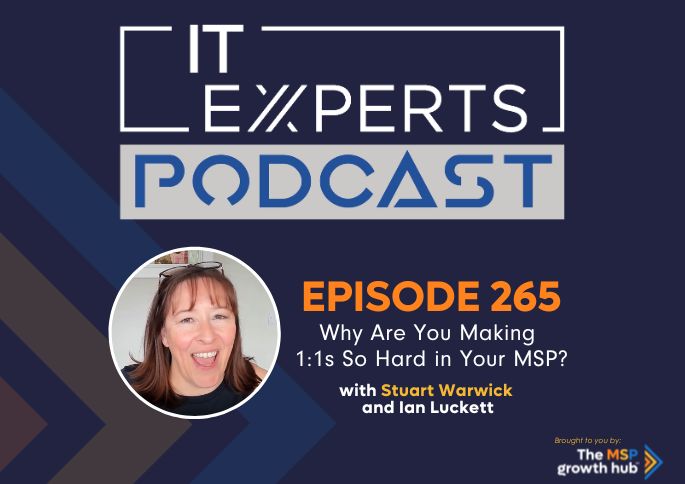
In this episode of The IT Experts Podcast, I dig into one of the most misunderstood leadership habits inside MSPs, the one to one. I am joined by Julie Hutchinson, and together we explore why MSP 1:1s so often feel heavy, awkward, or avoidable, and what is really going on beneath the surface when leaders say they do not have time for them. This conversation is about stripping away complexity and bringing the focus back to clarity, trust, and leadership rhythm inside growing MSPs.
I speak to MSP owners and leaders every week who know that MSP 1:1s matter. They understand the theory. They know they should be happening regularly. Yet in practice, these meetings are often the first thing to be cancelled, rushed, or turned into task updates that add little value. Julie and I unpack why this happens so often. It is rarely a diary problem. More often it comes down to discomfort, uncertainty, and a lack of structure. When leaders are unsure what good looks like, avoidance quickly becomes the default.
Throughout the episode, I come back to a simple truth. MSP 1:1s are not about tasks. They are about people. When leaders turn one to ones into performance interrogations or reactive problem-solving sessions, trust slowly erodes. Team members become guarded. Leaders feel drained. The meeting becomes something to get through rather than something that creates progress. Julie shares how this shows up again and again in MSPs where growth has outpaced leadership capability, leaving managers unsure how to hold effective people conversations.
I also share why MSP 1:1s work best when they are treated as a leadership habit rather than a management tool. Consistency matters more than perfection. A regular rhythm creates psychological safety. Over time, people stop bracing themselves and start opening up. This is where real issues surface early, before they turn into disengagement, performance dips, or people quietly checking out. I see this constantly with MSPs who come to us thinking they have technical problems, when what they really have are unresolved people issues that better one to ones could have surfaced sooner.
A big part of the conversation is about ownership. Julie challenges the idea that leaders need to carry the entire meeting. Effective MSP 1:1s are a shared responsibility. When team members are encouraged to bring topics, reflect on their own progress, and talk openly about what they need, the dynamic shifts. The meeting becomes lighter, more focused, and far more productive. Leaders stop feeling like they are dragging information out of people and start having proper conversations instead.
We also talk openly about the emotional side of MSP 1:1s. Many leaders avoid them because they fear difficult conversations. I am very clear on this point. Avoiding these conversations does not remove the difficulty, it delays it. When feedback is withheld, frustration builds on both sides. When issues are named early, with care and clarity, relationships strengthen. The confidence to do this well comes from practice and from having a simple structure to lean on.
Another important insight we explore is that MSP 1:1s are not the place to fix everything. They are the place to notice patterns. I explain how leaders can listen for themes across multiple one to ones and then address systemic issues elsewhere, rather than trying to solve every problem in isolation. This reduces pressure on the meeting and helps leaders think more strategically about their teams and their business.
Julie also shares practical guidance on what good actually looks like. MSP 1:1s should feel human. They should create space for personal check in, professional development, and honest dialogue. When leaders show up with curiosity rather than judgement, trust grows naturally. Over time, these meetings become one of the strongest tools an MSP has for retaining good people, developing future leaders, and maintaining momentum through change.
We close the conversation with a reminder that leadership is learned through doing. Nobody starts out brilliant at MSP 1:1s. The leaders who improve are the ones who commit to the rhythm, reflect on what is working, and stay open to feedback themselves. When one to ones are done well, they stop being hard work and start becoming one of the most rewarding parts of leading an MSP.
If you want to strengthen your leadership rhythm and make MSP 1:1s simpler and more effective, this episode will give you clarity, reassurance, and practical next steps you can apply straight away.
Make sure to check out our Ultimate MSP Growth Guide, a free guide that walks you through a proven process to take your MSP from stuck to scalable, without working even more hours. It’s 44 pages rammed with advice, insights and inspiration to help you decide what support is available to you now if you want to grow and scale your business. Click HERE to get your copy.
Connect on LinkedIn HERE with Ian and also with Stuart by clicking this LINK
And when you’re ready to take the next step in growing your MSP, come and take the Scale with Confidence MSP Mastery Quiz. In just three minutes, you’ll get a 360-degree scan of your MSP and identify the one or two tactics that could help you find more time, engage & align your people and generate more leads.
OR
To join our amazing Facebook Group of over 400 MSPs where we are helping you Scale Up with Confidence, then click HERE
Until next time, look after yourself and I’ll catch up with you soon!
IAN: In this week's episode of The IT Experts Podcast, we answer the question, why are you making your one-to-ones with your team so hard?
INTRO: Welcome to The IT Experts Podcast, the only podcast to help MSPs scale to 1 million, and if already there, get to five and go faster. At the end of the day, isn't it all about building a business that works for you rather than you for it? I hope you enjoy the show.
IAN: So good morning, good afternoon, good evening. Welcome to The IT Experts Podcast today again for, I don't know, when, how many times now, Julie Hutchison, our amazing leadership coach is back in the house. Good morning, Julie. How you doing?
JULIE: Hello? Hello. I've got a very deep gruff voice today because I've got a cough. Apologies if I cough.
IAN: We like that. And we will do our very best to edit all the coughs and splutters out. So hopefully you are, you'll be feeling better by the time we finish this one. Today, Julie, real interesting subject we're going to be talking about. One-to-ones. And why do MSPs make this such a difficult task? Which is quite a laugh really, isn't it? Because when the time you, you think about the amount of technical solutions and problems that these ladies and gents go through in their daily life, and yet communication, speaking to someone in their team to help them lift up, get out of their own way. Owner not needed. Grow the business. Build efficiencies. Seems to be one of the hardest things in the world, doesn't it? Why are we talking about this today, Julie?
JULIE: We are talking about it today because over the last couple of weeks it's been something that we've been trying to, you know, push, our clients to make sure they're doing. And what I'm getting is a whole load of pushback and like, Ooh, how do I do it? Where's the form? What sort of form should I use? Oh, I don't know what to do. Any other excuse under the sun not to do them because they're in the too difficult box at the moment.
IAN: Yeah. And they're not their happy place, are they? So, let me put a bit of context around this, which we talk around in our, potential versus performance framework that we have here at the MSP Growth Hub. And if you bring in somebody, who is earning, I don't know, 25-30,000 pound a year, the one thing that we need to do, the one thing we need to make sure that we're doing is we are, they are providing value to the business. So, great analogy, years ago I was on a property event and this guy said to me, he said, I have all my little one pound coins and they're all in my top drawer and my bedside cupboard, and I open them up every morning. These little one pound coins, they all jump off, they bounce down the stairs and they go off to work and then at the end of the day, I open up the drawer and they all come back to bed again. But there's more that's come back because they've gone out and they've invested and they've made some more value and they've, you know, and it was kind of this really good analogy that every pound that goes out needs to bring more money kind of back in. So when we look at this in people's side of things, you recruit someone 25, 30,000 pounds, you want to get that money back. It's like a sales person or account manager. If you bring a, somebody in at that value, you want to make sure they're bringing at least that back, if not 2, 3, 4 times that in business. And then they're a good ROI. But what happens is that if we don't spend time doing what, what we're talking about today, which is communicating, finding out how things are working, and we'll talk about the benefits and everything like this, of doing one-to-ones, in a moment. Their value's going to erode, and within a year they're going to be, you know, very much under the, under their salary bracket and not really delivering much value to you. If you meet up with them every quarter, what you'll find is, of those 12 weeks, week 10 and 11 will be super productive and everything will be absolutely amazing and splendid. They'll have the meeting and then they'll drop back off again. It's three months. It's a long time. It takes a, you know, a long time, I don't, I talk to my team every day. So another thing we're going to talk about, Julie, is what do we talk about in these one-to-ones, and it's not a technical conversation on how's your week going? But when you do these monthly, which is what we recommend, you get that connection and you've got a period of reflection afterwards and a period of preparation, then you've got two weeks basically, where they can be doing the work and you can be, you know, checking in on them on regularly. And what will happen is once you start doing it, like on a monthly basis, is their value increases. So it gets to, for example, 35, 45, 50,000 pound, whatever it might be, adding more and more value into the business. And when we look at the fact that, you know, people, costs are the biggest, one of the biggest costs in MSPs. And we're not talking to people. It's as simple as that, isn't it, Julie?
JULIE: It is absolutely as simple as that. If you think, you know, if they're the biggest cost in your business and you are not on it with how they're doing and what they're doing and understanding how they're achieving, then, or you haven't set where you want them to go, then they're just going to randomly show up and do what they think is best. You know, nobody wants to come to work to do a bad job, but you're not going to know what it is. And they're not going to know whether they're doing a good job or a bad job, which means that it's all a bit random and, you're just putting money in their slot machine and pulling a handle and hoping for the best. Really? And you don't normally get free, what is it, plums coming up on the thing. Do you?
IAN: So the golden question is, why? Why do we need to bother doing one-to-ones? What's the benefit to you know, to the business.
JULIE: Yeah, of course. Think of it like this. I like the good old airplane thing. If we're going on holiday, Ian, I'm going to New York in, at the end of the month, so we'll try that one. Well done. And, you know, to get to New York, when we getting that plane, the old pilot, you know, he says, well, here we are in Gatwick. That's A, and I want to get to B, which is New York, and I'm going to set a course. Yeah. I want an outcome of arriving in New York. By a set time. And so we set a course and it's a nice straight line or around the curve of the earth or whatever, but it's generally, you know, it's a bit of a straight line. So if you just imagine there's this lovely straight line and the airplane, you know, flies off in a straight line, and that's what you would hope it would do. That would be the shortest distance between two points is a straight line. And the same way, with word, with what you want, with, your people is a, you know, I set a goal, they do the goal. That would be lovely, wouldn't it? You know, just to film with it, get on it, and that's point B. Point B is where I've set a goal. Okay. And so the importance is, is that you want them to achieve the thing that's been set. And so if you know where you are now and you know where you want to be, then, we have a number of choices. And as you said, if you don't do anything, then you just get to the end. You get to the end of the year, let's say. And imagine, you know, imagine if like you are on this airplane and you just did that, and you're like, oh, yeah, yeah, we'll just, aim in that direction generally, and then by the time you get there, if you didn't check in while you were there, you'd be way off course and you wouldn't know it. And this is what we're doing. The importance of one-to-ones is a course correction. That's all they really are. But you can only do it. And I think this is why people find it so difficult. It's quite often we haven't set the course, we haven't, we possibly haven't set our KPIs or objectives or any of those things. So it's not really clear what, where B is, let's say. And therefore it makes it difficult to have a conversation to say whether you're on course or off course. When there is no course. So, you know, if you're flying your airplane, you come in, you come in every, I don't know how often they check, but every couple of seconds probably. And you know, they're checking in and they're only a little bit off course. They're always off course, but they just swing around the course. They go along that straight line, and they're always off a little bit. So little that they can still get to be. Yeah, because it's not too far away. And what one-to-ones are doing is saying, correct your course, give your team, set them up to succeed. Give them the opportunity to succeed and get to be by helping them to know, am I on course now? Is there a way I need to change what I'm doing? Soon enough, and as what you were saying there, soon enough so that it's not so far off course that there's just no way we're going to get back. So that's what one to ones afford is a course correction on A to B. So we find it so difficult because we didn't set a B. Number one.
IAN: Yeah.
JULIE: Maybe you did, maybe you got the, oh yeah, I did that. That's great. Well done. But then what we don't do is we don't check in often enough. So you say, no, no, I'm doing that. And then is we are not having the right conversations, when we have those, or we finding them difficult, so we avoid them or we say the wrong thing or we make it really awkward and we just, or we grab the form Ian, this is the best one. We get our form that we've so complicatedly made and got a lot of tick boxes on, and we just sit there like a machine and ask questions and tick boxes, but we don't have a human conversation. And I said it before, you know, like, we want to set them up to succeed. How does somebody succeed? They know where they're supposed to be going. They're capable of doing it.
IAN: Yep.
JULIE: And they, wants to do it, you know, with good old hark back to our can't, won't, don't, this is can do, wants to and will do. But you know, he or she knows where they're going and your job is to make sure they've got the skill and if they don't have the skill, help them find that skill. Hopefully employ them with some skill, but then always need a bit of extra, and help them find the way, help them find the will to want to do it. So the way is that B, and the more often you check in, you can say, well, you're off course, you're on course, you're off course, you're on course. Let's do that.
IAN: Yeah.
JULIE: And the conversation that everybody wants to avoid by using their lovely tick form is not, are you any good or it's not a harsh conversation. It doesn't need to be, especially if you do it often enough. What this is a collaborative conversation. Imagine walking alongside them, saying, where do you think you are on this course that I've told you about? Because if you do it often enough and you do it in collaboration and with a B, then you don't have to sit opposite somebody and feel like you're going to have to tell them off and make it a hard conversation. You are so, it's such a minute correction that you need and you're, and if you can assume that there's always going to be a correction as well, because like an airplane, there's always going to be the wind blows one way something happens. We go in a air pocket, whatever it might be, there's always a little correction, but it's okay. It's just, it is what it is. It's not a bad thing, then nobody feels bad. And we walk alongside that person. We collaboratively correct their course with them, and that means that we have a coaching conversation. And you know, we've talked about coaching conversations before, so we ask questions like, where do you think you are at the moment? How far are you on course? How far are you off course? What do you think you need to do to get back on course? What help do you need from me? What help do you need from anybody else? What resources do you need? Can you see? They're all questions.
IAN: Yeah.
JULIE: But they're all course correction questions. They're not, are you any good? Are you, you know, like, and, and then obviously if you've got somebody who's got poor performance, we can still relate it to being on course or not. For example, if they're like, I don't know, they keep having a argument with Bob, let's say in the corner, and you want to deal with that. You can relate to, look, you know what, in order for us to all achieve our goals, our Bs, you know, we've got to work together. We've got to do, you know, how do you think the way that you're behaving at the moment is helping you stay on course? So can you see it still a course correction conversation.
IAN: Love it.
JULIE: It's much easier to have a nice, I'm making it sound a bit pink, fluffy there. Sorry about that. But to have a good conversation, you know, I'm not that nice.
IAN: I do know, I do know pink and fluffy are not two words that come out your mouth very often, Julie.
JULIE: No, no, exactly. So what I mean is you need a good conversation that is not one of those ones that you would define as difficult conversation because you've had it often enough and everybody knows what the score is, so they know what they're going to get when they come into that conversation. They know that you're going to ask, where are you on the course? Right? They know that you are going to ask what do you need and all of these things, but you are going to point out. If they're not or if they say, well, I'm on course, and you are like, well, you're not on course. You have to have that diff, it's a difficult conversation, I suppose, but it's a whole lot less difficult if you do it once a month than if you do it once a year. Yeah.
STUART INTERRUPT: If scaling your MSP is your goal, but you're not sure which road to take, then you'll really want to get hold of the MSP growth guide. It's the shortcut most MSPs wish they had much earlier on to work out what the right support is for them. Even better, if you like meeting up in person, why not come to join us at one of our live events, see the system, meet the people, get inspired, get to kick the tires and see exactly what we get up to at the Growth Hub. So, details are on the show notes below. Go have a look, click and come and join us and we look forward to seeing you another time, but let's get back to the show.
IAN: Thanks, Stuart.
Love that. Let's just talk just, quickly about preparation. In terms of expect, yeah, because we started this podcast going, oh my God, this is so hard. Why do I do it? It's in my too difficult box. Oh, there's something else going on, let's distract and go over and do that. In terms of preparation, so we want to set people up with a cadence of monthly one-to-ones with their direct reports. What sort of preparation would you expect the manager, the owner, and or then the individual to do in preparation for that meeting. So what expectations are we setting before the session?
JULIE: I think you make a really good point there in the first before saying what ones, it's the fact that you did that, is that you set expectations because if you don't do that, then nobody really knows what's going to happen in that, conversation. Whereas if you say to Bob, let's say, you know, right? The thing that we are going to do in this conversation is we're going to have an A to B conversation. It's about how to get you on course, right? So what I expect from you is for you to be able to tell me where you're at and what's working, and what's not working, and what you've already tried. So that I, when I come in and help you, I'm here to have a collaborative conversation. So if you set that expectation, you can say, you know, this is meant to be something that we both benefit from, is to look and stand next to you so that you can see that we are working on this course and we're going to course correct and I want to help you to achieve. So if you come with that, I will come with really understanding what I want from you and I'll make sure that I've got all of the, I've read all of the notes before. So the things that need to happen is that you as the manager, need to know what was said before, what you agreed, what did you, and to do the things that you say you're going to do for them or with them. So make sure that you know what B is for start. Where you going, where do you, where did you tell them that you wanted to go? And is that the same? Do you have to do a major course correction, as in, oh look, we can't go to New York. We've got to go to Boston instead because it's snowy at the moment or, you know, or because, we need a new client or something like that. We need you to do something different. Do you need to completely change the course? So you need to do that work so that you are prepared. The other thing that you need to do is prepare your mindset. Because let's say you don't really want to do it and a lot of people don't really, don't really want to have to have this conversation, but that isn't going to help, okay? So you need to go in with a coach mindset of like, number one, this is collaborative. Number two, I don't need it to be difficult. I need it to be a conversation. And number three, I am not going to just tell them what to do. I'm going to ask good questions now then you need to tell them to make sure that they're prepared and that it's going to be a useful meeting. And the reason why most people don't prepare is because it's not a useful meeting and therefore they get bored and don't, they just come and they don't see what the value is. So make it useful for them. Tell them what you're going to do. As I said, this is the expectations. This is what we do. But in order for us to have a really good conversation, I need you to know where you are, where your A is. I need you to make sure you know where your B is. And I need to know where you are on the course and as I said earlier on. What help you do you need? What have you tried already? What resources do you need? Is there anything that's going to get in your way? And therefore, the conversation becomes like, you know, if you're imagining that that good old field of corn that you're trying to get through, you know, you're kind of like working together to create that path. And that is it. Now.
IAN: It's as simple as that, isn't it?
JULIE: It's as simple as that. Although, one of the questions I got the other day was, you know, ooh, do we have to have personal conversations? You know, personal, and I said, well, you're not listening. You don't want their life story, but we are human, therefore, what they bring and where they're at, where their A is at this moment in time. And how far off course they are will have something to do with who they are as a human being and what's going on for them as a human being. So you have got to have understanding and an interest in that person as well. Because if it were as simple as just setting the goal and them doing it, then you wouldn't need one-to-ones at all. You'd just say it and it'd be done. So that's not the case. Things get in the way. What are the obstacles? And it might be an obstacle with Jennifer in the office, it might be an obstacle because they've been poorly, it might be an obstacle because they've got a problem understanding how to do something. So what you are looking for. And as I said, is, what resources do you need? What's going to get in your way? What help do you need to remove some of that? And of course some of that might be, you know, well the thing that's stopping you at the moment is, I can't get to sleep because I've got a baby crying, or whatever the thing is, so you, you're not trying to delve into the most significant path, but what you're trying to do is understand what are those obstacles and how can I help them as a human? As much as I can do as a business to remove the obstacles for them or to minimise those obstacles. So if it is Jennifer in the corner, you might have to deal with that. If it is baby crying, maybe you need to be flexible on hours, something like that. So they're the personal conversations, I think they're the ones that scare people the most. But if you just see them as like, I need to know that information to know what obstacle can I help you remove.
IAN: What would you say to an MSP if they said to you, We have daily huddles. I catch up with everybody every week when we're having a pizza on a Friday. Why do I need to have another meeting?
JULIE: I wish I'd stopped calling it meetings. That would be more helpful, that's the problem. It's not, it's not a thing, it's a conversation. Do you know what I mean? I don't care where you have it. You can have it like, you know, in a coffee shop or walking down the road, walk, walk down the forest if you like. But what you need is an individual conversation that is tailored to that person and the results you want from that person. Don't get me wrong, you might want a team one as well, yeah, and that might be over pizza, but, and it's the same conversation. Maybe it's not as deep and meaningful in certain places, but you need that person to trust that they can give you the honest answer. Okay. Because, you know, sometimes, like, you know, well maybe you ask your wife, how is she, and she says, fine. Yeah, sure, that doesn't happen to you, Ian.
IAN: No, no.
JULIE: But, but when she says, fine, it's not fine. Okay. And that is the same with your staff. So if you make it non uncomfortable or it's not a trusted environment, it's an uncomfortable environment, they are going to lie. Right. Not because they're bad people, because they just don't, they not lie as in like, no really bad lie, but...
IAN: factual, lying.
JULIE: They're going to avoid telling you what's really going on. You know, they're not going to say, oh my, I've got a divorce, or, oh, I don't like Jennifer, or they're not going to tell you. They're just going to say, oh, yeah, yeah, fine, fine, fine, fine. Because they think that you either don't care or there's nothing you can do or you're not willing to do. And so how are you going to have that in a daily huddle? You need daily huddles. Therefore, the doings of the do therefore the problems of the day. The things that are happening. They're not to reflect, they are action huddles and things like that. They're action. Yes, we're going to, you know, there are minute course corrections, let's say, you know, but these are looking at, well, what are your objectives? How are you getting on with that? They're much, much longer. I suppose you could liken it to like, this is, you know, a little, those little things are, did you get to the gate in time? Have you gone through security? Those are the huddles. Did you get on the plane? Did you find your seat? Have you put your seatbelt on? All that sort of stuff is huddled, huddle conversation. Yeah, but this conversation is, are we going to New York?
IAN: Are we going in the right direction?
JULIE: And are we going in the right direction? Have we set the course right? Is there anything you've noticed in the weather that we are going to. That's going to stop us from getting there. It's bigger stuff. Yeah. And oh, the more often you do it, the more you know that you are you know, you turn the wrong way.
IAN: Absolutely. Love it. Brilliant tips there Julie, before we summarise and wrap up, I just want to have a quick chat about, or a quick suggestion about goal setting. We talked about it at the beginning. We have the vision. This might be a rather large question, so we'll be swift with the responses. We've got the vision and the mission. Then we have a departmental goal. But some people do struggle, don't they, to say, well, how do I set a goal for a help desk engineer? How do I set a goal? What does that look? How would I set their objectives up? And some of the things are, you know, some of the suggestions are we create them around the company values and how that can improve their goals, but, in short, how does the MSP owner help to set individual goals for the different types of people in, you know, in their business, because this is, this can be a blocker as well, isn't it?
JULIE: Yeah. So I normally say it has to, you know, wherever you do on a daily basis. When I was in the police, you say, do you turn left or right out the police station, because it doesn't really matter. Unless you actually want to achieve something and you set a goal, and if it's, there's been lots of burglaries, then it's go where all the burglaries are. That makes life simple. So the goals that you are making are relevant to what you're trying to achieve. So the reason why you set the company vision, and you break it down to departmental, is because every single person in your business is you are paying them, to help you get where you want to go to. Okay. So we won't use, does it make the boat go faster? Because I like that phrase, but I'm going to make, does it make the airplane go faster? Because we've just been talking about them. It's like, as I said to you, like, you've got to get through security, you've got to get all these things done. So if your job is security, then the goal of security is, well, well, let's think about it. What do I actually want to happen? How is that going to make us all get on the plane easier, right? And without anybody having anything they shouldn't have. Let's say. So like, okay, so we are going to give them a goal of, you know, nobody spends more than 10 minutes in a queue at security and we don't have anybody with a shoe bomb on or something like that. You know? So here's two got, so two, it's very specific about how does that thing make the business go faster. What is it that it's going to do? So you want them to be really, really clear that if I came to work today in that department and I said, well, oh, I've got some skills. What do I do? My aim of the day help desk is to help people as quick as possible, get their things solved with a smile on their face.
IAN: Yeah.
JULIE: And then you ask yourself the question, does that make, will that make the business better? Will that make this department, you know, make the business better towards, towards what we're trying to do? And if the answer is, yeah, that would definitely do it. Then there you go. And you want to put a number on it or whatever it want to be, you know, like 10 minutes or whatever the thing is. But it's as simple as that is what would you, you know, if Bob sat there looking at you, what do you want him to do? And you would be like, oh, thank God he is doing that.
IAN: It's taking the guesswork out, isn't it? I mean, and it goes back to the, I'm not going to repeat it, but you know, we're not just going to take off and just fly aimlessly. We're going in this direction. Are we there staying on that plane? So...
JULIE: But you wouldn't believe how many companies do fly aimlessly because they've got some skills. They're like, oh, we've got a plane. Oh, you know, let's all get on this plane and let's all switch it on and see what happens. And then you're aimlessly flying and wonder why you've gone to Albania or somewhere. Not there's anything wrong with Albania. Everybody wants to go there at the moment, but you didn't want to go there, you wanted to go somewhere else. So we, and this is the thing I think that we kid ourselves about. When people say, I don't have a goal, what they mean is they haven't asked themselves properly.
IAN: And that is a mic drop moment.
JULIE: Because we had this in the oh, I don't know if you were still in the room on the day the other day when we had our planning session. Our small and compact and planning session. One person said, oh, I don't have a goal. I don't really want anything. I like working, so I don't really, I don't want to, I don't have a goal because I just want to turn up, you know, if my business grows, I still want to be there. He's like, okay, really? And he says, yeah. And then in the next sentence, in the next breath, without realising, said, yeah, but I want my girls to go to university and I want them to be able to, and what I want to be able to do is to spend time with them and make sure that I'm around for them and in support of them so that I don't have to go to work. And I'm like, okay, so what you mean is you want to be, owner, not needed in your business? He said, well, yeah, I suppose so. He says, but I like going. I said, so you want to be able to choose, to be able not needed in your business. And he said, yeah. I said, okay, so what has to happen for you to have that? And he went, well, I need some systems and processes and I need people to be able to step up. I need leaders. I said, alright, so what are the goals of your business then this year? And he went, oh, well I need to set processes and I need to grow my leaders. And I said, great. Well, should we put some goals out for that then? And he's like, oh...
IAN: I love that. You just, you do this every day, Julie. You just open up the top of that paint pot lid, and then you just creep in and go, oh, hello. What's going on in here?
JULIE: But what we tell ourselves, and this is the big thing we tell ourselves, it's difficult, it's the same as one-to-one. We tell ourselves it's difficult because we didn't sit for a minute and ask ourselves, what do I really want for my business? And then, what does Bob have to do to be worth his money? To do the thing that takes me near the goal in my business? And if you don't know what it is, what the hell are you employing Bob for? You know, because like if you have an clue what you want him to actually do, it's like, then you are wasting your money because Bob could turn up and just sit there with his head on the desk. And you wouldn't be able to say no. You know? So if what you want Bob to do, if you just define it as what would it make you breathe a sigh of relief, you know, that he's doing. If he were doing that and you were happy, what would it be? Oh, well, he'd be answering the phone really nicely or, you know, and he'd be solving their problems really quickly and he wouldn't come and ask me and knock on my door every five seconds. Okay, great. So what does that look like then? And spending a bit of time doing that and making your B really, really clear, it's so much easier because then everybody knows where they're going and the conversations that you have are much easier because they're on track. Because if you tell somebody they're going to New York and you put them in a plane and they can fly, they're going to set the direction to go that way and they're going to do all the things they need to do that, that's great, because most people want to come to work to do a good job, just need to set them in the right direction.
IAN: Thank you, Julie. That was absolutely brilliant. That was just some great tips and tricks there. I think if you got to this stage in the podcast and you're not doing one-to-ones, I'd highly recommend you go and listen to it again, but this time with a pen and paper and write down that plan, just literally step by step, just has Julie has done it. Any final thoughts from what we talked about today to kind of bring it up to 30,000 feet? Continuing the aviation analogy.
JULIE: Stop avoiding them and make them make, you know, make them your friend. Because they are, they will help you to achieve what you really want to achieve in your business.
IAN: Lovely stuff. Thank you, Julie. Thanks for today's show. I look forward to catching up with you on the next one. You take care and everybody have a great day. See you later.
JULIE: Bye.
OUTRO: Wait, wait, wait, wait, wait. Just before you go, and if you're curious about how this episode links with the ability to scale your MSP to a million or, or if you are already there, accelerate to five, then we want to invite you to come and take the MSP Mastery quiz, and in just three minutes, you're going to get 360 degrees scan of your business where you can identify the one or two tactics that can help you find more time, engage in, align your people and help generate more leads in your MSP. It's really simple. Just click on the link in the show notes and if you have enjoyed this episode, we'd love to get some feedback from you by means of a rating review on Spotify or iTunes, or your podcast platform of choice. We really appreciate every single one of them.
Now, you can go and enjoy the rest of your day and we look forward to catching up and connecting with you soon. All the best day.

The MSP Growth Hub is designed specifically for IT & MSP Business Owners who want to build a profitable IT & MSP business.
The MSP Growth Hub
Suite 215
Jansel House
648 Hitchin Road,
Luton, Beds
LU2 7XH
OUR TRUSTED FRIENDS OF THE GROWTH HUB