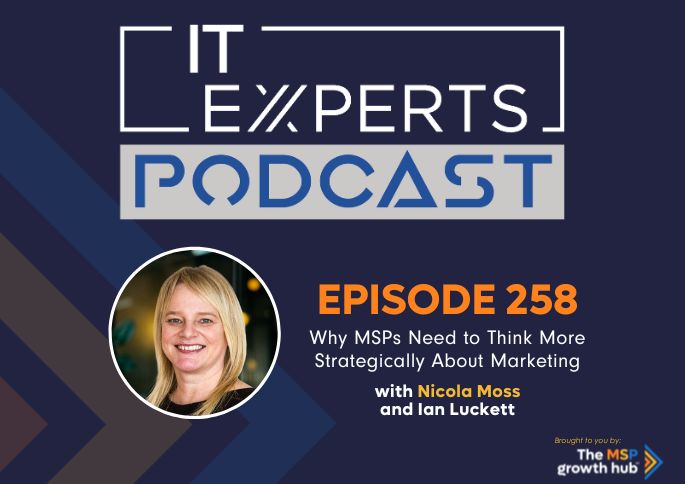
In this episode of the IT Experts Podcast, we explore why so many MSPs hit a ceiling when it comes to growth and how shifting your marketing mindset from activity to strategy can unlock the next level of success.
I’m joined by THE Nicola Moss, a seasoned marketing leader and founder of The Fractional Marketeer, who works with MSPs to bring structure, credibility, and clear direction to their marketing efforts. Nicola has spent years leading marketing functions inside MSPs, so she knows firsthand the challenges that owners face when they try to move from tactical marketing, emails, webinars, and social posts to a true strategic approach that builds long-term business value.
At The MSP Growth Hub, we see this all the time. Many owners tell us they are doing “some marketing” but feel it’s not getting traction. They’re sending emails, posting online, maybe running the odd event, but it all feels disconnected. Nicola explained that this is where most MSPs sit for far too long, often because marketing isn’t their happy place. It feels complicated, time-consuming, and expensive. But as Nicola reminded us, what got you here won’t get you there. The habits that got an MSP to a few million in revenue are rarely the ones that will take it beyond that point. To grow, you need to think differently.
Nicola talked about the moment when MSPs start to realise they need a more cohesive approach. That’s when things start to feel messy. There’s often a marketing assistant, a digital agency, maybe a salesperson, but no one is joining the dots. It becomes fragmented, and without a guiding hand, you end up with activity without impact. This is where having a clear marketing strategy connected directly to your business goals becomes essential.
At The MSP Growth Hub, we help MSPs connect the dots between their commercial plan and their marketing focus. Nicola shared that one of the biggest mindset shifts for MSPs is to start viewing marketing not just as lead generation, but as a way of building transferable value. She made the point that every MSP will eventually exit their business, whether through sale or succession, and that marketing has a direct influence on valuation. A well-defined brand, a consistent message, and clear differentiation all make the business more attractive to both clients and buyers.
We also explored the question of what an effective marketing team should look like. Nicola explained that in smaller MSPs, marketing often starts with an outsourced agency or a junior hire handling basic digital tasks. But as the business grows, it becomes important to have someone internal who understands the company, its values and its customers. Eventually, that person needs strategic guidance to connect all the moving parts: sales, operations, and growth priorities. This is where bringing in a fractional CMO or senior marketing lead can make a huge difference.
At The MSP Growth Hub, we often encourage MSPs to grow their own internal marketing resource but to support them with strategic oversight. Nicola’s experience as a fractional CMO mirrors this. She shared how her clients benefit from having someone who isn’t just managing an agency but is actually embedded in the business, aligning marketing to outcomes such as revenue growth, client retention, and brand credibility.
A major part of the discussion was about measurement. Marketing can feel hard to measure, especially when some activities build awareness and trust over time. Nicola acknowledged that not everything can be tracked to a spreadsheet, but revenue growth, margin contribution, and progress against the business plan are strong indicators that marketing is doing its job. She also pointed out that marketing and sales should share the same growth targets. Success comes when both teams work together, not in silos.
Another powerful insight came when we talked about the middle of the funnel: the stage between awareness and conversion. Many MSPs are active at the top of the funnel, creating blogs or posting on LinkedIn, and they get referrals at the bottom, but there’s a big gap in the middle. Nicola explained that this is where educational webinars, customer advocacy, and community engagement play a huge role. Case studies, client stories and thought leadership all help to build trust and credibility before a sales conversation even begins.
As we wrapped up, Nicola left us with an important reminder. Marketing isn’t a nice-to-have. It requires investment, consistency and strategic thinking. The MSPs that succeed are those that move beyond scattergun activity and focus their marketing around clear objectives that support the overall business plan. When marketing, sales and leadership are aligned, growth becomes predictable and sustainable.
At The MSP Growth Hub, we see this shift in action every day. The MSPs that take a more strategic view of their marketing see stronger lead flow, better client retention and ultimately higher valuations when it’s time to sell or seek investment. Nicola’s insights show that this level of clarity doesn’t come from doing more, it comes from thinking smarter, aligning your message with your market, and building a marketing function that truly drives the business forward.
If you’re ready to step back and look at your marketing through a more strategic lens, this episode with Nicola Moss is one you won’t want to miss. It’s a reminder that sustainable growth starts with focus, alignment, and a plan that connects marketing directly to your MSP’s long-term goals.
You can connect with Nicola Moss on her LinkedIn HERE.
Make sure to check out our Ultimate MSP Growth Guide, a free guide that walks you through a proven process to take your MSP from stuck to scalable, without working even more hours. It’s 44 pages rammed with advice, insights and inspiration to help you decide what support is available to you now if you want to grow and scale your business. Click HERE to get your copy.
Connect on LinkedIn HERE with Ian and also with Stuart by clicking this LINK
And when you’re ready to take the next step in growing your MSP, come and take the Scale with Confidence MSP Mastery Quiz. In just three minutes, you’ll get a 360-degree scan of your MSP and identify the one or two tactics that could help you find more time, engage & align your people and generate more leads.
OR
To join our amazing Facebook Group of over 400 MSPs where we are helping you Scale Up with Confidence, then click HERE
Until next time, look after yourself and I’ll catch up with you soon!
IAN: In this episode of the IT Experts podcast, we help you think a little bit more strategically about your MSP marketing.
So good morning, good afternoon, good evening. Welcome to the IT Experts podcast. Today we are going to help you think very differently and strategically about your marketing and why this can make such a massive difference in your growth plan. So today we are talking to Nicola Moss, Nicola is a fractional CMO. Welcome to the show, Nicola. How are you doing today?
NICOLA: Thank you. I'm brilliant. Thank you. How are you?
IAN: I'm really good today. Really good. It's Friday, so everything, every day's a good day on a Friday, right?
NICOLA: Absolutely.
IAN: Thank you for coming onto the show today. We're going to be talking today to probably some of the mid-level seven figure MSPs around some of the marketing pitfalls and challenges that turn around. And what got you here is not going to get you there. And what Nicola's going to help us do is share with us her a massive experience in this area about why you need to think a bit more strategically a bit more structure around your marketing. But before we do that Nicola, tell everybody who are you, what do you do, and who'd you help?
NICOLA: So I'm Nicola, I'm a fractional CMO. I set up the fractional marketeer.co.uk earlier this year and with a mission really, to help some of the smaller MSPs out there to really drive a coherent marketing strategy yeah, to help 'em grow their businesses. I've come from a background of reasonably sized MSPs leading marketing functions and initiatives. Yeah, hoping that I've got some experience and hopefully a bit of credibility behind me to maybe bring that down into the smaller MSPs.
IAN: Absolutely brilliant. And today we're going to be, as I say, we're going to be talking a bit more... And when we say the word strategic, don't all turn off and get all bored about it. We know the struggles that MSPs have when we're talking about marketing. Alright? It takes too long. It costs too much. It's not my happy place. I have to do it because someone tells me that's how the business is going to grow faster than referrals, but I don't want to do it. Is this what you are hearing right now? You know what's your kind of take on MSP's appetite for eating A big chunk of Marketing Pie.
NICOLA: That's right. I think when you get to a certain, level of growth or a certain size of MSP? I think the attitude towards marketing does tend to change and I think MSPs do know that a shift needs to happen, but actually getting it over that line from being a sort of very interruptive outbound, sort almost tell it just telemarketing email type driven MSP into something that little bit more thought through balanced, perhaps implementing a bit of brand and positioning, messaging, credibility, all of that good stuff, it's, is probably turning into that sort of headache I can do without that kind of stage, I think.
IAN: Yeah. And it's one of these things, I said it a minute ago, you know what got you here is not going to get you there. So many MSPs that we see, when they, it's quite crazy really, because most MSPs, as soon as they join the Growth Hub, they've got at least a year before they do any sales and marketing. But if they've got some bandwidth, then we help 'em get, starting to get that up and running and I think if look at any mSP probably sub a million pound. They just do marketing, don't they? They do the standard, posting emails. They might do a couple of webinars. They might, they're going to do some stuff because they've got to, right? Yeah. And they, even though it's, as I say, it's not their happy place, but then we sometimes hear, I'm going to bring in a sales person, I'm going to bring an account management person. And then it's how does that account management person and the sales person work alongside the marketing? And is that in-house marketing? Is that outbound marketing and things like, why do they need to then change their thinking around this? because this is where it starts to get a bit muddy the waters a little bit, isn't it? It needs, and they need to start getting a bit more clarity in this area.
NICOLA: Yeah, that's right. And I think ultimately I think, I mean for most MSPs that I've worked in or that I'm working with, there is an end goal at some point there will be an end goal of exit, and I think we all need to just keep our focus on what the marketing needs to be in order to focus on what that exit is going to look like at whatever point it might be. And it could be 20 years down the line, but it could be five. So I think at that point you need to maybe start thinking about marketing in a just a slightly different way that it's not so much just about bringing leads into the organization, but it's about making your business valuable and valuable to customers so that they can stay sticky with you, but also valuable for that ultimate goal of exit.
IAN: Yeah it's interesting, isn't it? I suppose I was talking to someone the other day and they said, oh, I haven't really thought about exit, and I said, I'll tell you one thing that is absolutely certain. One day you will sell your MSP whether you like it, whether you don't like it, whether you planned for it, whether you didn't plan for it or not, you will be selling that business.
NICOLA: Yeah.
IAN: And he never even thought about it. So you've played right into my hands there with creating that transferable value. How do we build a system and a process into that business and to get into that position. Yeah. But when you've got, obviously we know. One of the ways you can scale a business quickly is through acquisitions. But if they were to double down on their marketing, they've got some budget they're turning over, seven figures if not more. What are some of the common pitfalls that you see that those size MSPs are doing? Are they already doing what they're doing but they're just doing more of it or do they need to think differently?
NICOLA: I think, when you're getting to be that sort of size of an MSP, I think there's a few things that kind of start to come into play a little bit more that perhaps aren't considered when they're a smaller MSP. And I think we touched on it earlier on in terms of that sort of, that differentiation and how you bring about that differentiation. What makes you different in the marketplace to your competitors and really starting to try and draw that out so that you can start to be a bit more credible in, in that particular differentiation or that field that you are trying to be different for. So in terms of messaging, it's perhaps not just talking about the tech and features it's actually talking about business outcomes and the value that you are bringing to your customers and maybe positioning slightly on, on that front. I think sometimes marketing can, and it does happen and I'm guilty of it as well. Sometimes it's just very fragmented and you are running as fast as you can and you've got lots and lots of competing priorities within an organization. Yeah, the marketing, if you've got marketing personnel, they're generally run ragged and you're not really probably sure what they're doing or you've got an agency that is probably difficult to hold to account over certain things, but it's very busy and your marketing can be pretty fragmented. And I guess it's about pulling that together in a sort of a more of a cohesive kind of strategy that's actually aligned to business goals and the business goals of revenue and growth. And I think maybe. At that point as well, there may be some common pitfalls is maybe a lack of investment in marketing tooling marketing automation perhaps a lack of visibility on a marketing pipeline. I think we're very, with sales pipelines and what that means, but in terms of looking at that marketing pipeline and how you are nurturing that pipeline, what's valuable in that pipeline in line with your iCPs, it's like identifying who your ICPs are and making sure that your activities are all around that. So I guess probably, I'd say probably it's a pitfall, but I guess a lot of these things are overlooked when you're a smaller MSP and you are just running as fast as you can and you're trying to get leads in.
IAN: So here's a great question for you. What is the ideal marketing team? What should that look like? Because as you just said it it's quite fragmented. You're doing lots of different things, you, one minute your brain's over in operations. The next minute, the brain's over in marketing and new business and projects and whatever it might be to keep it stable. We know that. And to really accelerate any growth of any business you need to have a solid team. But what should that team look like, do you think, from your point of view? Regardless of kind of the end product, of the marketing support.
NICOLA: So that's an interesting one. And I think it depends on where the company is on their growth journey. I think, a smaller organization is probably unlikely to have any form of marketing representation that they might outsource to an agency, for example, and probably outsource either to an all rounder or a digital marketing agency because digital, you can measure an ROI from digital and it's very easy to see the impact of what a digital strategy can have. I think when you start to get to be a bit more of a sizable MSP, it's very it's easier to have somebody on the ground in your business that understands your business, that understands your brand, your culture, your values that can work together with sales. And I think an MSP would, probably the first hire would be a marketing assistant or a, junior marketing manager at. Probably would report into the commercial side of the business, I would say, as a general rule of thumb.
IAN: Yeah.
NICOLA: And I think that's perfect for that early stage. Let's just get some marketing activity going and let's try and make a difference. I think when you are in that sort of growth mode and you are looking to really try and grow your organization, that's where you probably need to start to think about where does marketing sit? Does the marketing sit within sales where it's probably reached the level of marketing expertise that the commercial side of the business can bring?
IAN: Yeah.
NICOLA: So that marketing function really needs to be developed at that point. And at that point is probably where you'll either need to bring in some strategic help to help guide that organization's marketing strategy. You might start to then hire somebody with a bit of experience, a marketing manager. Depends on your budgets, on your cost base, and on what you can afford. But that's the next level. And then. Beyond that then you're starting to look at building out a team. But of course at this point you've perhaps still not got that strategic board level voice on your, from a marketing perspective in your organization. And I suppose it's going through that, that curve of using agencies to having your own in-house team and getting that strategic input so that in-house team is working towards your business goals effectively.
IAN: So absolutely makes perfect sense. And I do favor the grow your own marketing team. I think that's one of the most powerful ways because, as long as you've got someone who's got an idea about marketing and then they understand more about the business, then it's easier to do that rather than have other outside influences in. Is it not just a case of just do more of what you did before? You mentioned before about, you mentioned about, the strategic side, which is what this podcast is all about. But what does that actually mean? Why? Why do they need to start thinking about this more? Do they not just need to put more stuff out on LinkedIn, do some webinars get the sales pipeline filled up put some content out there. Isn't it just doing more of that?
NICOLA: There's a massive challenge in marketing for sure, because the number of channels that we have and the number of tools that we have at our disposal right now is phenomenal and more than ever from e even 20 years ago when there was two or three channels that you were using. And it's important that we need to show up in all of these channels to a certain degree. So there is an argument that says, yes, we still need to be doing more. We need to be present in all of these channels. I think, gartner is still saying from a couple of years ago, their latest report was that it's 20 touch points now for
IAN: yeah. Yeah. And the rest could.
NICOLA: Contact to, to even get to be a sales qualified lead. So absolutely, a hundred percent. There is a need to keep doing and keep showing up and keep it repeated and keep doing more. But there is a point where. You don't want to be busy falls, and when you've got, a certain size marketing team, they do need to be aligned to what that goal is, what that revenue goal, right? And making sure that you are actually focusing on, you are launching products in the right areas. You are focusing on that, the higher margin solutions. Assuming that margin is a growth goal that you are focusing that your activities in all of the right places, but you are still showing up and doing your day to day absolutely.
IAN: So a good mentor that I used to listen to back in the day, Zig Ziglar. It's a checkup from the neck up. It's having a look at going hang on a minute, let's just have a look at what's going. Let's stop for a minute. Where is your target market? because I know many MSPs that have grown, in good size by serving everybody. Have they got great profitability? Possibly not. Affecting the exit thing we were talking about, the exit multiplier we were talking about earlier on. Have they got people on longer term contracts? Possibly not. That'll affect your exit again, is the service desk a frantic place to be where there's lots of calls coming in, possibly again, that will then affect the exit. So everything pulls it back down to the exit. So it feels to me like by putting a strategic 30,000 foot pair of eyes on this, you can actually then start to go with your marketing, where are we actually going with the business and then aligning the activities, because I guess as MSPs get bigger and bigger, I suppose it might not be the right analogy, but it is one that feels fit for a Friday morning. You've got these guns that you're going to fire, your emails, you're going to be firing out, and you want to make sure that every email and that every bit of money that you pump into that fun gun or whatever you want to call it, that's going to go and it's going to land in the right place and it's going to give you the maximum impact. And that sounds to me like that's what the strategic element would look like.
NICOLA: Yeah, it is. Exactly that. It's about making sure that all of your activities are aligned up to that end goal. And the end goal might not be an exit for sale, it could be an exit or it could be sort of investment. So it could be that, they want to go even further in their growth journey and they're looking for private equity investment, for example. So what does that look like and how do you need to position your business in order to be able to get that investment and make sure that you are, that you look like you are an investible organization and what does the plan look like from that perspective from the PE house, how are you going to get, how are you going to satisfy what their expectations are and what does that next stage of growth look like and where is it going to come from? And I guess it's about working at that level really to try and understand, exactly what that marketing input needs to be.
IAN: Okay. Okay. I'm going to ask you the question now that you're going to hate me asking and that everybody wants me to ask of marketing. Come on.
NICOLA: Fun zone.
IAN: Jesus Christ. Okay, so here we go. Measuring what matters. Marketing is one of the worst businesses to say, yeah, just gimme some money and it'll be all right. We'll get some stuff. You can never tie it down. You can never work out. Even when people come towards us and we've got quite a tight marketing machine, it's where, how did you come? I can't remember that. It might have been Facebook, might have been an email, it might have been a LinkedIn, might have been a podcast. I go, that's not helping me. I want to try and measure it. And I think, you, they come to a point where, you know that. You can measure so much. Yeah. And you know that, if you've got, I heard yesterday one MSP was doing a round table and one MSP gets 400 people on a webinar once a month for a security update. Oh my word. His marketing's working without a doubt. Something is going very right in that MSP, if you are at one, two, or 3 million, you are very aware of your numbers. You are very aware of, everybody's gotta earn their earn their salts as it would do. But how do you then want to bring in a strategic marketing person, right? To add even more cost to the marketing tools and. How do we measure, how do we track ROI? How do we demonstrate what are the, what do we need to keep our eyes out for?
NICOLA: You're right, it is a tough one. And it is sometimes it can be quite slippery for marketing to justify sort of their ROI on their investments. And particularly when you're talking a lot about. Building a credible brand? Like how is that measured? How is the value of goodwill towards a brand measured? That's really difficult. But if you can just I, I think there's a point at which, back in the day before all of the KPIs were around that are that there are today, 20 years or so ago I didn't have any KPIs and I was probably, heading up a marketing function of the, probably the fastest growing MSP that the UK had ever seen. And I was never held to account over away with it. But you just knew it was just working. Now I'm not suggesting that we go back to that because obviously there, there is a level of visibility that you now need, but in terms of its, is the business growing? That is a key measure, especially when that marketing is sharing that revenue goal with sales. It's not just sales that are accountable for that. So it's a shared goal. Is the revenue, is the margin in line with what the three or five year business plan is that can be equally a key measure of success. And then all of the other strands that fall out of achieving that goal is what we should be measuring, and ultimately that, the cost of acquiring customer, all of the usual standard KPIs are very relevant in terms of measure, but for me anyway, it's that revenue growth, that margin contribution is a good metric for whether your marketing is being successful because there is so much of stuff that just can't be measured. If you were to sponsor something something like...
IAN: Yeah. Oh, that one.
NICOLA: Would you ever like the finance guy would be sat there saying, we've spent 10,000 pounds sponsoring something, and what leads have we got from it? And. And you can probably, yeah, that's right, say zero. We haven't got anything from it. But the next year that you do it, the year after that you do it, that's when things start to kick into place. And that's where this 20 touchpoint thing happens, with each contact that you've got in your marketing funnel, it's going to be 20 times for them to even get somewhere with you. So there's going to be multiple channels that are having an impact on that contact and 19 times it's going to have failed. But it's the accumulation of all of that activity that is actually going to tip it over the edge. And the edge could be where it's tipped over. It could be that they've attended a webinar and the finance goal. But yes, that webinar is the successful element. Let's do more. Let's do 20 webinars. Let's do it. But actually it's the culmination of everything.
IAN: Yeah. Yeah. And that's why it's so hard, isn't it? And I think that's why sales and marketing need to work so closely together. And I always ask, whenever anybody comes on a call is how have you ended up on this call today? And it'll be, oh, this happened, that happened, or, I've hit rock bottom and I know that my business isn't worth as much as it is. I'm just about to lose a big client's, one of our favorite ones. And I know I need to do something about it. How do I, I'm just going to, went to LinkedIn, saw your post. Da dah and those conversations about how that all works. And if they say, I don't know, what might have been this, it might've been this, it might've been that, it might've been the roundabout sign. Someone's going to go, yes, it was the round. I knew it was the roundabout sign. The roundabout sign didn't close or the golf what's the next one? The golf sponsorship. Here's the question for you. In your experience? We talk a lot about missing middle of funnel all the time. Put some stuff out at the top. Yeah, some blogs and everything like that, and the referrals come in the bottom, but there's this gaping great hole in the middle. What's some of the most successful? Activities webinars, events, that sort of thing. And I'm not putting thing, not putting words into your mouth there, but what's the best middle of funnel activities that you've seen work and help move people from cold to solve even quicker.
NICOLA: So I do, it's with MSPs for me, my personal opinion is that with that middle of funnel, you are getting to that point where, they know who you are, they know what you do, and this is about selling your value to them. So anything that you can do that sells the value of your organization above your competitors is something that's going to work educational webinars could be really good. If you've got assessments and toolings that you can push out often a lot of vendors at this stage will have, I desperately, trying to think of the word for it now. What's the word? M-D-F-M-D-F and development fund. They'll have certain...
IAN: It's called money.
NICOLA: That can try and help, try and help in this area as well. That the case studies, the ref, the thought leadership, the present, getting customers to actually customer advocacy is enormous in this area. So if you've got. Great customers and they're an advocate for your brand. Use them, get them to talk about their experiences with you and in exhibitions, in theaters and seminars, on your own webinars introduce them onto panels. Use them for panel debates. Start building that community, that trust in your brand is all really important because then they know who you are, what you do, and they've got trust in you and belief that you could actually do what they are paying you to do. So for me that's middle of funnel is all about trust and credibility and spewing out to because once it's a sales qualified lead, actually, getting a sales qualified lead is the hard, it's a really hard, it's a tough gig for marketing to get those sales qualified leads and sales, the sales teams are normally pretty hot, and if they get a good inbound lead, chances are they'll close one in two, one in three of them. That is, it's getting the leads into them. That's the hardest part. And that's really where the sales and marketing need to work together. And I think previously and historically, the sales teams have always been a bit prickly about marketing, wanting to understand, was why wasn't it qualified? And what was wrong with it? And of course it was qualified. And there's all this aha barge between sales and market. But actually, and I think sales feel a bit prickly that we are poking and we're absolutely not. Like we really need to understand what it was that made that lead qualified or what it wasn't, so that we can actually, start to address the marketing activities that we are doing and I think getting that balance right with sales and marketing to that happy harmony where there is an understanding that marketing need to understand what's going on and there's only the sales team that can tell them is another big area I think really.
IAN: The marketing, if the marketing should be doing all the heavy lifting, shouldn't it should be doing that. You know that? No. And trust that building that credibility that, it's a professional service. At the end of the day, you're not just buying a car, you are not buying a holiday. You are buying something that you want to enter into a relationship with someone that you trust. And if you are not, as you say, you're not putting out content that they can trust you and think that you are that thought leadership. Then it's the salespeople will always be moaning. They'll always be moaning. Give us let's just before we wrap up, great shows so far, but before we wrap up, can you just give us the kind of, the different options in terms of bringing in, that marketing support? I know we support, I know we spoke about, bringing in a marketing manager or a marketing internal or somebody within your organization who's going to anchor that to the business. But when you want to accelerate it, you obviously, you've got outsourced, agency. You could bring in more team more of a team, but that could come with the problems with I didn't really know what I was doing with the first marketing person, let alone any more marketing people, depending on those people that you bring in or then there's like a, a strategic person, someone like yourself. Do they need someone like you full time or is it. If they were going to invest in the marketing, what's the next step that they need to take once they've got the fact that they need to do things a bit differently?
NICOLA: So I think hopefully it's not a shameless plug, but I think that's why I set up the fraction.
IAN: I wouldn't expect anything else.
NICOLA: The fractional marketeer really, in fact, actually it was born out of somebody that I had worked with previously had said to me he had moved into a smaller MSP and he had said, I think we could do with you, but we just can't afford you is there something that we can figure out. Yeah. And that's how it started. And as I've gone on this journey I've realized that there actually probably is a real market here for that sort of smaller sized MSP those that are on a growth journey that sort of actually could benefit from a fractional, senior level or board or senior management, team level voice that's helping to guide their growth strategy going forward. And of course this it's on a sort of a pa part-time basis or however they want to engage. But I think the benefits of it being fractional is that, that I'm actually involved in their business as much as they are. So it's not an out outsourced forget kind of model. It's it's actually is outsourced, but it's actually part of that team and wanting to. Part of that growth journey, albeit as an outsource consultant. So I do feel that there is a kind of a gap in the marketplace for that sort of sized MSP that, hasn't got the funding or the budgets or the inclination really to have a full-time senior marketing person as part of their team driving that growth strategy with them but would perhaps benefit from some in fractional guidance,
IAN: Yeah. And so I guess what we're saying then is that for a marketing agency, if you want, and there are a few great marketing agencies out there for MSPs. There's an awful lot of marketing agencies out there that are not MSP focused, and I would not necessarily recommend, I wouldn't at all recommend going with one that hasn't got any MSP experience in it, but their place is to help get the activity up and get the traction going kind of maybe in your sub seven figures as you're early getting in. But it's when we've got to this tipping point now where we've said we've got to change gears. We've gotta do something different. We need to bring in, you bringing in a fractional FD. Why is that you're bringing in an md, you're bringing in, all these other, these senior level people. So bringing in that marketing, and I guess to build a marketing team, you need to have somebody who's experienced in building marketing teams to do that. And you might have a great to marketing manager or person or administrator but are they going to lead it strategically and are they going to lead it and connect it to the plan? And as you said, quite rightly. Your profit margins. And I really get that point. We just had that down just to discuss at the end there, which is, which I think is a really valid point and a great opportunity.
NICOLA: Yeah, definitely., I think because often in MSPs like this, it's actually, it's actually sometimes it can even be the CEO that is managing the agencies. They are holding that marketing responsibility themselves and, they're a busy CEO and at some point that needs to be given to somebody else to take that strategy and vision forward. And you are right. Perhaps the marketing intern or the marketing man, whatever, may not quite have that level of expertise. But equally my role, I suppose is equally to go on board and maybe upskill and bring their internal teams in line to where they perhaps need to be. So I see it as maybe it's a bias for you, but I see it as a, it's almost like a win-win because if they've got a team that they want to upskill, then I can help to do that too.
IAN: Exciting, exciting. Nicola, thanks very much for your time today. It's been absolutely brilliant. Love the insights the experience and everything that you've been sharing with the audience today. So when an MSP has realized that, what's got 'em here is not going to get 'em there with regards to their marketing and they need to change gears and do things a bit differently, what's the summary points for you today for them to take away from the show?
NICOLA: Oh, I think I'd probably say, probably just needs to be a realization that marketing, it's not a nice to have like that. It needs investment, it needs a strategy, it needs consistent execution. And some of it's measurable, some of it's not. But so long as it's aligned to that end goal of revenue growth or margin or both. And we are seeing those numbers. Increase in accordance with the business plan then it's going in the right direction because I think, the market's tough. And just as you mentioned earlier, you know that scatter gun approach is going to make, it's going to become really difficult. It's going to be an uphill battle.
IAN: Yeah. It's going to get bigger and bigger...
NICOLA: That bigger and bigger and unless you pivot and start to think about what's actually going to push that needle in a very competitive marketplace, budgets are tight with customers, with their ICPs they're investing in projects, but perhaps not as much. You really need to stand out in that marketplace, position yourselves as a credible provider and make sure that all of your marketing activity is focused on that end goal and those business metrics that you've set.
IAN: Absolutely brilliant. Thank you very much. Again, not only preparing, but recording the show today really value your time and experience. As I said, if people want to continue the conversation with you, which I think there may be a few that do how do they get in contact with you, Nicola?
NICOLA: Oh, brilliant, thank you. I have a website. It's the fractional marketeer.co uk. I'm equally can find me on LinkedIn. I've got a company page on LinkedIn and also my personal profile. Email is hello@thefractionalmarketeer.co uk and happy to be contacted and any which way.
IAN: Great stuff. If you just send all those links over to us, we'll pop 'em in the show notes so it's easy for people to get in contact with.
NICOLA: Oh, that's fantastic.
IAN: Thanks again, Nick. I thoroughly enjoyed our chat this morning. I look forward to catching up with you soon. Brilliant. Thanks again.
NICOLA: Thank you so much, Ian.
BOTH: Thank you. Bye-bye.

The MSP Growth Hub is designed specifically for IT & MSP Business Owners who want to build a profitable IT & MSP business.
The MSP Growth Hub
Suite 215
Jansel House
648 Hitchin Road,
Luton, Beds
LU2 7XH
OUR TRUSTED FRIENDS OF THE GROWTH HUB