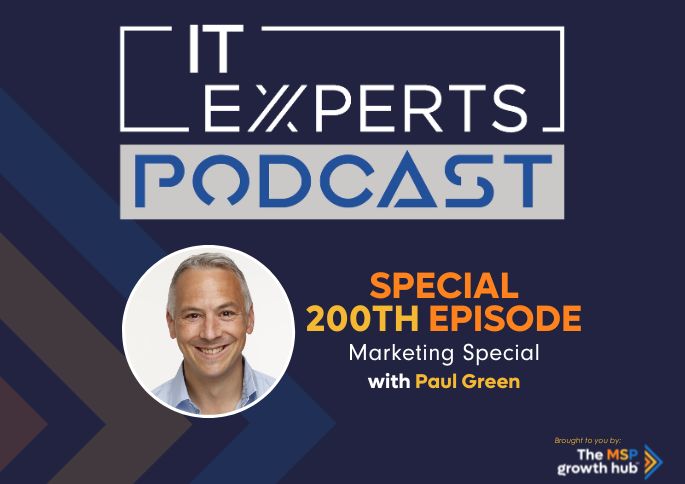
Paul Green is well known for his deep insights into MSP marketing and how to create lasting results through simple, effective strategies. During this live episode, he shared valuable tips on how MSPs can consistently find new prospects, nurture relationships, and convert leads into paying clients. As Paul emphasised throughout our discussion, the key to success in marketing is consistency. He highlighted the importance of showing up regularly—whether it’s through weekly emails, posting on LinkedIn, or running a podcast like ours. The big takeaway here is that marketing isn’t a one-off activity; it’s about building relationships over time, something that requires daily, weekly, and monthly commitment.
One of the first crucial topics we addressed was the top methods MSPs can use to turn cold prospects into warm leads. Paul Green stressed the importance of using LinkedIn as the primary platform for MSPs to find decision-makers and influencers. According to Paul, LinkedIn is a goldmine for prospects, and with everyone MSPs would want to do business with already on the platform, it’s just about making the right connections. In addition to LinkedIn, Paul mentioned the power of networking—physically attending events like BNI or chamber of commerce meetings. He pointed out that networking accelerates trust-building, helping MSPs move relationships forward faster. Lastly, building an email list was another critical tactic Paul highlighted. By capturing emails from LinkedIn connections and adding them to your marketing funnel, MSPs can create direct and ongoing communication with prospects.
We then explored the challenge of finding a niche, a problem faced by many MSPs. Paul shared a very practical approach to discovering your ideal niche: look at your current clients and ask yourself, “Who do I enjoy working with, and who is most profitable?” By identifying these two factors, you can focus your marketing efforts on clients that bring both satisfaction and financial return. Paul Green has helped many MSPs discover their niche and scale their business by honing in on specific industries or verticals. The lesson here is that marketing becomes exponentially easier when you make your message relevant to a defined group of people.
Another key topic we tackled was the role of marketing tools in measuring success. Paul had a straightforward answer: the most important tool is your bank account. He encouraged MSPs not to get bogged down in vanity metrics like LinkedIn’s Social Selling Index or the open rates of email campaigns. Instead, focus on the actual outcomes—new clients and increased revenue. Paul reiterated that marketing, at its core, is about creating opportunities to have meaningful conversations with prospects, and the best metric of success is the number of clients you bring on board.
We also delved into the power of personalised video messages in marketing. Paul Green discussed how platforms like Vidyard and Bonjoro allow MSPs to send tailored video messages to their prospects. The key here is personalisation. By recording a brief message directly for a client and embedding it in an email, you increase engagement dramatically. Paul shared a great tip—holding up a card with the recipient’s name in the video’s thumbnail—to make it more likely that they’ll open the email. This small touch can make a big difference in getting your message across in a crowded inbox.
As the episode progressed, Paul and I took questions from our live audience, covering a range of topics from how to structure LinkedIn content to adapting marketing messages for different geographical audiences. One of the standout moments was when Paul provided his golden rule for time management in marketing: spend 90 minutes every weekday working on your business. This simple yet powerful tip can help any MSP owner build momentum and see long-term growth.
In summary, this episode was packed with actionable advice from Paul Green, especially on how MSPs can take control of their marketing by being consistent, focused, and creative. Whether it’s using LinkedIn effectively, defining your niche, or utilising personalised videos, the underlying message is clear—marketing is a long game, but if you show up regularly and stay committed, you’ll see the results. As always, it was a privilege to share this special milestone with our community, and we’re looking forward to continuing to support MSPs on their growth journey.
Thank you to everyone who has supported us over the past 200 episodes, and a huge thanks to Paul Green for joining us for this unforgettable event!
Connect with Ian HERE on LinkedIn and also Stuart by clicking this LINK
If you’re ready to take the next step in supercharging your MSP, take the Scale with Confidence MSP Mastery Quiz. This tool is designed to help you understand where your MSP stands and what steps you can take to scale profitably and effectively. This will provide you with insights and guidance tailored to your specific needs.
OR to join our amazing Facebook Group of over 400 MSPs where we are helping you Scale Up with Confidence, then click HERE
Until next time, look after yourself and I’ll catch up with you soon!
PAUL: Ladies and gentlemen, live from Luton, it's the 200th episode of the IT Experts Podcast, your host, Ian Luckett!
INTRO: Welcome to the IT Experts Podcast, the only podcast to help MSPs scale to one million, and if already there, get to five and go fast. At the end of the day, isn't it all about building a business that works for you rather than you for it? I hope you enjoy the show.
IAN: Thank you very much, Paul Green. What an absolute storm. So, a bit of context for everybody today. We are sitting in the middle of our two day client intensive with, funnily enough, our clients. Two days helping coaching, mentoring, and we decided that what we were going to do was bring Paul Green in, which is high risk for anybody. And then we're going to record the 200th episode on the show and answer some great questions. And someone's going to get the prize of 200 Amazon voucher today. So, we've got everybody staring at us, which is weird. I've just got myself a new voiceover man. Thank you very much, Paul, for that.
PAUL: You're welcome. Thank you very much. It's a bit like Stuart and his podcast voice. Stuart's got a much better voice, though.
IAN: Ah, guys, I don't need to hear that over and over again. I think the first thing I just want to say, and I know that you really value the whole podcast thing. This is our most powerful tool to help educate, which is what we've been talking today about the marketing and helping MSPs to generate their marketing. You've been with our clients the first time you've met them, first time we've let anybody loose on them. So as I say, it was super high risk. What's what you what have you been what have you learned this morning? What have you heard this morning from the community of the MSPs we've got in the room?
PAUL: Oh, it's been awesome. You guys have been awesome today. So thank you very much for a wonderful, this isn't a kind audience, really and they’re hungry as well. No, it's amazing so it's been. Really good, this morning we've in fact, this is the first in depth session I've done for about five years I've been in a room with an audience and we've spent a couple of hours and we've been looking at basic marketing today. So let's build audiences. Let's grow relationships and let's convert those relationships. How do we take someone from being a suspect to being a bonded client? And it's been great delving into the different issues that MSPs have. Well done, by the way, on 200 episodes of a podcast. I think, I'm not going to say that I'm at episode 264 on mine.
I have got a podcast. Paul Green's MSP marketing podcast available on your favorite podcast platform and YouTube. But the principle, because most MSPs shouldn't use a podcast. But the principle of what Ian has done here is he's turned up, is it every week yours? Every week, obviously I listen, but I just thought I'd double check. Every week Ian has to sit down and do a podcast and do some marketing and the, what makes this successful? Because you said about 400 downloads a week, 400, 500 downloads. That's insane for a podcast in a niche of a niche or a niche of a niche, depending which country you're listening in. And what's made that successful is turning up every week. And that's one of the things we've been talking about today is that rather than doing a little bit of marketing here, a marketing there, you commit yourself to a marketing plan and you do it. You do stuff every single day. You do stuff every single week. You do it every single month, whether that's a podcast, whether that's sending out emails, whether that's posting on LinkedIn, whether that's sending printed newsletters. And it's when it's the MSPs who do stuff regularly, who always see the results in the longterm. And the reason it has to be the longterm is because selling managed services is really difficult. It's really hard. It's a complicated sale. It's a difficult thing for people to buy. It's not like you're selling a predefined widget at a predefined price. So therefore you have to build up a relationship with people, build some trust. So what you're doing with this podcast is amazing. Fantastic. Thank you.
IAN: Thank you for your support and for everyone else in the channel and our clients as well for giving us all the ideas that we do. You're not supposed to admit that. I just open up. You're supposed to pretend that you come up with the ideas. Ah, that's probably Stuart comes up with them anyway. It's all about Stuart. Okay let's get into these questions. So we've got some seven questions. First of all, Gary Tolosa has asked a question, and he's asked you what are the top three methods of finding cold prospects and turning them into warm prospects? Top to the middle of funnel. What's the top method, top three methods.
PAUL: Top three methods to find them. Let's say LinkedIn as the first one, because LinkedIn is the number one place that MSP should be going to prospect. Everyone you could ever do business with ever is on LinkedIn right now. The vast majority of decision makers and influences are already on LinkedIn. And that's, we'll go there. That was the first one. The second one I'm going to say networking. Okay. And I don't mean cables. Getting out, going to the BNI or to your local chamber networking or something like that. So physically getting out of your comfort zone be interesting. We can do live interaction with the audience, right? Of course we can. So hands up please if you regularly go I'm not going to ask you questions. I just want to do a show of hands. Oh, okay. All right. So hands up if you regularly go networking, just by show of hands. So what's that, about a third? Yep. About a third of people. Maybe a bit more. That's really impressive. And I think that's reflective of the audience we've got here. So every MSP that's in the room here with Ian and Stuart. You're here because you want to grow your business, right? You're not here, you're not here for the food and you're certainly not here for the entertainment because let's be honest, the entertainment is not so good. But so this isn't, I would say this is not reflective of a normal MSP audience, but networking is beautiful because one of the things we've been talking about today is moving relationships forward as fast as you can. So building trust with prospects as quickly as you can. If you're meeting someone in a room that moves the relationship forward more, and the most efficient way to do that is networking. So anyone who's not networking now, and I know it's out of your comfort zone, and particularly if you think of yourself as an introvert, you can't think of anything worse, getting up at 5am, going for a nasty breakfast and meeting people. One of meetings don't work, but as you build relationships, that really works. So we've got LinkedIn, networking, what should we go as the third one? So many different things you could do. I'm going to just go with building an email list, and I actually think you can link your LinkedIn in your email list, so when you connect with people on LinkedIn you can find their email address and put it on your email list, but your email list is, it's the most, outside of LinkedIn, it's the most control you have over any marketing method, because that's your data. If you build up an email list of even a thousand people, that belongs to you. If you fall foul of your CRM, it doesn't matter. You take your data. You go to another CRM.
IAN: Fantastic. Lovely stuff. That was question one out of the way. Question two. Love this question. Love to see it. I've asked people to submit questions that could trip pool up. So I'm just looking. I'm waiting. I'm waiting. So Simon Lewis has asked a question. How do you go about discovering your niche client. All marketers say you need to do one, but where do you start and how do you find, how do you start off with finding a niche or sector?
PAUL: Yeah, that's a really good question. So there's a very easy answer to this as well. So let's just quickly look at the beauty of a niche or a vertical from a marketing point of view. All marketing gets easier when you can make it more relevant to the people you're speaking to. So let's say you wanted more lawyers. I don't know why you would want to work with more lawyers, because they're not nice people. But let's say you wanted to work with more lawyers, and you decide to revamp your website, revamp your LinkedIn. Have I just offended people who are married to lawyers? There was a very cold reception to that joke there. Apologies if you're married to a lawyer, but you could look at your life choices. Let's say you want to work with lawyers. Oh, there is someone actually married to a lawyer. That was a bad thing. You can you can change your website. You can change your LinkedIn. You can change your marketing message. And it's all about lawyers. It's about cyber security for lawyers, keeping you safe here in the UK. I'm not sure how it is around the world, but here in the UK, if lawyers lose money, lose client money, they have to replace it. And I know of an MSP who worked with a lawyer who, Sent someone's house deposit off to the wrong account. It was because someone was sat in their Outlook. They edited a PDF, all the money went off and the lawyer, it cost the lawyer 50, 000 to replace a house deposit. So you start saying, sending messages like that to someone and that's really relevant to them. So that's the advantage of being in a niche or a vertical. Simon's question was, how do you find it? Very simple, Simon. You ask yourself, who do I love working with? Or who do I want to do more work with? So you might have right now 20 different clients across 20 different sectors, and you'd look at them and you'd say, Dentists, nah, don't like dentists. They're very down in the mouth. That was a joke as well. There was a bit of a groan in the background there. That was Veterinarians, don't want to work with those, don't really like that retail, nah, there's no money in retail. We don't like EPOS. Ooh, lawyers. CPAs, accountants. I like these. I'm going to do more of these. So it's literally looking at your database and saying, who, sorry, not your database, your clients, and saying, who do I like working with? Who do I enjoy working with? Who would I like more of? And who is also profitable? It's got to be those two things. Lots of MSPs get caught up on manufacturers. Just by a show of hands. Hands up who loves working with manufacturers. Show of hands here. That's four, five, six. I think manufacturers is a terrible vertical because there's no efficiency of scale. Because all manufacturers do different things with different machines. Lots of manufacturers have got that critical one million pound machine, which is run off an XP machine that hasn't, hasn't been rebooted for seven years. Why would you want to support that? Are you mad? Versus an accountant who uses Xero, Sage, name all the other standard software that all the accountants are using. And all accountants do the same things with the same kind of software. So it's very easy to make your marketing relevant to them. So who do you enjoy working with? Who's profitable? And also, who've you got a great relationship with? I've worked in a number of different verticals over the years. My last business worked with veterinarians, dentists, and opticians. And it takes very small amounts of time to become known in a sector. I know lots of MSPs. I know someone who's dominating veterinary right now. I know someone who's dominating dentistry in Australia. I know a couple of guys in the US who are dominating their particular sectors, and they're very, certainly in the US, it could be a niche within a niche, or a niche in a niche, and actually, there's tons and tons of work, and it's very easy to meet more people. You can go to events, you can go to meetings. Go in their magazines. You can go into forums. It's beautiful. Learn all about them
IAN: Lovely stuff. Thank you. This is an interesting question now from Mark Doggs about the niche. Now Mark is into a sector, a business sector, but other businesses are inquiring about his services and he is worried about Putting them, putting them off because he's a specialist in a certain sector. So am I going to be put off by these people? So he's not connecting with them. So there's potential loss of opportunity. Whereas we know marketing is an activity rather than you don't have to tilt the whole business to do that sort of thing. What's your recommendation, doesn't really want to create another LinkedIn profile.
PAUL: Hi Mark. I know Mark very well. And that's a great questions. Mark always asks sensible questions. But the answer Mark is another LinkedIn profile. So stop being lazy. And, so if you've got, sorry Mark, if you've got a LinkedIn profile that's targeted as a niche, a vertical, and you just want lawyers and that's all you want on that LinkedIn the, there's something called Occam's Razor, have you heard of Occam's Razor? Hands up, who's heard of Occam's Razor? Quite a few of you. Occam's Razor is invented by Mr. Occam in the 17th century or something, and it's that the answer to a problem is most often the simplest explanation, right? It's like magic tricks. You see a magician saw someone in half on a stage, and you think, what's the most obvious way that they've done that? That's probably the answer. This is why when you discover how magic tricks happen, it's always a bit of a disappointment. The most obvious answer to, I've got a LinkedIn that's targeted a vertical, but I also want to talk to general people. The answer is get a second LinkedIn. So the answer for Mark, and I happen to Mark has a business partner called Gary. The answer there is if Mark doesn't want two LinkedIn accounts, then Mark keeps the niche on his LinkedIn account and Gary goes after the general audience with his account. Now Mark does all the marketing in that business while Gary does the operations, although there's of course there's some crossover, but Mark could still run Gary's LinkedIn on his behalf. It doesn't have to be Gary doing the work.
IAN: That's a very good point. And I actually think I've spoken to Mark about that before, so he'll probably listen to you now. Probably. Yeah. Great. Question four we've got coming up. What are the essential tools that MSPs need to use to measure the success of their marketing?
PAUL: Wow, that's a good question. I think the most essential tool is your bank account. Okay. There are lots of things you can measure. You can measure how many people have we got in our audience? How many connections on LinkedIn? How many in our email? What's our open rate? What's our click through rate What's our there, there rate? Or you could just say, let's just keep everything really simple. And how often do we win new clients? So you have a great framework. Tell us about your one client a month framework.
IAN: Yeah. It basically goes from the top of the funnel all the way down to the intro call, but it goes through Building a list, creating a campaign, getting them into the campaign, following up, and then into the call.
PAUL: And what's the name of this framework?
IAN: The OnCam framework. One new client a month.
PAUL: One new client a month. And that's what most MSPs want. It's one new client a month will change your life. Not just change your business, it would change your life because if you know you can get a client every month, everything else just becomes a matter of dealing with the problems of scaling up and systemizing and working yourself out of the business. So I think the answer to that is new clients. And we had exactly this conversation here this morning with this wonderful group of people. You can measure so many things. So my job and everyone's job is to keep marketing as easy as possible. Don't obsess over the tiny figures. Obsess over how many video calls, introductory is called discovery calls. How many discovery short video calls are we having? How many sales appointments, physical sales appointments, how many proposals are going out and how many new clients and those are the things to obsess over. Simple as that, isn't it?
IAN: Simple as that. Now this was a competition. So the more entries that took place, then you're more chance you got winning. And Martin Jones took that on board. So he submitted the same question twice. I've just noticed that. So well done, Martin. If you'd actually asked two questions, then you would have had two, two, two bites of the cherry, but they're both the same. And it's around LinkedIn social selling index. Is it something that we need to focus on? Is it useful? Is it, what is it and why do I need to care about it? Really? Sure.
PAUL: The LinkedIn social selling index is a thing which I don't really know huge amounts about it because LinkedIn has so many different aspects. As I admitted to the group earlier, you asked me a question about LinkedIn, a detailed question. I'm probably going to Google it before I, because things change all the time. But the social selling index is a thing of LinkedIn. It shows your kind of standing. It like gives you a rating. It's an algorithm report. It's an algorithm report. Can I be honest? Don't worry about it. It's if you're a full time marketer and your job is just doing marketing full time, you're doing it for a business and you have to talk to a board and give them a report and do that. Of course, your social selling index would be a stat, wouldn't it? It's Oh, in the last quarter, we've improved our social selling index from 46 to 48. Well done me, gave me my bonus. The reality is, does it win you new clients? No.
IAN: Yeah.
PAUL: Is it something, is it a number you can obsess over? Yes. But should you obsess over it?
IAN: No.
PAUL: So my advice to the MSPs, don't think about it, focus on those things we were just talking about, sales appointments, zoom calls, clients.
IAN: Fantastic. You've met some of the most probably ambitious MSPs in the UK in this room today. So you would have thought we would have come up with some amazing questions, wouldn't you? Yeah. Yeah. Absolutely. so much. We've had one, no we haven't, we've had two actually, a sensible one and then this next one from Mark Stevens, who I believe is one of your clients, who's obviously got this idea from you.
PAUL: And the question is who's sexiest, you or me?
IAN: It's actually not far from that. It's who's better looking, Ian or Paul? No way. Yeah, absolutely. Yeah. And it says, and does this help with marketing? See what he's done there.
PAUL: Mark, all joking aside if you read a book called it's by Robert, Dr. Robert Cialdini and it's called Influence written in 1984 and it's about the psychology of marketing. I'm pretty sure it's in that book because I've read hundreds of business books. I'm sure it's in that one. It talks about the fact that good looking people typically have better sales results than. Not good looking people. For example, if you and Stuart were to go selling, I would expect Stuart to perform better. Just as an example. And also, actually, Stuart is taller than you, and again, taller people tend to perform better. I say this as a guy who's shorter than everyone in the room. Yes, I was just about to talk about the height challenge of that.
IAN: Brilliant. Great question, Mark. Mark. Fantastic. Yeah, great. One of our other clients, David, did put a better question in. It's an interesting question as well. He can't get into the MSP marketing edge. It's apparently it's a, some marketing thing that that you have. And because the area is covered, which is common for areas and but he's absolutely committed to improving his marketing results, but what advice have you got for those who are outside the program, still looking to grow, stand outside the community, stand outside, in the competitive market but can't use your materials and, to help him with his marketing.
PAUL: Yeah, no, that's a great question. And that was
IAN: from David.
PAUL: David. So thank you. Thank you, David. And. The MSP Marketing Edge is the leading. But it's not vetted in his area. It's not vetted in his area. It's kind of as pointless as a bag of carrots, isn't it? Maybe or but obviously we're talking about my service here, so I'm not going to sit and say my own service is useless. Congratulations for filling his area, which is central London in fairness. Yeah, central London's been always gone. So we only work with one MSP per area. But you can take the core strategy that it's built on, David, and you can still use it. So that core strategy, and again, it's about making marketing easy, you build audiences of people to listen to you, you grow a relationship with those people using marketing content, we'll talk about where to get that in a second, and then you convert that relationship. So whether you get, whether you use the MSP marketing edge for this, which is highly advised, or you use other content you can get from anywhere, because there's plenty of content around, you can still use the same strategy. And I've given this strategy to thousands and thousands of MSPs. Let's be honest, there's marketing everywhere. There's great marketing content on the tech tribe. There's apparently there's copycat services of the MSP Marketing Edge. I can't believe it. Don't name them. There's you can get all the vendors have got copy content, right? There's content everywhere. Content is not the problem. The problem is how do I use that content? So always be asking yourself, what are the simplest things I can do? To build audiences of people to listen to me, build up your connections on LinkedIn, build up your LinkedIn newsletter, subscribers, build up your email list. That's the first step. What can I do to build a relationship with them? Put content on your website, send an email once a week to your audience, post every day on LinkedIn. There's other things you can do. And then convert relationships. The best way to convert relationships is to hire someone to sit and phone your databases. They're not cold calls. They're slightly warm calls back to work. Mum working 23 hours a day, 23 days a week, just calling people on your behalf, talking about them and their business. And not talking about you. And the outcome of that back to work mom is booking a 10 or 15 minute discovery call with you like we were talking about earlier. That's what you want. If you want to get one new client a month as Ian's framework, the insurance framework suggests, then you've probably got to do Four or five discovery calls a month to get it down to a couple of physical sales meetings to get it down to a client. And don't get hung up on those numbers because that will differ per area. That's going to be different to in Aberdeen and is to Iowa to central London. There's a lot of different variables, but anyone can look at it and say, there's a funnel where you just need to start with lots of people and you just drill it down as to Who's ready to talk today and who's nearly ready, willing and able to make a purchasing decision in the near future?
IAN: I've got a question. I didn't submit it, but it's my podcast, so I don't care. I'm going to repeat a question we had over here yesterday, which was when an MSP is getting started with marketing, how much time, and we've talked about the frameworks, we know your framework, our framework, and the small steps you need to take. You don't need to eat this. Elephant in one big chunk, how much time do you think an MSP needs to spend on marketing on a weekly basis, on a daily basis, just to try and start to get some traction, feel more confident, feel more yeah, feel more confident in just getting the ball rolling.
PAUL: Yeah. I'm going to give you two answers to this. There's a flippant one and then there's the actual answer. The flippant one is as much as you can. So you as the owner of the business, as the driver of the business, your principal activity. is to grow that business. And there are only three ways to grow any business. And anyone who's a fan of, have you heard of Jay Abraham or Dan Kennedy, or Russell Brunson, it's crazy. So these are big name marketers who specialize in working with businesses just like ours. Most of their content comes from Jay Abraham, who is the granddaddy of small business marketing is in. So I've spent tens of thousands of dollars on Jay Abraham stuff over the years. Jay Abraham says there are only three ways to grow your business. Number one, you get more new clients. Number two, you get those clients to buy from you more often. Number three, you get those clients to spend more and you as the owner of the business. That's your job, right? Your principal job is not. You could argue it's retaining clients and maintaining, but it's not doing technical work. I know you need to oversee the technical work because that's what the business does. But your principal job is to grow the business. And by growing the business, you can pay your staff more. You can look after the clients better. You can take more holidays. Who wants more holidays? By show of hands. A few hands went up for that one, right? You can spend more time with your dog. You can spend more time with your kids. You can spend more time on your yacht. That's your yacht Ian. Yes, thank you. Whatever it is that you want to do. And all of that comes from growing the business. So the flippant answer is the more time you spend on growing the business, the faster it's going to grow. I spend 80 percent of my time. I only work 30 hours a week. So I'm a sole parent. I have, it's me and my 14 year old daughter who is so trying at the moment. I know she doesn't listen to your podcast. She listens to mine, but not to yours. She does when you're in the room. I'll call on a Friday. Oh yeah. Ian phones me when she's in the car and he says rude words. Anyway she's very trying at the moment. So I only work 30 hours a week. She gets the rest of my time, but in that 30 hours, 70 to 80 percent of my time is working on my own business, right? And growing that business, which is a great position to be in. Most people aren't in that position yet. So the flippant answer goes into the real answer is how much time should I spend growing your business? This is the real answer. And every single person Who's listening, watching, who's in the room can do this. Your challenge is to find 90 minutes every single weekday to work on your business. 90 minutes. Now, even if you're working 60 hour weeks, and I know some of you are still working 60 hour weeks, I promise you, if you can find 90 minutes every weekday, that you can change your entire business in those 90 minutes. So I had a business from 2005 to 2016, which I sold and we reinvented that business a couple of times. It became a healthcare marketing agency. I built that business up in 90 minute chunks. Now I used to get up at 5 a. m. to do that, which sounds extreme. When I was a radio presenter before that, I got up at 4 felt like a lion. You can fool yourself, but it meant from 5 a. m. to 6 30 a. m. every day. When my family were asleep, when no one was expecting an email reply, when the phone didn't ring, that was when I grew the business. And all I did in that 90 minutes was activities that got new clients, got those clients to buy more often, and got those clients to spend more. Now, most people won't do that at 5am, because that's nuts, right? You wouldn't do that at 5 a. m. But for you, it might be 7 a. m. in your office before your staff come in. You can do 30 or it might be at lunch. You leave the office at 1 1 p. m. every day and you go to your Starbucks down the road or whatever your coffee shop is or a hotel and you lock yourself away and kill your PSA and kill teams and turn off your phone. And you work just on your business for 90 minutes. Or if you're a night bird, if you're a night owl, it might be eight o'clock at night. You've had dinner, you've said goodbye to your kids, they've gone off to bed and you go and lock yourself in your home office and you do it at eight o'clock at night. The point is, if you can make it the same time every day working on your business, those 90 minutes, the first week, the first two, three, four weeks, it doesn't feel like you're getting anywhere. But eventually you get to a point where you're saying. What am I going to do in my 90 minutes tomorrow? And so suddenly you start doing more marketing activities. You start doing more activities that grow monthly recurring revenue or get more clients to buy more from you. Or, Hey, what if we could increase the per the per user monthly recurring revenue by five pounds, 5, 10 whatsoever. And that's when it starts to get really exciting. The other thing is in that 90 minutes, if you're not growing the business, you're saying, how can I get myself? out of the business more so I can give it even more time because my 80 percent of my time now, which works out at around six hours a day. So it hasn't always, I didn't jump from 90 minutes to six hours. I built it up gradually. I, and again, this is the role, the job for you as the business owner is any job that you were doing that any other human being on the planet can do, you give to someone else, right? So the third line tech work, which is what you're best at, you may always be doing that or you may choose to always do that until you hire some good third line technicians. The sales, the physical sitting down with someone, you may choose to keep that because there's only one or two sales meetings a month. But, who's reset a password in the last month, just by a show of hands? One hand. Two, three. Shame on you for resetting a password, right? Because you're the business owner! Who's set up a new user in the last month? No, no one's going to put their hand up now, because I'm going to tell you off. But you get the idea, right? And I know there's always exceptions, and someone was ill this day, and this and that, and it is good to spend a week on the helpdesk at least once a year, just to remind yourself of the hell of being on the helpdesk when actually you were doing that 20 years ago. But the point is, only you can grow the business. Your staff can't. Cannot grow the business because they just don't have the ability. They don't have the drive to do it. That's your primary job. And actually you owe it to them to do that. Because if you grow the business as well as you taking more holidays, you can pay them more.
IAN: Fantastic. Thanks, Paul. We've got one more question left, But while we do that we are going to open up the mics to the clients just in case anybody wants to ask a question and appear on this show. So that is real high risk because I have no idea. And we're running, we're going to run this just in one edit, so I'm not even going to cut anything out. So we've got one question. So if you get yourselves ready, I'm going to I'm going to just ask Paul the last question and then we'll come to come to some client questions and then see what's really happening. But this one's from Henry Duncan. Thank you, Henry, for this. And it was seeing more and more vendors using tools to embed personal video messages into their marketing emails. What's your view on the effectiveness of this for MSPs?
PAUL: Yeah, great question. I know Henry as well. Hi, Henry. So yes, personalized videos. You've got platforms like Vidyard. Bonjouro Vimeo I think now has it, but a lot, all of the video platforms are adding this. It's the ability to do a personalized video and just, you don't need special equipment. You can do it off your phone or off your webcam. Beautiful. Absolutely beautiful. Because the thing about a personalized video is it's you directly talking to someone else. It's you. In a visual manner. And so people who are watching this right now, they, you can see me moving my hands and getting passionate and woo. I like to move a lot as I talk, but if you're listening to this on an audio only platform, even though I did radio for 10 years, so I know how to play with my voice and use emphasis and delays and gaps and stuff like that, you're missing all the visual, right? You're missing my expressions. You're missing the, I'm sweating at the moment, you're missing all the hand expressions. And it's exactly the same when you send an email. In fact, it's even worse when you send an email to someone, isn't it? It's dry, boring text. It's like when you text someone and they misinterpret the tone that you wrote it. And it's the same with emails. So you send a video to someone, and it's beautiful. And a lot of these platforms will let you see if that person has opened it, if that person has responded, all of that kind of stuff. Can I give you two quick suggestions on that? When you send, so A, yes, use that if you're going to use it regularly. It's worth getting a paid account to do so as well for the tracking. If you're going to do stuff, do something else. They have these videos create thumbnails that what makes these platforms great is they do all the work for you. You sit in front of a webcam, you press a button, it goes three, two, one, and you record it and you can do screen share or just you and you talk, blah, blah, blah, blah, blah, and you finish it. It then will create a little animated thumbnail so you can embed that in an email or a webpage whatsoever. The first few seconds are the thing that determine whether or not they'll open it.
IAN: Yeah.
PAUL: My super pro tip for this and anyone who's ever joined the MSP marketing edge will know this because in the last. Five years or so, I've done a personalized welcome intro to everyone. I hold up a bit of a card that says four person's name. So the first three seconds, which becomes the animated intro, you can look at the thumbnail and there's me holding up a card that says your name. And it's very hard for you not to open that kind of message. So that's my first pro tip. The second one is And this is a with caution one because I don't know the results of this. Increasingly, these platforms are introducing AI. Now I haven't touched this yet, but I want to experiment with it before the year is out. We use Vidyard and they've just introduced a Vidyard AI where you can record a video once and it will personalize that for thousands of people. So I might record it of hi, insert name, blah, blah, blah, blah, blah. And then. It sends one to you and it changes my mouth to say, Hi, Ian Luckett. Now, I'm going to guess that's not quite perfect yet. It will be in a few years time. Use that with extreme caution, like any AI tool right now, just because you can do something doesn't mean you should do something. But I think those personalized videos are some great stuff. Yeah.
IAN: Thank you. Thank you very much. Questions from the floor. What we got? Richard. Yeah.
QUESTION FROM CROWD: We've LinkedIn. What sort of content would you post? Sales? Personal? Teaching? What percentage of each would you (inaudible)
PAUL: Yeah, great question. I wouldn't have a percentage, but I think it's Assuming that you're connected on LinkedIn to ordinary business owners and managers, so they're not tech people. Your goal is to post content that does two things. It educates them and it entertains them. We mash these two things together into one word, which is edutainment, which you may have heard about. So it's going to be a little mix, a little bit of Teaching them stuff with a caveat that no one goes on to LinkedIn to be taught. Why do people go on to LinkedIn? Either to find a job or to sell something, right? No one says, Oh, I'm just going to go on to LinkedIn and look in my feed. No one does that. That's not a natural thing, but people just do that as being part of LinkedIn. So a little bit of educational stuff that's at people's, ordinary people's level, not technical stuff. A little bit of personal stuff, but not too much. No one cares what you've had for dinner. It's not Instagram. But they do care if perhaps you've won a new client or you saved a client today from a malware attack or it's just you and your car doing a 20 second video of good morning LinkedIn. I'm out here today in Luton and we're just off to go and see a new client today and I've got a big box of donuts to take him. I'm going to meet 20 new people I've never met before. I'm going to have a fab day today. I hope you do too. Now some of you, you'll be cringing and thinking that sounds awful. So fine, don't do that. But for other people, that's the kind of content that actually gets the best kind of reaction on LinkedIn. So I've got two thoughts on this. Three thoughts. Number one is don't overthink the content that you're putting on LinkedIn because number two, it's disposable, right? What you put on LinkedIn today is not going to be remembered tomorrow. It really isn't. And number three is It's gone completely out of my head.
IAN: Just do two. Just do two. There we go. Just do two. Number three will be a mystery forever. Absolutely will be. If you want to know number three, you need to join MSP Marketing Edge, right? There we go. It's the first thing I'll email to you or the MSP Growth Hub. What else could we promote?
PAUL: We've given Tech Tribe about seven mentions. Yeah, Tech Tribe. We'll go with Tech Tribe as well.
IAN: Yeah, go with that. Any other questions? Charles?
QUESTION FROM CROWD: I won't say this after, but America tends to be slightly in front of when it comes to sort of technology in the curve. Are there any new trends that are starting to bubble up in America that you think might make its way into our small little land?
PAUL: Great question. That is a great question because I have more MSP Marketing Edge members in the US than here. And I'm desperately trying to think of something funny, like robots or something. But do you mean marketing trends or tech trends?
QUESTION FROM CROWD: Kind of both. But ideally marketing trends.
PAUL: Yeah.
QUESTION FROM CROWD: Working well over there that haven't quite (inaudible)
PAUL: I'm going to give a general, not reluctance, I'm going to say no. And the reason being is actually, we're global now, right? So it's if you said to me, and I'm not a technical person, but if you said to me, Paul, what's the hot new cybersecurity product in the U. S. right now? I'd say I'll ask you that, Giles, because you're in the same forums as U. S. MSPs, probably. You read the same things, you'll be marketed with the same marketing, and we're in a global world, aren't we? You can sell, and, I, I've got. I've got loads of members of the MSP Marketing Edge in the US and I've never been to the US to speak or to do selling. I've done it all from the UK. I just go there for holidays, for vacations. So in terms of marketing things, a lot of the marketing things we've talked about here today are exactly the same marketing tools that would be in the US. So I probably wrong, there's probably something, but off the top of my head, I can't think of anything. I'll tell you the one big difference between the US and the UK is the revenue per seat. Or the revenue per user. What did the UK do wrong, right? It's like the US, it's what is it? Three, four times to what it is here. So I don't understand. No one has ever yet been able to explain it to me. Why a US MSP can have three clients. be supporting 60 users, and that pays for them and two staff. Whereas in the UK, that wouldn't even pay for your wine bill, right? Yeah. So I don't understand why that's happened, and I don't understand how, as a country, we would raise that.
IAN: There you go. Excellent. Anything else before we wrap it up?
Last question, then we'll reveal the winner. Then we'll have some lunch. Go for it, Kim.
QUESTION FROM CROWD: Information come from the U.S. How should a message be changed between a U. S. audience and a UK audience?
PAUL: Now that is a really good question and that is one I can definitely answer because I have a team of content creators. They work for me and we create content for the UK and for the US. And the difference between the content is purely based around the difference, cultural differences. So this, of course, there's some slight language differences. US English and US and UK English are different languages. Surprisingly similar. You'll obviously know there's some words that are spelt with a Z in America, and with an S in the UK. But you can, that's almost, that's just one part of it. The biggest difference is cultural stuff. Think of an example. Think of an example. We have a sense of humor and they don't. We have a sense of humor and they don't. Charles, how dare you.
IAN: Oh my word. Think of your audience.
PAUL: As someone who works with lots of US MSPs, I think you're wrong. I think you're wrong. I think the people in the US are very funny. It's all about cultural stuff. I'm sat here with a room of people in the UK, so we all have certain things in common, based on if I mentioned, I can only think of the wrong TV presenters, if I mentioned TV presenters from the past, Brian Kant everyone knows who Brian Kant is, yeah, lots of nods in the room, so US MSPs will say, I have no idea who that is. You can imagine some of the other TV presenters I was thinking of that I'm not going to name, just back from the 70s, right? But Brian Cahn, for most of us here in this room, he was like a kids TV presenter, it's all nostalgia, it's warm. Trumpton. Trumpton was amazing. Who remembers Trumpton by show of hands? It's amazing, right? Go and watch Trumpton on YouTube tonight, it's really bad. But when we were kids, it was really good. So it's those kind of, of Things are completely different. That was a bad example because that was based around TV and nostalgia. But I think to answer your question, it's more around culture than it is anything else. And I think the vast majority of marketing stuff in the US marketing as with technology is becoming globalized. And there may be differences with different languages, I don't know, because we don't really work in different languages, but, as much as the US and the UK and Canada, I work in Canada, I work in Mexico, I work in lots of countries where English is a primary language, increasingly everything is becoming more or less the same. If you strip out some of the details, it's becoming more or less the same. And certainly from a marketing point of view, you're trying to reach ordinary business owners and managers, right? Ordinary business owners and managers, they have the same problems worldwide. Every business owner everywhere has a night where they don't sleep because of cash flow. Hands up if you've had a night where you haven't slept because of cash flow. Hands up. So that's the a majority of people in the room, right? I certainly have in the past. Ordinary business owners and managers worry about key members of staff leaving. They worry about A major client leaving. They worry, and we don't want to use fear, uncertainty and doubt in our marketing of cyber security, but actually they don't know what they don't know about cyber security. They don't know what malware is. They don't know what a ransomware attack is. And that's universal because cyber security is the same the world over. The hackers don't sit there and say, let's target the UK today. They doesn't work like that, does it? They're targeting all businesses all the time. So I think in terms of the content you are talking about it's very similar from country to country, but great question. Thank you. Thank you very much.
IAN: Let's bring this one in for a landing. Thank you very much, Paul, for your time. Can you please announce the winner of the greatest question for the 200 Amazon voucher?
PAUL: Yes. So the person who asked the greatest question, which was about who is your niche client? The winner is Simon Lewis. Fantastic.
Let's give him a round of applause.
IAN: Cool. Absolutely brilliant, mate. Thank you ever so much for your for your time doing this. Everybody's Standing between us and lunch now. I just want to say at this point, thank you ever so much for everyone for all your support for the last 200 episodes. Here's to the next 200 episodes. And I might even release a few midweeks just to try and see if I can catch up with you.
PAUL: You've got 64 to catch up.
IAN: Is that what it is? Maybe not. Excellent stuff. Thanks again and catch up with you all on the next show.
INTRO: So I hope you enjoyed the show. If you did, I'd love it if you could leave a rating and review on your favorite podcast platform. If you want to learn more about how to take your MSP to a million, or if you're already there, go faster, then come and join Stuart Warwick and myself in the Scale with Confidence Facebook group.
The link is in the show notes. You go and enjoy the rest of your day, and I look forward to connecting with you soon.

The MSP Growth Hub is designed specifically for IT & MSP Business Owners who want to build a profitable IT & MSP business.
The MSP Growth Hub
Suite 215
Jansel House
648 Hitchin Road,
Luton, Beds
LU2 7XH
OUR TRUSTED FRIENDS OF THE GROWTH HUB